
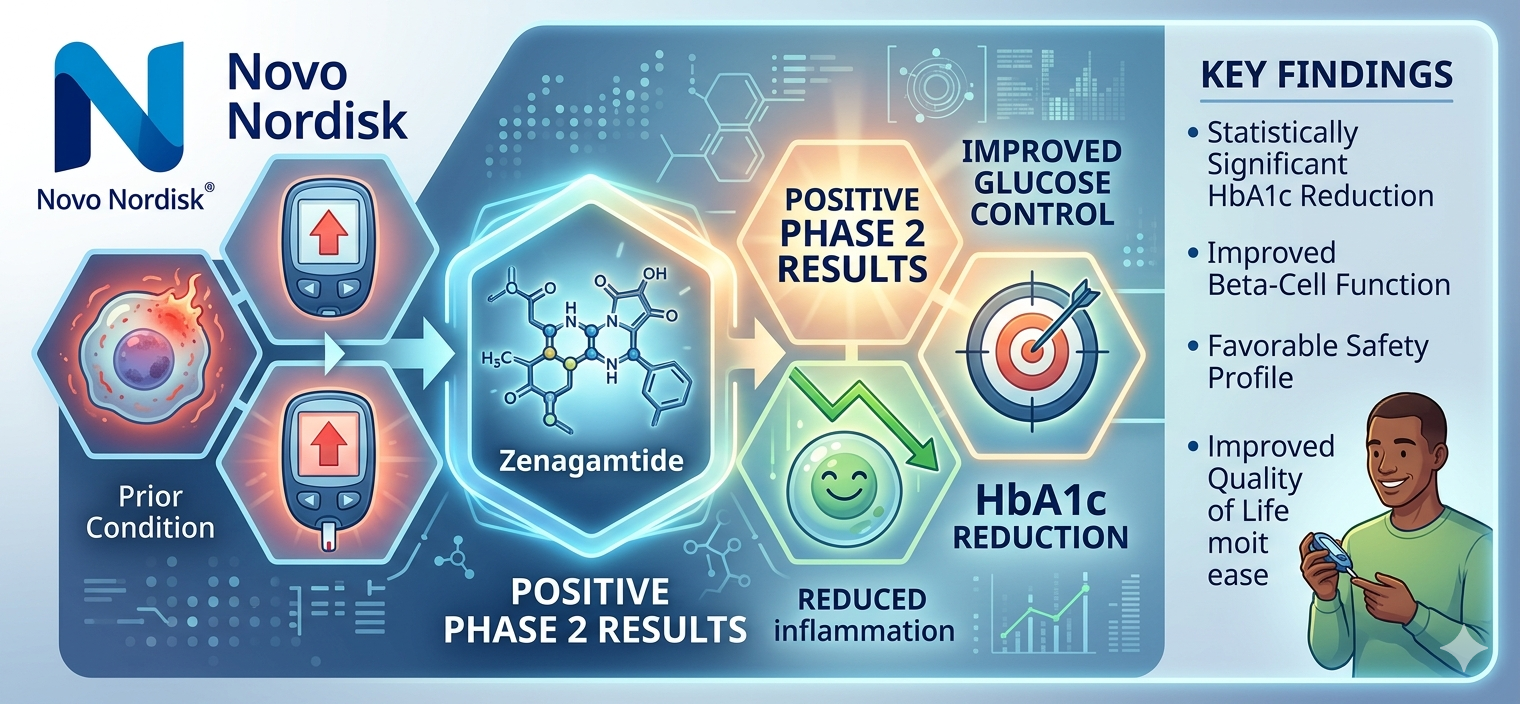
Novo Nordisk Reports Positive Phase 2 Results for Zenagamtide in Type 2 Diabetes
Novo Nordisk has shared encouraging results from its Phase 2 clinical trial evaluating zenagamtide, also known as amycretin, an investigational treatment for adults living with type 2 diabetes. The findings were presented at the 2026 Scientific Sessions of the American Diabetes Association (ADA) in New Orleans, Louisiana.
The study showed that zenagamtide significantly improved blood sugar control and supported meaningful weight loss in people whose diabetes was not adequately controlled with metformin, with or without an SGLT2 inhibitor.
What Is Zenagamtide?
Zenagamtide is a new investigational therapy being developed by Novo Nordisk. It is the first treatment in its class that combines two important mechanisms into a single molecule.
The therapy works by activating both:
• Glucagon-like peptide-1 (GLP-1) receptors
• Amylin receptors
These two pathways play important roles in regulating blood sugar levels, appetite, and body weight. By targeting both receptors at the same time, researchers believe zenagamtide may offer stronger benefits for people living with type 2 diabetes and obesity.
The treatment is currently being studied in both injectable and oral forms.
About the Phase 2 Trial
The Phase 2 study was a randomized, double-blind, placebo-controlled, dose-finding trial conducted over 36 weeks.
A total of 262 adults with type 2 diabetes participated in the study. All participants had HbA1C levels between 7.0% and 10.0%, indicating that their blood sugar levels were not adequately controlled.
Researchers evaluated six different doses of zenagamtide, ranging from 0.4 mg to 40 mg, and compared them with placebo.
The primary goal of the study was to measure changes in HbA1C levels, while key secondary endpoints included body weight reduction and other metabolic measures.
Strong Improvements in Blood Sugar Control
The study successfully met its primary endpoint, showing statistically significant reductions in HbA1C across all zenagamtide dose groups compared with placebo.
Participants started with an average HbA1C level of 7.8%.
After 36 weeks of treatment:
• The highest dose of zenagamtide (40 mg) reduced HbA1C by up to 1.71%.
• The treatment difference compared with placebo was 1.56%.
• Up to 89.1% of participants achieved HbA1C levels below 7%.
• Up to 76.2% achieved HbA1C levels of 6.5% or lower.
These results suggest that zenagamtide has the potential to provide strong glucose control for people with type 2 diabetes.
Time in Range Results Were Also Encouraging
Another important measure in diabetes management is "time in range," which reflects how often blood glucose levels remain within the recommended target range.
International guidelines recommend maintaining glucose levels within the target range for more than 70% of the time.
In this study, all zenagamtide dose groups exceeded that benchmark.
The highest dose achieved time-in-range results of up to 91.4%, highlighting the treatment's potential to help patients maintain stable blood sugar levels throughout the day.
Significant Weight Loss Observed
Beyond blood sugar control, zenagamtide also demonstrated impressive weight-loss benefits.
Weight management is a major challenge for many people living with type 2 diabetes, making this outcome particularly important.
Participants receiving the 40 mg dose experienced:
• An average body weight reduction of up to 14.6%.
• Participants had an average baseline weight of approximately 219 pounds.
By comparison, participants receiving placebo experienced an average weight reduction of only 2.1%.
Researchers also noted that there was no visible weight-loss plateau at Week 36 among the higher-dose groups, suggesting that weight reduction may continue with longer treatment.
Safety and Tolerability Findings
The safety profile observed in the study was generally consistent with what has been seen with other GLP-1 and amylin-based therapies.
The most commonly reported side effects were gastrointestinal in nature, including symptoms typically associated with this class of medicines.
Most adverse events were:
• Mild in severity.
• Moderate in severity.
The trial followed a fixed-dose escalation approach. If a participant could not tolerate the planned treatment dose, treatment was permanently discontinued.
Overall, researchers reported a safety and tolerability profile that supports continued development of the therapy.
Novo Nordisk Plans to Move into Phase 3 Development
Based on these positive results, Novo Nordisk plans to begin a Phase 3 clinical development program for zenagamtide in adults with type 2 diabetes during the second half of 2026.
According to Martin Holst Lange, Executive Vice President and Chief Scientific Officer of Novo Nordisk, the findings add to the growing evidence supporting zenagamtide's potential to improve both blood sugar control and body weight management.
He noted that the treatment could eventually provide healthcare professionals and patients with another important option for managing type 2 diabetes and obesity.
Why These Results Matter
Type 2 diabetes remains one of the most common chronic diseases worldwide.
According to data from the U.S. Centers for Disease Control and Prevention (CDC), approximately 40.1 million people in the United States live with diabetes, and around 90% to 95% of those cases are type 2 diabetes.
While several treatment options already exist, many patients continue to struggle with maintaining healthy blood sugar levels and managing their weight. As a result, there is ongoing demand for therapies that can address both challenges simultaneously.
The Phase 2 results suggest that zenagamtide may have the potential to do exactly that.
Looking Ahead
The latest data position zenagamtide as one of Novo Nordisk's most promising investigational therapies in the metabolic disease space.
With significant reductions in HbA1C, strong weight-loss outcomes, and a manageable safety profile, the treatment has shown encouraging potential in adults with type 2 diabetes.
As the company prepares to move into Phase 3 studies, researchers and healthcare professionals will be watching closely to see whether these benefits can be confirmed in larger patient populations. If successful, zenagamtide could become an important new option for people seeking better control of both diabetes and body weight.
Optimize Your trial insights with Clival Database.
Are you exhausted from the uncertainty of trial insights pricing? Clival Database ensures the clarity in the midst of the global scenario for clinical trials to you.Clival Database is one of the best databases that offers an outstanding number of clinical trial data in terms of 50,000+ molecules and from primary regulatory markets as well as new entrants like Indian and Chinese markets.
With Clival, you get accurate positioning of historical sales data, patent database, company profiling, safety & efficacy, and prediction of launch of new innovative molecules helping you to align your research and driving down the cost.
To add value, we further break down our analytics for you so that improving your operational effectiveness; optimizing your clinical trials; and offering you accurate and high-quality data at lowest possible prices becomes possible.
Elevate your trial success rate with the cutting-edge insights from Clival database.
Check it out today and make more informed sourcing decisions! Learn More!