
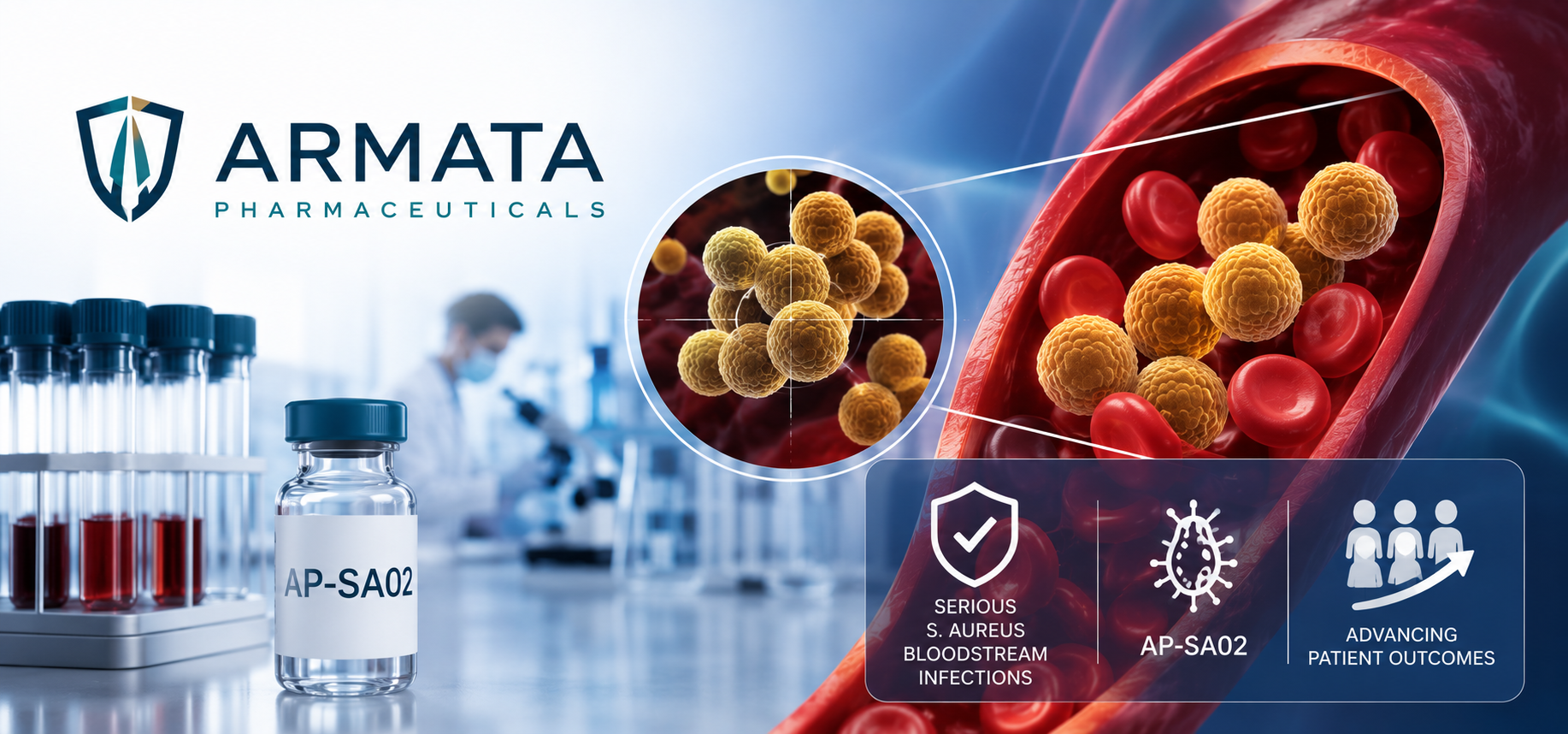
Company submits Phase 3 protocol and FDA responses as it prepares for planned second-half 2026 trial
Armata Pharmaceuticals, Inc. has announced regulatory, manufacturing and operational progress in the development of AP-SA02, an intravenous multi-phage therapy being developed for the adjunct treatment of complicated bloodstream infections caused by Staphylococcus aureus, including methicillin-sensitive S. aureus (MSSA) and methicillin-resistant S. aureus (MRSA).
The company said it has submitted the complete Phase 3 superiority study protocol to the US Food and Drug Administration (FDA), along with comprehensive responses to comments raised by the agency following an End-of-Phase 2 meeting.
Armata is planning to begin the pivotal Phase 3 study in the second half of 2026. The company expects the study to support the future development of a Biologics License Application (BLA) for AP-SA02.
Phase 3 Protocol Submitted to FDA
The submitted Phase 3 protocol includes changes and updates based on feedback received from the FDA during the End-of-Phase 2 process.
Armata has also submitted complete responses addressing FDA comments covering clinical development, Chemistry, Manufacturing, and Controls (CMC), and regulatory matters.
The company said these submissions are an important part of its preparation for the planned Phase 3 superiority study.
The study is expected to evaluate AP-SA02 as an adjunct treatment alongside standard antibiotic therapy in patients with complicated S. aureus bacteremia.
Manufacturing Activities Completed Ahead of Phase 3
Armata has also completed four engineering runs of AP-SA02 at its in-house current Good Manufacturing Practice (cGMP) manufacturing facility in Los Angeles, California.
The next planned manufacturing activity is the production of clinical trial material required for the Phase 3 study.
The company said the completion of these engineering runs supports its preparations for the late-stage clinical programme.
AP-SA02 is a fixed multi-phage cocktail designed to target S. aureus bacteria. The therapy is being developed for use alongside antibiotics in patients with complicated bloodstream infections.
Armata Receives Additional $2.5 Million in DoD Funding
Armata also provided an update on funding for its Phase 3 preparations.
The additional $2.5 million announced on June 23, 2026, is a continuation of an earlier award from the US Department of Defense (DoD). With the latest funding, total funding received by Armata under the award has reached $28.7 million.
The new funding is intended to support activities related to the company's preparation and readiness for the planned Phase 3 clinical study.
Armata said it remains in close communication with the DoD regarding potential additional support, including funding that could help with the execution of the planned Phase 3 study.
The company is also evaluating other funding options to support the Phase 3 programme separately from its existing or potential future DoD funding.
AP-SA02 Targets Antibiotic-Resistant Bacterial Infections
AP-SA02 is being developed as an intravenous treatment for complicated S. aureus bacteremia.
The therapy is based on bacteriophages, which are viruses that specifically target and infect bacteria. Armata is developing high-purity, pathogen-specific bacteriophage therapies to address bacterial infections that can be difficult to treat with existing antibiotics.
AP-SA02 is designed to target both MSSA and MRSA infections.
The product candidate has received Qualified Infectious Disease Product (QIDP) and Fast Track designations from the FDA.
Earlier Phase 2a Study Showed Positive Results
The development programme for AP-SA02 includes the Phase 1b/2a diSArm study, identified as NCT05184764.
The multicenter study was randomized, double-blind and placebo-controlled. It evaluated the safety, tolerability and efficacy of intravenous AP-SA02 when administered alongside best available antibiotic therapy.
The study compared patients receiving AP-SA02 plus best available antibiotic therapy with patients receiving placebo plus best available antibiotic therapy.
Armata previously presented positive results from the Phase 2a portion of the diSArm study at IDWeek 2025 in October 2025.
The company is now using the data and regulatory feedback from the earlier development programme to prepare for its planned Phase 3 superiority study.
Company Plans Phase 3 Study in Second Half of 2026
Armata's planned Phase 3 study is expected to be a superiority trial evaluating AP-SA02 in complicated S. aureus bacteremia.
The company said the study is being designed to support the potential submission of a future BLA to the FDA.
Deborah Birx, chief executive officer of Armata Pharmaceuticals, said advancing AP-SA02 into the Phase 3 study remains the company's top priority.
She said the recent regulatory submissions bring the company closer to starting the study and that Armata is focused on conducting a rigorously designed and operationally efficient clinical programme.
David House Promoted to Chief Financial Officer
Alongside the AP-SA02 development update, Armata announced the promotion of David House to chief financial officer.
House has been serving as the company's senior vice president of finance and principal financial officer since August 2024.
In his new role, House will oversee the company's financial leadership as Armata continues to advance AP-SA02 and its other clinical programmes through late-stage development.
The company said the appointment is intended to provide the financial leadership needed to support its development strategy and upcoming clinical milestones.
Armata's Broader Phage Therapy Pipeline
Armata is a late clinical-stage biotechnology company developing bacteriophage-based therapies for antibiotic-resistant and difficult-to-treat bacterial infections.
The company's proprietary technology platform is being used to develop both natural and synthetic phage candidates targeting important bacterial pathogens.
In addition to AP-SA02 for S. aureus infections, Armata is developing clinical candidates targeting Pseudomonas aeruginosa and other bacterial pathogens.
The company's development strategy is focused on using pathogen-specific bacteriophage therapies to address infections where existing antibiotic treatments may not provide sufficient treatment options.