
Phase 2 Trial Meets Its Primary Endpoint
Caliway Biopharmaceuticals has announced final statistical results from its Phase 2 study of CBL-514 for Dercum’s Disease, a rare condition that causes painful fatty growths under the skin.
The randomized, single-blind, placebo-controlled Phase 2 CBL-0202DD study successfully met its primary efficacy endpoint.
Patients treated with CBL-514 experienced a statistically significant reduction in pain compared with patients who received placebo.
The company said the improvement was seen in both the Full Analysis Set (FAS) and Per-Protocol (PP) populations.
The results also showed that the reduction in pain continued to increase over the treatment period, with benefits observed at Weeks 16, 20 and 24.
What Is Dercum’s Disease?
Dercum’s Disease is a rare and chronic condition involving abnormal deposits of fatty tissue under the skin.
These deposits can form painful lumps called lipomas or adipose masses. They commonly occur around the trunk and extremities.
For people living with the condition, the pain can continue for months or even longer.
Some patients describe the pain as burning or tenderness around the affected areas. The symptoms can make normal activities and daily life difficult.
Doctors still do not fully understand what causes Dercum’s Disease.
However, research suggests that abnormal fat tissue metabolism may play a role in how the disease develops.
There are currently no approved medicines specifically indicated to treat Dercum’s Disease.
CBL-514 Produced Significant Pain Reduction
The main goal of the CBL-0202DD study was to determine whether CBL-514 could reduce pain associated with Dercum’s Disease.
Researchers measured pain at different points during the study.
In the Full Analysis Set population, patients treated with CBL-514 had an average pain-score reduction of 3.1 points at Week 20.
The placebo group had an average reduction of 1.9 points.
The difference between the groups was statistically significant, with a p-value of 0.005.
This was the primary efficacy endpoint of the study.
Pain Reduction Continued at Weeks 16 and 24
Researchers also evaluated pain reduction at earlier and later time points.
At Week 16, patients receiving CBL-514 had an average pain-score reduction of 3.5 points.
The placebo group had a reduction of 1.7 points.
The difference was statistically significant, with a p-value of 0.0017.
By Week 24, the average pain-score reduction in the CBL-514 group had increased to 4.1 points.
The placebo group remained at a 1.7-point reduction.
The Week 24 comparison was statistically significant, with a p-value of less than 0.0001.
These results suggest that the treatment effect continued to build during the study rather than stopping after the initial treatment period.
Results Were Also Confirmed in the Per-Protocol Population
Caliway also analyzed patients included in the Per-Protocol population.
This analysis produced similar results.
At Week 20, patients treated with CBL-514 had an average pain-score reduction of 3.1 points.
The placebo group had an average reduction of 1.4 points.
The difference was statistically significant, with a p-value of 0.0002.
At Week 16, the CBL-514 group showed an average pain reduction of 3.5 points compared with 1.2 points for placebo.
The p-value for this comparison was 0.0001.
At Week 24, the average pain reduction was 4.1 points with CBL-514 compared with 1.2 points with placebo.
The difference was statistically significant, with a p-value of less than 0.0001.
The results in both analysis populations provide additional information about the consistency of the observed treatment effect.
Many Patients Achieved Meaningful Pain Relief
Caliway also conducted an exploratory analysis looking at the number of patients who achieved a meaningful reduction in pain.
In the Full Analysis Set population, approximately 90% of patients treated with CBL-514 achieved a pain reduction of at least three points in more than half of their treated painful lipomas.
The company said this result was substantially higher than what was seen with placebo.
This analysis was exploratory, so it is separate from the main efficacy endpoint of the study.
CBL-514 Was Generally Well Tolerated
Safety was another important part of the Phase 2 study.
CBL-514 was generally well tolerated throughout the trial.
No drug-related serious adverse events were reported.
The most common treatment-emergent adverse events were local reactions around the injection site.
These reactions were generally mild to moderate.
Caliway said the overall safety profile was consistent with what would be expected during the continued clinical development of CBL-514.
How CBL-514 Is Designed to Work
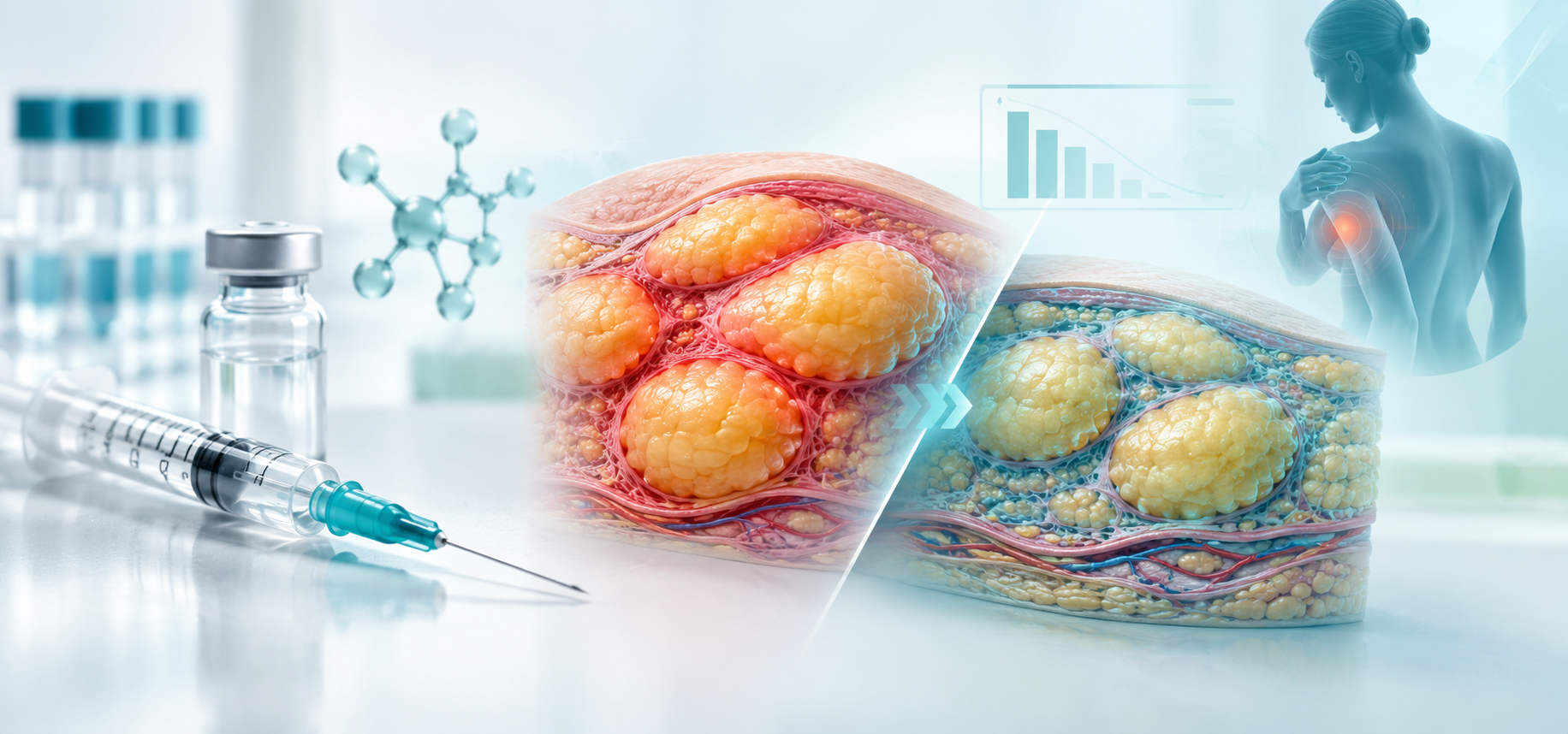
CBL-514 is a small-molecule injectable medicine developed to reduce subcutaneous fat.
The treatment is designed to selectively trigger apoptosis in fat cells.
Apoptosis is a natural process in which a cell is programmed to die.
In simple terms, CBL-514 is designed to make targeted fat cells break down without causing tissue destruction through necrosis.
The company says the treatment is intended to reduce fat at the injection site while avoiding damage to surrounding tissues and cells.
CBL-514 is being developed as a 505(b)(1) product.
A separate formulation called CBL-514D is being developed specifically for Dercum’s Disease.
Why CBL-514 Could Have More Uses
Caliway is not developing CBL-514 only for Dercum’s Disease.
The company is also studying the medicine for other conditions involving subcutaneous fat.
These include non-surgical fat reduction and moderate-to-severe cellulite.
The Dercum’s Disease results have also led the company to consider another possible use: Lipedema.
What Is Lipedema?
Lipedema is a chronic disorder that mainly affects women.
The condition causes abnormal accumulation of fat, commonly around the legs, hips and buttocks.
Unlike ordinary weight gain, this abnormal fat accumulation does not respond to weight loss in the same way.
People with Lipedema can also experience pain, swelling and tenderness.
The condition can have a significant effect on mobility and quality of life.
According to the market and epidemiological information cited by Caliway, Lipedema may affect approximately 10% of women worldwide.
The company estimates that the potential global market opportunity for treatments targeting Lipedema could exceed $30 billion.
There are currently no approved curative therapies that specifically remove the underlying abnormal fat accumulation associated with Lipedema.
Caliway Sees a Potential Opportunity in Lipedema
The results from the Dercum’s Disease study have encouraged Caliway to explore whether CBL-514 could also work in Lipedema.
The two conditions have some clinical similarities involving abnormal fat tissue and pain.
Caliway plans to work with clinical experts to evaluate how CBL-514 could be studied in patients with Lipedema.
The company will need additional clinical research to determine whether the treatment is safe and effective for this condition.
The Dercum’s Disease results alone do not establish that CBL-514 will work in Lipedema.
Dercum’s Disease Has Limited Treatment Options
People with Dercum’s Disease currently have limited treatment options.
Surgical removal of painful lipomas can provide temporary relief in some cases, but the condition can return.
Surgery can also involve unwanted effects and does not address the underlying biology of the disease.
Because there are no approved therapies specifically indicated for Dercum’s Disease, new treatment approaches are being investigated.
Caliway believes CBL-514 could provide a non-surgical approach to reducing painful fat deposits.
The Dercum’s Disease Market Could Grow
Caliway cited market research estimating that the global Dercum’s Disease market was worth approximately $11.3 billion in 2021.
The same research projects the market could reach approximately $19.96 billion by 2030.
That represents an estimated compound annual growth rate of about 6.76%.
These figures are market estimates rather than confirmed future sales for CBL-514.
The commercial opportunity will depend on further clinical development, regulatory decisions and whether the treatment ultimately receives approval.
More Than 500 People Have Participated in CBL-514 Studies
Caliway said more than 544 people have participated in clinical trials involving CBL-514.
The company also reported that 10 completed clinical trials with finalized statistical reports have met their primary and key secondary efficacy endpoints.
The company continues to evaluate the treatment across different potential indications.
The results from these studies will help determine which applications move forward into later-stage clinical development.
What Happens Next for CBL-514?
The Phase 2 Dercum’s Disease results give Caliway additional data for planning the next stage of development.
The company plans to work with clinical experts to assess the development strategy for CBL-514 in Lipedema.
Further studies will be needed to understand the appropriate dose, treatment schedule, safety profile and effectiveness in different patient populations.
For Dercum’s Disease, the company will also need to determine the next regulatory and clinical steps based on the Phase 2 results.
About Caliway Biopharmaceuticals
Caliway Biopharmaceuticals was founded in 2012 and focuses on developing new treatments for aesthetic medicine and biomedical applications.
The company is using its drug development capabilities to investigate treatments that target subcutaneous fat and other conditions with unmet medical needs.
Caliway was listed on the Taiwan Stock Exchange under the ticker 6919 on October 2, 2024.
CBL-514 remains an investigational medicine and has not been approved specifically for the treatment of Dercum’s Disease or Lipedema.