
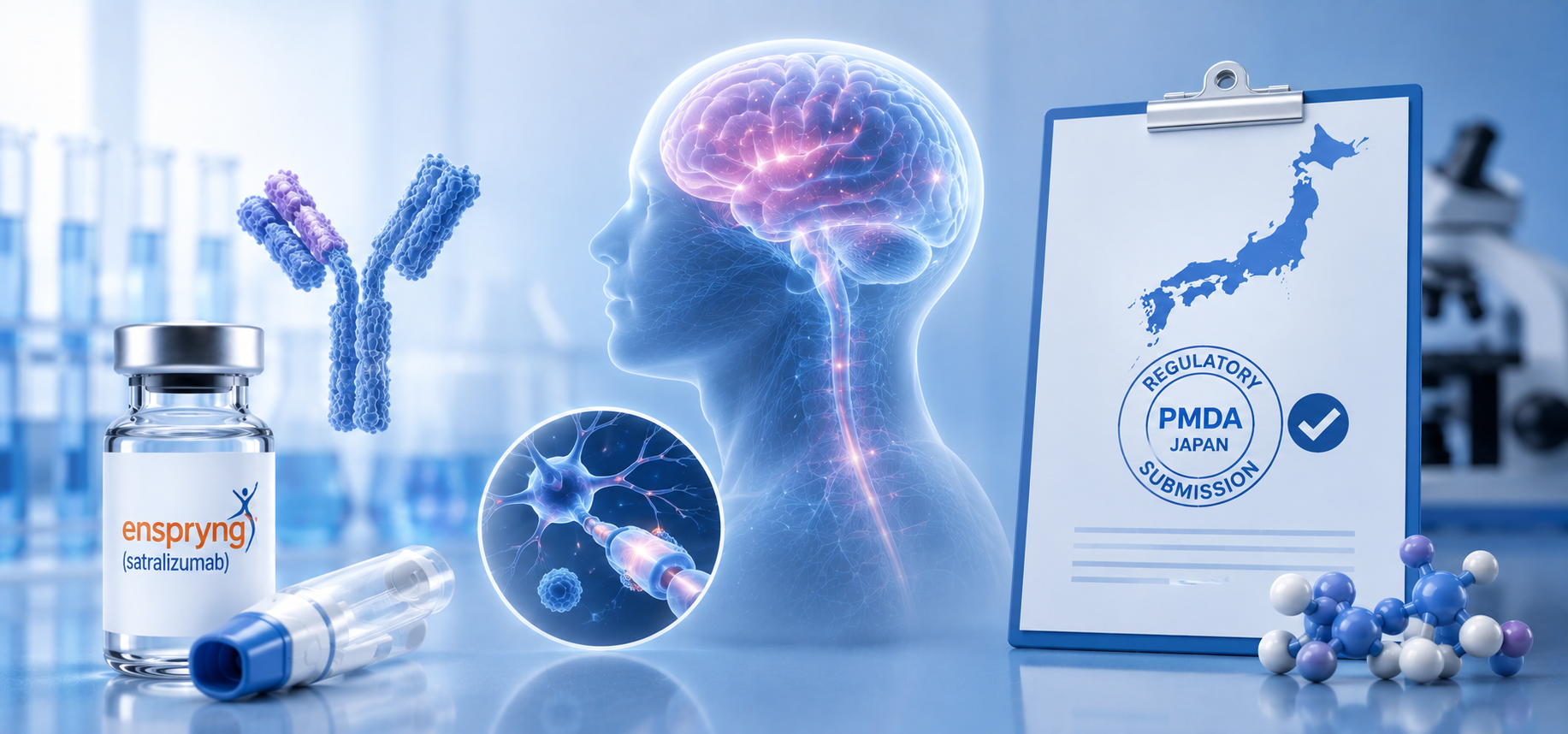
Chugai Seeks New Indication for Enspryng
Chugai Pharmaceutical Co., Ltd. has announced that it has submitted a regulatory application to Japan's Ministry of Health, Labour and Welfare (MHLW) for a new indication of Enspryng (satralizumab) to prevent relapse in patients with MOG antibody-associated disease (MOGAD).
If approved, Enspryng could become one of the first treatment options available for people living with this rare autoimmune disease, where no approved therapies currently exist for preventing relapses.
Filing Supported by Global Phase III Study
The regulatory submission is based on results from the global Phase III METEOROID clinical trial.
The study included adults and adolescents between 12 and 17 years of age who were diagnosed with MOG antibody-associated disease. Japanese patients also participated in the trial as part of Chugai's development program in Japan.
According to the study results, Enspryng reduced the risk of disease relapse by 68% compared with placebo.
These findings support the company's application to expand the medicine's approved use.
Chugai Aims to Bring Treatment to Patients Quickly
Dr. Osamu Okuda, President and Chief Executive Officer of Chugai Pharmaceutical, said the company hopes to make the medicine available as soon as possible because patients with MOGAD currently have very limited treatment options.
He explained that repeated relapses can leave patients with long-term neurological problems such as vision loss, visual field impairment, and paralysis, which can significantly affect their quality of life.
Chugai plans to continue working closely with Japanese regulatory authorities throughout the review process.
What Is Enspryng?
Enspryng, also known by its generic name satralizumab, is a humanized anti-IL-6 receptor monoclonal antibody developed by Chugai.
The medicine was created using the company's proprietary recycling antibody technology, which allows the antibody to remain active in the body for a longer period.
This innovative technology recently received the Imperial Invention Prize, the highest honor in Japan's FY2026 National Commendation for Invention.
Enspryng is already approved in approximately 90 countries, including Japan, the United States, and several European countries, for the treatment of neuromyelitis optica spectrum disorder (NMOSD).
The medicine is also being studied in additional autoimmune diseases.
Current development programs include:
- A global Phase III clinical trial in autoimmune encephalitis (AIE).
- A regulatory review by the US Food and Drug Administration (FDA) for thyroid eye disease (TED), where the application has received Priority Review.
These ongoing programs show Chugai's efforts to expand the use of Enspryng in several serious immune-mediated conditions.
Understanding MOG Antibody-Associated Disease
MOG antibody-associated disease, commonly called MOGAD, is a rare autoimmune disorder that affects the central nervous system.
The disease develops when harmful antibodies attack myelin oligodendrocyte glycoprotein (MOG), a protein found on the protective covering surrounding nerve fibers.
This immune attack causes inflammation in different parts of the central nervous system, including the optic nerves, spinal cord, and brain.
People living with MOGAD may experience symptoms such as:
- Vision problems or vision loss.
- Loss of sensation.
- Muscle weakness or paralysis.
- Difficulty with bladder function.
- Other neurological complications.
For many adults, the disease follows a relapsing pattern, meaning symptoms return repeatedly over time.
Approximately 80% of adult patients continue to experience relapses even with currently used therapies, creating a significant unmet medical need.
How Enspryng May Help
Researchers believe the inflammatory protein interleukin-6 (IL-6) plays an important role in the development of MOGAD.
IL-6 helps stimulate the production of harmful autoantibodies and contributes to ongoing inflammation within the nervous system.
Enspryng works by blocking the IL-6 receptor, which may help reduce inflammation and lower the chance of future disease relapses.
The positive Phase III results suggest this approach could offer a new treatment option for patients who currently have limited choices.
Estimated Patient Population
Although MOG antibody-associated disease is considered rare, it can have a significant impact on patients and families.
Chugai estimates that around 1,700 people in Japan are living with MOGAD.
With no approved relapse-prevention therapies currently available, the need for new treatment options remains high.