
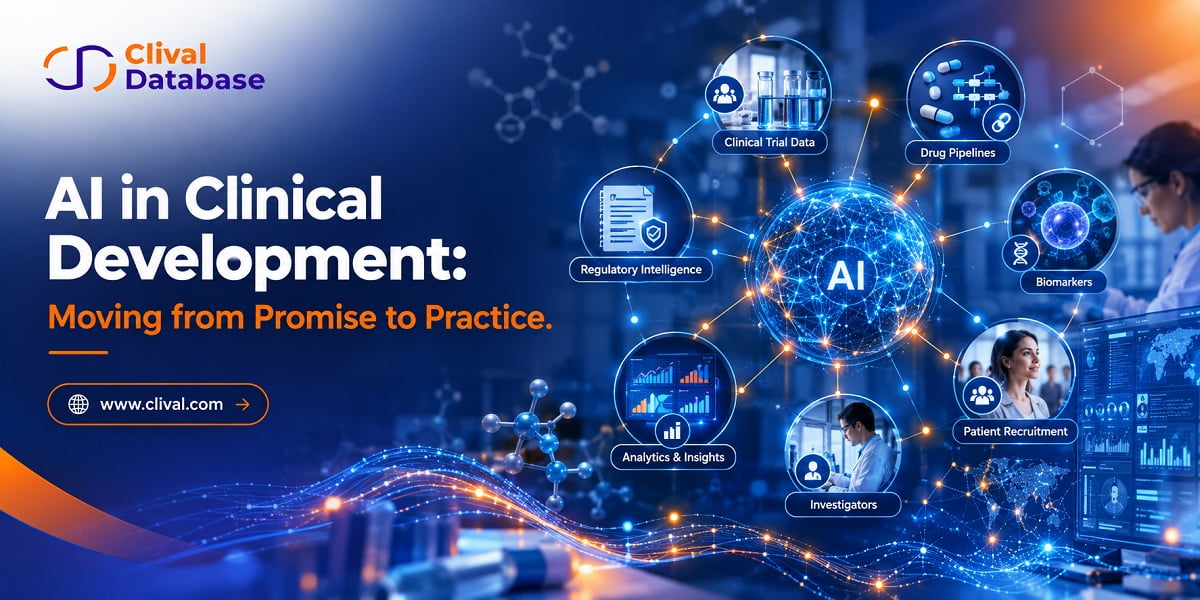
Artificial Intelligence has graduated from being used in experimental purposes to practical applications in clinical development. There has been an increasing usage by pharmaceutical and biotechnology companies of artificial intelligence to assist with patient identification, trial optimization, data analysis, safety monitoring, and regulatory submissions.
However, the true value does not lie in simply “applying AI.” Instead, the key value of AI lies in using it within the appropriate clinical development processes, backed up by reliable data, validation, governance, and context of use.
Regulatory bodies are following this trend as well. In January 2025, the FDA released a draft guidance document about using AI in making regulatory decisions related to drugs and biological products, while the EMA has published a set of principles and guidance documents on using AI in medicine.
The questions for pharmaceutical companies, biotech, CROs, and clinical intelligence teams thus shift from Is AI going to change the face of clinical development? to What is AI already being used for in clinical development?
AI in Clinical Development: Applications and Use Cases
AI can be used for different stages of clinical development process.
|
Clinical Development Area |
Potential AI Application |
Business Value |
|---|---|---|
|
Trial design |
Protocol optimization and feasibility analysis |
Better planning |
|
Patient recruitment |
Patient identification and matching |
Faster enrollment |
|
Site selection |
Site performance and investigator analysis |
Better site decisions |
|
Data management |
Automated data review and anomaly detection |
Higher data quality |
|
Medical imaging |
AI-assisted image assessment |
Consistent measurements |
|
Biomarkers |
Pattern and biomarker identification |
Better patient stratification |
|
Safety |
Signal detection and case processing |
Earlier risk identification |
|
Clinical data analysis |
Pattern recognition and predictive modeling |
Faster insights |
|
Regulatory work |
Document review and evidence analysis |
Greater efficiency |
Value differs considerably based on its applications, the level of quality of the data set, effectiveness of the model used, and human involvement.
1. AI Applications in Clinical Trial Design
The first application of AI that comes to mind is better clinical trial design.
Past clinical trial data can be used to discern patterns in:
- Eligibility criteria
- Endpoint selection
- Recruitment rates
- Trial duration
- Geographic distribution
- Patient populations
- Protocol amendments
- Study discontinuation
This will aid the development team to recognize some possible issues regarding feasibility before even starting the study.
For instance, being too stringent about the eligibility criteria may lower the pool of patients. The use of AI technology for such an analysis will enable the team to determine what happened historically in terms of trial enrollment, and how the protocol performed.
It is worth noting that while AI can be helpful in this case, it does not replace clinical or statistical knowledge since trial design is heavily dependent on biological and program specifics.
2. Patient Recruitment and Matching for Trials
Recruitment of patients continues to be one of the pragmatic bottlenecks in clinical studies.
AI can assist in matching patients with the trials using structured and unstructured clinical data matched against trial eligibility criteria. Natural language processing can also assist in mining relevant clinical data.
Possible applications may include:
- Matching patients to trials
- Eligibility screening
- Identification of underrepresented populations
- Recruitment forecasting
- Enrollment monitoring
This is not just about increasing the number of patients that are seen. It is about finding suitable patients effectively, while still maintaining privacy and data quality.
3. AI-Powered Site and Investigator Intelligence
Success of clinical trials may be greatly dependent on selecting the right investigators and sites.
Using AI to integrate historic data from clinical trials with site-specific metrics would allow teams to assess:
- Previous enrollment performance
- Therapeutic-area experience
- Trial participation history
- Investigator experience
- Geographic coverage
- Study timelines
- Competing clinical trials
This creates an important connection between clinical trial intelligence and AI.
Rather than analyzing each trial individually through manual means, one can rely on structured intelligence to discover patterns and select sites for further examination.
This can prove useful for pharma and CROs in performing feasibility studies, selecting sites, choosing investigators, and conducting competitor surveillance.
4. AI and Biomarker Intelligence
AI can also play an important role in precision medicine.
There is a great deal of information generated during clinical trials including biological, clinical, genomic, imaging, and patient data. Using artificial intelligence and machine learning, it may be possible to uncover connections within such data that would otherwise remain hidden.
Some potential applications are:
- Biomarker discovery
- Patient stratification
- Treatment-response prediction
- Disease subtyping
- Mechanism-of-action analysis
- Identification of potential responder populations
Analysis of biomarkers with AI technology would enable linking clinical trial intelligence, biomarker intelligence, and drug pipeline intelligence.
This is especially important when the companies evaluate their competitors’ programs or consider whether a new therapy concept is different from others.
5. AI for Clinical Data Analysis
Clinical trials generate intricate data sets which need to be thoroughly analyzed.
AI may assist in performing processes like:
- Data cleaning
- Anomaly detection
- Pattern recognition
- Data classification
- Medical coding support
- Imaging analysis
- Patient-level risk identification
The regulatory environment, however, requires careful attention to model reliability and reproducibility.
The EMA states that AI/ML models used for clinical-trial data analysis should follow applicable statistical principles, with appropriate documentation of data processing and model development. For pivotal trials, it specifically highlights the importance of controlling issues such as overfitting and data leakage.
6. AI in Safety Monitoring
Clinical safety is another important application area.
AI can help process and analyze large volumes of safety information, supporting activities such as:
- Adverse-event processing
- Signal detection
- Safety trend identification
- Case classification
- Literature monitoring
- Pharmacovigilance workflows
The EMA has identified pharmacovigilance and signal detection among potential AI applications across the medicine lifecycle.
The practical objective is not to remove human safety expertise. Instead, AI can be employed in analyzing big data sets on behalf of the team and focusing the efforts of experts where it really counts.

From AI Experiments to Operational Systems
The biggest paradigm shift in clinical development is the move from AI experimentation to operation.
It involves more than picking an AI algorithm.
A practical implementation should consider five areas:
1. Define the Context of Use
The initial query must be:
What particular decision-making process will the AI aid?
An AI system used for exploratory analysis has different requirements from one influencing a pivotal trial endpoint or regulatory submission.
The FDA's 2025 draft guidance uses a risk-based credibility assessment framework tied to a model's specific context of use.
2. Build on Reliable Data
AI performance depends heavily on the underlying data.
Clinical development teams should evaluate:
- Data completeness
- Data provenance
- Population representativeness
- Data consistency
- Missing information
- Potential bias
- Data interoperability
A sophisticated model cannot compensate for fundamentally unreliable input data.
3. Validate Performance
AI models need appropriate validation before being incorporated into important clinical workflows.
Validation should consider whether model performance remains reliable in the population and setting where the system will actually be used.
The EMA emphasizes that sponsors should understand the integrity of datasets, model performance, and generalizability to the intended population and context of use.
4. Maintain Human Oversight
Clinical trials cannot be viewed as places where everything generated by AI is automatically correct.
Human experts remain important for:
- Clinical interpretation
- Statistical judgment
- Safety decisions
- Regulatory assessment
- Exception handling
- Final decision-making
A practical AI strategy therefore combines automation with expert review.
5. Monitor the System Over Time
AI implementation does not end when a model goes live.
Teams need processes for monitoring:
- Model performance
- Data changes
- Bias
- Unexpected outputs
- System changes
- Regulatory expectations
This becomes particularly relevant where artificial intelligence technology is being applied in highly impactful clinical and regulatory settings.
Why Clinical Intelligence Infrastructure Is Important
AI becomes more useful when organizations can access structured, connected intelligence.
For example, an AI workflow analyzing a therapeutic area may need information about:
- Active clinical trials
- Sponsors
- Drug candidates
- Development phases
- Mechanisms of action
- Biomarkers
- Investigators
- Trial locations
- Competitor programs
- Pipeline movements
It is here that a clinical trials database platform, and more broadly, a clinical intelligence solution framework, can be useful.
Clival Database provides clinical trial intelligence, drug development and pipeline intelligence, sponsor intelligence, biomarker and mechanism of action intelligence, therapeutic area intelligence, competitive intelligence, investigator/site intelligence, and market intelligence in a more generalized business intelligence workflow.
For strategic planning, R&D, competitive intelligence, business development, and licensing groups, structured clinical intelligence can enable a data basis on which to spot trends and perform AI-enabled analysis.
What Comes Next for AI in Clinical Development?
The next phase of AI adoption is likely to focus less on demonstrations and more on measurable operational outcomes.
Companies will increasingly ask:
- Does AI improve trial feasibility?
- Can it reduce manual data review?
- Can it improve patient recruitment?
- Can it identify meaningful pipeline signals earlier?
- Can it improve site selection?
- Can it support better biomarker strategies?
- Can its outputs be validated and explained?
- Is it able to meet regulatory expectations?
EMA and FDA have collectively established ten guiding principles for good AI practices within the medicine life cycle in 2026, pertaining to the use of AI in evidence generation and monitoring within fields like clinical trials.
This marks a significant development since AI implementation within drug discovery is now being viewed as a regulated science and operation rather than a technological experiment.
Conclusion
While AI for clinical development is transitioning from theory into practice, its successful implementation depends on a number of factors beyond algorithms.
The most successful examples of AI applications include the following components: high-quality clinical data, defined goals, proper validation, regulatory considerations, and professional experience.
Pharmaceutical companies and biotech firms have a competitive advantage in implementing AI technologies for turning difficult-to-understand clinical and pipeline data into intelligence.
The more data-driven clinical development gets, the more prepared organizations with robust clinical intelligence capabilities will be for integrating AI into research and development activities, strategy, competitive intelligence, and business development operations.
Clival Database is here to help you create an intelligence framework that includes structured information about clinical trials, drug pipelines, sponsors, biomarkers, investigators, therapeutic areas, and the competitive environment. Ask for a Personalized Demo to learn how clinical intelligence can help your decision-making processes.