
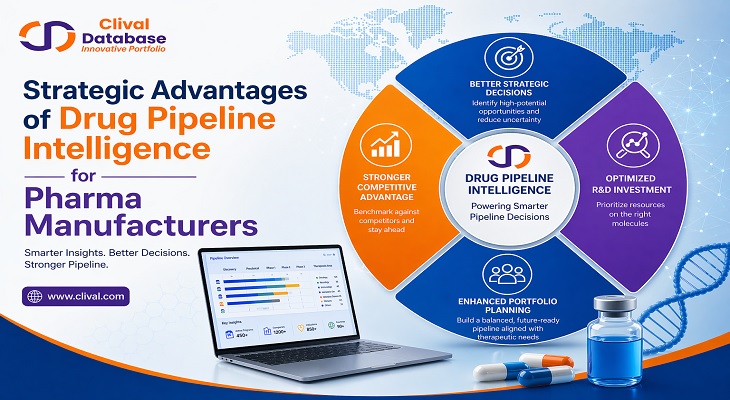
Here's a hard truth most pharma executives don't say out loud: a staggering number of high-stakes manufacturing and R&D decisions are still made with incomplete, or outright missing, pipeline visibility. Teams rely on fragmented reports, delayed market signals, and gut instinct dressed up as strategy. The result? Wasted capital, missed windows, and a lot of very expensive regret.
Drug pipeline intelligence changes that equation. Not as a nice-to-have data feed, but as a competitive lever, one that tells you what's moving through trials, who's funding it, and how close it is to disrupting your current market position. Used right, it doesn't just inform decisions. It accelerates them.
This post isn't about defining what pipeline intelligence is. It's about what it does, specifically, the seven strategic advantages it gives pharma manufacturers who choose to act on it rather than admire it from a distance.
7 Strategic Advantages of Drug Pipeline Intelligence
Whether you're planning manufacturing capacity, scouting licensing deals, or trying to figure out which therapeutic area deserves your next big bet — pipeline intelligence is the unfair advantage most competitors aren't fully using yet. Here's what it actually delivers:
|
Advantage |
What it Tracks |
Business Impact |
|
Faster decisions |
Real-time pipeline signals |
Shorter go/no-go cycles |
|
Competitor Tracking |
Trial phases and geographies |
Benchmark against rivals |
|
Risk Reduction |
Failure probability data |
Avoid costly missteps |
|
Market Entry Timing |
Approval & launch windows |
First mover advantage |
|
Licensing Opportunities |
Promising molecules early |
Strategic partnerships |
|
API Demand Forecasting |
Pipleline progression signals |
Optimized supply chain |
|
Competitive Positioning |
Whitespaces vs. saturation |
Focus on growth areas |
1. Faster, Data-Driven Decision Making
Speed is the new moat. When your R&D team is still debating trial data from six months ago, your competitor has already moved. Drug pipeline intelligence feeds real-time signals directly into the decision-making process, clinical phase updates, compound status changes, regulatory submissions — so your team stops guessing and starts acting.
- Replace lagging reports with live pipeline signals that reflect what's actually happening in trials right now.
- Align R&D, manufacturing, and commercial teams around a single, shared picture of the landscape — no more cross-functional confusion about what's worth prioritizing.
2. Early Competitor Tracking and Benchmarking
Your competitors aren't waiting for you. They're quietly advancing molecules through Phase II while you're still analyzing last year's launch. Pipeline intelligence tells you who is building what, how far along they are, and which geographies and indications they're targeting.
- Identify rival programs before they hit the market — not after they've already taken shelf space.
- Benchmark trial phases, therapeutic targets, and geographic footprints so you know exactly where you stand relative to the field.
3. Risk Reduction in Manufacturing Investments
Scaling production for the wrong drug is one of the most expensive mistakes in pharma manufacturing. Pipeline intelligence lets you filter out the noise — identifying which candidates have strong trial momentum versus which are statistically likely to fail before approval.
- Avoid committing manufacturing resources to high-attrition pipeline candidates.
- Prioritize production planning around compounds with robust Phase III data and realistic regulatory timelines.
4. Smarter Market Entry Timing
Timing a market entry is part science, part art — but mostly data. Too early and you're burning cash in an underdeveloped market. Too late and you're fighting for scraps in a crowded therapeutic segment. Pipeline intelligence maps the approval landscape so you can find the window that's actually open.
- Track regulatory submission timelines and anticipated approval dates across key markets.
- Identify therapeutic areas that are approaching saturation early enough to redirect resources before you're locked in.
5. Identification of Licensing and Partnership Opportunities
The next blockbuster molecule might already be in Phase I at a biotech startup you've never heard of. Pipeline intelligence surfaces these opportunities before they get picked up by the big players — giving you first-mover advantage on partnerships that could reshape your portfolio.
- Spot promising molecules at early stages, when licensing costs are still negotiable.
- Identify smaller biotech firms whose pipelines are progressing faster than their balance sheets — prime candidates for collaboration or acquisition.
6. API Demand Forecasting and Supply Chain Planning
Active pharmaceutical ingredient shortages don't happen overnight — they're the result of supply chains that didn't see demand coming. Pipeline intelligence changes that. By tracking where drugs are in development, manufacturers can anticipate which APIs will be in high demand six to eighteen months out and plan accordingly.
- Align sourcing strategy with pipeline progression data to reduce last-minute procurement scrambles.
- Calibrate production capacity based on real demand signals, not backward-looking forecasts.
7. Competitive Positioning Across Therapeutic Areas
Not every therapeutic area is created equal. Some are overcrowded. Some are wide open. Pipeline intelligence gives you a clear-eyed view of where the whitespace is — and more importantly, where it's shrinking fast so you can get there before it disappears.
- Map saturation levels across therapeutic categories to avoid investing in areas with diminishing returns.
- Identify high-growth indications early, where patient demand is rising but competitive density hasn't caught up yet.
How Clival Database Enables Smarter Decisions?
Having access to the right data is one thing. Being able to act on it cross-functionally is another. Clival's pipeline database is built around the principle that intelligence is only useful when it's operationally accessible — not buried in raw data exports that take an analyst three days to clean up.
- Centralized pipeline visibility: one source of truth for trial status, compound profiles, regulatory milestones, and competitive activity — accessible across your organization.
- Actionable insights, not data dumps: Clival surfaces what matters and contextualizes it, so teams can make decisions without needing to be data scientists.
- Cross-functional utility: from R&D strategy to manufacturing planning to business development, Clival's intelligence is structured to answer different questions for different teams — all from the same platform.
For context, platforms like Clarivate have long demonstrated that centralized, structured drug development data directly improves speed and accuracy of pharma decisions. Clival takes that principle and makes it accessible for manufacturers who need operational clarity, not just market research.
Conclusion
Drug pipeline intelligence is no longer a luxury reserved for the largest players with the biggest analytics budgets. It's a foundational capability, one that directly impacts revenue potential, risk exposure, and the speed at which manufacturers can move from insight to action.
Manufacturers who build pipeline intelligence into their strategic planning don't just react faster. They make better bets, form smarter partnerships, build more resilient supply chains, and avoid the costly surprises that come from operating with incomplete visibility.
The edge is measurable. The gap between those who have it and those who don't is widening. Clival exists to make sure you're on the right side of that gap.