
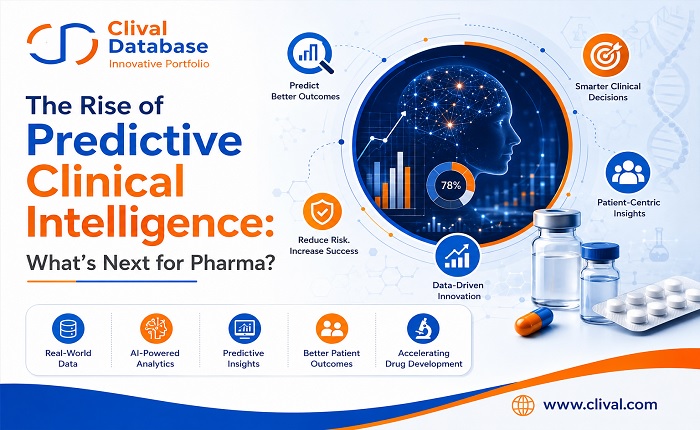
Information has always played a very important role in the decision-making process in the pharmaceutical industry. In every process like identifying promising drugs, designing clinical trials or obtaining regulatory approvals, precise and accurate information is needed. But the amount and complexity of the data available in clinics today have changed the way these decisions are now being made.
There are thousands of clinical trials conducted all over the world each year giving rise to massive amounts of data such as data related to disease, therapy, biomarker, patient and efficacy of treatment. The data is valuable but merely having data is not sufficient. Companies in the pharma sector need the ability to predict the trends, opportunities, and risks in their decision-making.
The result has been a new approach called Predictive Clinical Intelligence which uses artificial intelligence, machine learning, real-time clinical data and analytics for predicting future outcomes and not reporting on past events.
In effect, predictive intelligence is becoming an increasingly essential asset for pharmaceuticals, biotech, CROs and business development teams to develop clinical drug development and speed up innovation.
What Is Predictive Clinical Intelligence?
Predictive Clinical Intelligence: The usage of artificial intelligence, analytics, and clinical data to predict future trends in the lifecycle of drug discovery and development.
Prediction differs from the conventional reporting, whereby you get historic data and information about what has happened before, to answering some queries a little bit into the future, such as:
- Which therapeutic fields will grow in the coming 5 years?
- Which clinical trials will succeed?
- Who will be the new players in diseases?
- • What are the new licensing opportunities?
- Which clinical trials will have recruitment challenges?
Pharmaceutical companies are able to plan ahead instead of reacting to the changes and making decisions in advance.
This tool enables organizations to use their resources wisely and have an edge over their competitors.
The inadequacy of traditional clinical intelligence is outlined.The limitations of traditional clinical intelligence are explained.
Why Traditional Clinical Intelligence Is No Longer Enough
The science and innovation are advancing at a rapid pace across a variety of therapeutic areas, clinical trials are becoming more global and the development of new drugs more specialized.
The traditional intelligence approaches generally are based on:
- Manual research
- Static reports
- Historical data
- Multiple disconnected databases
- Periodic competitive reviews
While these still serve well, they are unable to keep up with the changing times.
By the time of quarterly market report, for instance, competitors could be running new studies, expanding clinical programs or announcing strategic partnerships.
Predictive intelligence addresses this challenge by constantly analysing real time data and detecting significant patterns before they are apparent.
The Role of Predictive Intelligence in the Drug Development Clinical Trial Phases
All medicines go through a specific process of development to become successful medicines. Predictive intelligence delivers valuable insights in every phase of the drug development clinical trial stages, supporting organisations to make smarter decisions at every stage from discovery to commercialization.
Drug Discovery
The first phase of clinical drug development is to target biological entities and identify desirable compounds.
Historical research, scientific publications, genomic data and information about biomarkers can all be analysed using predictive analytics to identify the most promising targets.
This allows research staff to concentrate on the most viable opportunities.
Preclinical Research
In preclinical development, efficacy, toxicity, and safety is evaluated before human trials.
To help prevent potential risks from occurring, and to help organisations to shape their development plans, predictive models are used.
Phase I Clinical Trials
Phase I trials are conducted on a small number of people to test for safety and dosage.
The predictive models powered by AI enable improved patient selection, prediction of potential operational risks and greater feasibility planning in trial design.
Phase II Clinical Trials
Further research is ongoing to determine the efficacy of the treatment and predictive intelligence is being applied in assisting with the optimization of patient recruitment, monitoring progress towards recruitment and identifying factors that can be linked to delays in recruitment. These insights allow intervention to be made earlier and study times are maintained. This activity represents Phase III Clinical Trials.
Late-Stage development is more complex and patient numbers are larger.
Predictive analytics supports:
- Site performance monitoring
- Recruitment forecasting
- Operational risk assessment
- Resource allocation
- Timeline optimization
These features help to make the development more efficient and to lower development risk.
Regulatory Review and Commercial Readiness
Predictive Intelligence is useful even after clinical development.
Integrated clinical and market intelligence allows organizations to expect regulatory demands, assess competitive releases, predict market demand, and plan commercialization plans.
Predictive intelligence enables enterprises to make decisions based on data and avoid reacting to events in the process of drug development.
The Role of AI in Predictive Clinical Intelligence
The powerhouse behind predictive clinical intelligence is artificial intelligence.
AI is not meant to replace human intelligence, but rather complement it, handling vast amounts of data that are too complex to be processed by human operators.
Faster Analysis of Clinical Data
Data is analyzed by AI in an effective manner (such as data gathered from clinical trials, scientific publications, regulatory news, sponsor news, and pipelines).
Therefore, decision makers can focus on analyzing the data rather than gathering them.
Improved Patient Recruitment
Another major challenge for conducting clinical research is recruiting patients.
Predictive AI is capable of determining the best locations for conducting studies, predicting the time needed for recruitment and identifying potential recruitment problems in advance.
Smarter Competitive Intelligence
Competitor pipelines, sponsor activity, expansion of therapeutic areas and new technologies are monitored continuously by AI.
These insights assist organizations to benchmark their rivals and discover strategic opportunities earlier.
Improved Portfolio Strategy
The pharmaceutical industry is adopting predictive intelligence in more and more investment decisions, to gauge scientific risk, and to spot market opportunities.
Organizations can now make forward-looking decisions based on real-time evidence, rather than just historical trends.
Why Predictive Clinical Intelligence Is Becoming a Competitive Advantage
Pharmaceutical industry is getting more and more competitive each year.
The earlier that the organization identifies the trends, the more benefits they can have for research, licensing, investment, and commercialization.
The companies can use predictive intelligence to:
- Constantly track the clinical activity around the world.
- Benchmark competitor pipelines
- Get to know licensing options sooner
- Recognize new therapeutic areas that are emerging
- Reduce development risk
- Improve R&D productivity
- Strengthen portfolio planning
This transition is making Intelligence a strategic competency of the Business.
Organizations that have successfully leveraged predictive intelligence in their business are more likely to be able to react fast to scientific discoveries and market dynamics.
How Clival Database Supports Smarter Clinical Decisions
In today's pharmaceutical companies, clinical data is just not enough; they need actionable intelligence instead.
Clival Database is a unique single platform that integrates multiple intelligence capabilities, allowing users to make decisions throughout the drug development lifecycle.
These capabilities include:
- Clinical Trial Intelligence
- Drug Pipeline Intelligence
- Sponsor Intelligence
- Biomarker Intelligence
- Mechanism of Action Intelligence
- Therapeutic Area Intelligence
- Competitive Intelligence
- Investigator & Site Intelligence
Clival Database connects these data sources to provide a complete picture of clinical activity across the world that serves the pharmaceutical and biotechnology industry, CROs, business development teams and investors.
This can help users to predict what is coming next, compare against their rivals, look for licensing options, and inform their planning throughout the drug development process.
Conclusion
The future of innovation in the pharmaceutical industry will hinge on intelligence, not just information.
At the dawn of clinical research worldwide, there is the necessity for systems that will facilitate the transformation of data into valuable predictions.
Predictive Clinical Intelligence provides a competitive advantage to pharma executives through the ability to make quick and well-informed decisions using AI, clinical data, and analytics.
Predictive Intelligence allows companies to avoid uncertainties, gain efficiencies, and seize opportunities before other players in the market optimize clinical drug development process.
Predictive intelligence has now become an integral part of pharmaceutical strategy today and not some future dream.