
Let me be blunt. Drug development used to be a chemistry problem. You had brilliant scientists in labs, running experiments, failing 90% of the time, and hoping luck showed up before the funding ran out. That model? It is being replaced. Fast.
What is driving this shift? Data — specifically, the explosion of real-world data (RWD), clinical and genomic datasets, and AI-driven analytics. In 2026, data is not being used to support drug development. It is drug development. It is the backbone. The engine. The edge.
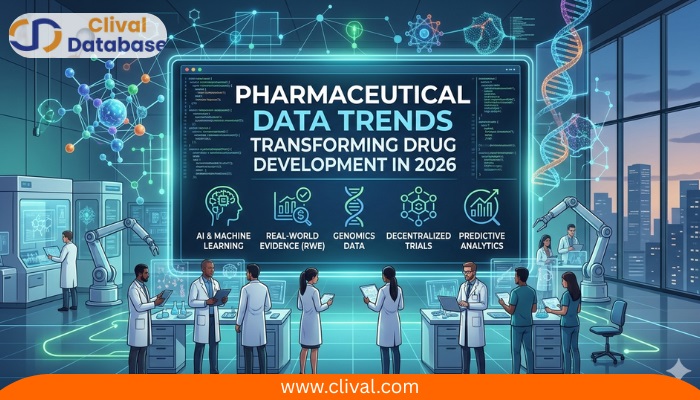
In this post, five major data trends are broken down — the ones reshaping pharmaceutical R&D right now — along with how pharma companies are leveraging them and why platforms built for this data-first era, like Clival, are becoming non-negotiable.
Trend #1 — AI-powered drug discovery is becoming the default
Here is what most people still get wrong: they think AI is a tool pharma companies experiment with. It is not. It is now embedded across entire pipelines. Target identification, molecule screening, lead optimization — AI is running point on all of it.
The impact is being felt across three dimensions:
- Faster timelines. Candidate compounds are being identified in weeks, not years, because AI can screen billions of molecular structures that no human team could physically evaluate.
- Reduced trial-and-error. Predictive modeling eliminates a huge chunk of the guesswork that used to eat R&D budgets alive.
- Lower R&D costs. When fewer experiments fail at expensive late stages, the savings compound dramatically.
The real shift, though, is from data analysis to generative modeling. AI is now being used to design molecules — not just screen existing ones. Generative AI for molecule design is not a future concept. It is a present competitive advantage.
Companies not using AI in their drug discovery pipeline are not "playing it safe." They are already behind.
Trend #2 — Integration of multi-source data (breaking data silos)
The biggest problem in pharma today is not a lack of data. There is more data than ever. The problem is fragmentation. Clinical data lives in one system. Genomic data lives in another. Manufacturing data, market intelligence — all siloed, all isolated, all nearly useless in isolation.
|
Data type |
Where it lives |
What it unlocks when integrated |
|
Clinical data |
Trial management systems |
Patient outcomes and safety signals |
|
Genomic data |
Research databases |
Personalized medicine pathways |
|
Manufacturing data |
Operations platforms |
Quality control and supply chain decisions |
|
Market intelligence |
Commercial teams |
Pipeline prioritization and competitive positioning |
Unified data platforms and cloud-based ecosystems are being adopted to solve this. When data is brought together, cross-functional decision-making improves dramatically, and go/no-go calls in drug pipelines are made faster and with more confidence. Centralized platforms — like Clival — enable actionable insights to be pulled from what was previously just scattered, unusable data.
Trend #3 — Decentralized and data-driven clinical trials
Traditional clinical trials are slow, expensive, and built around physical sites. That model is being dismantled. Trials are going digital, remote, and data-rich — and the results are hard to argue with.
Three elements are driving this transformation:
- Remote monitoring. Patients are tracked in real time without requiring them to visit a clinic, dramatically lowering dropout rates and recruitment barriers.
- Digital endpoints. Outcomes are measured through validated digital tools rather than subjective, infrequent in-person assessments.
- Wearable-generated data. Continuous, passive data collection from patients produces richer datasets than anything a quarterly check-in could provide.
AI is also being used for patient matching and risk prediction — making recruitment smarter and safety monitoring more proactive. The bottom line: clinical trials are evolving from static, phased studies into continuous data streams. Companies that adapt to this model will recruit faster, spend less, and produce better evidence.
Trend #4 — Synthetic data and digital twins are emerging
What happens when real data is limited, too sensitive to use, or simply unavailable? Pharma companies are generating their own.
Synthetic data — AI-generated datasets built to mirror real patient populations — is being used to run simulations without touching a single real patient record. Privacy problems are solved. Data scarcity problems are solved. And digital twins, which are virtual models of patients or biological systems, are being used to test drug responses and simulate trial scenarios before a single physical experiment is run.
The implications are significant. Early-stage dependency on physical trials is being reduced. Hypothesis testing is getting faster. And in the not-too-distant future, this trend could fundamentally redefine what preclinical research even looks like.
Trend #5 — Data-driven regulatory and commercial decisions
Data's influence does not stop at the lab door. It is now shaping regulatory submissions and commercial strategy in ways that were not possible five years ago.
Regulators are increasingly accepting real-world evidence and AI-supported insights alongside traditional clinical trial data. Meanwhile, commercial teams are using data to make sharper decisions on pricing strategy, market access planning, and competitive intelligence. Globally, data is influencing regulatory frameworks and cross-border approval strategies.
The takeaway is simple: data now determines not just what gets developed — but what gets approved, priced, and sold.
Why these trends demand better pharma data platforms?
Here is the uncomfortable truth most pharma teams are sitting with: they have too much data and not enough usable insight. The data exists. The infrastructure to actually leverage it, often, does not.
What the industry needs is structured, validated, and searchable pharma intelligence — not raw data dumps. Platforms like Clival are built for exactly this. By aggregating global pharma data, enabling faster decision-making, and cutting the time it takes to go from question to insight, Clival gives teams the competitive leverage that raw data alone never could.
In 2026, competitive advantage does not come from having more data. It comes from using it better than everyone else.
Conclusion
AI-powered discovery, real-world data, integrated platforms, decentralized trials, and synthetic datasets are not separate trends. They are converging into a single, fundamental shift: pharma is moving from slow, linear development cycles to fast, data-driven ecosystems.
The companies that will win in this environment are not the ones with the biggest datasets. They are the ones that can turn complex, fragmented data into clear, confident decisions — faster than anyone else.
Data is no longer optional. It is the engine of modern drug development. The question is whether your organization is driving it, or being left behind by it.