
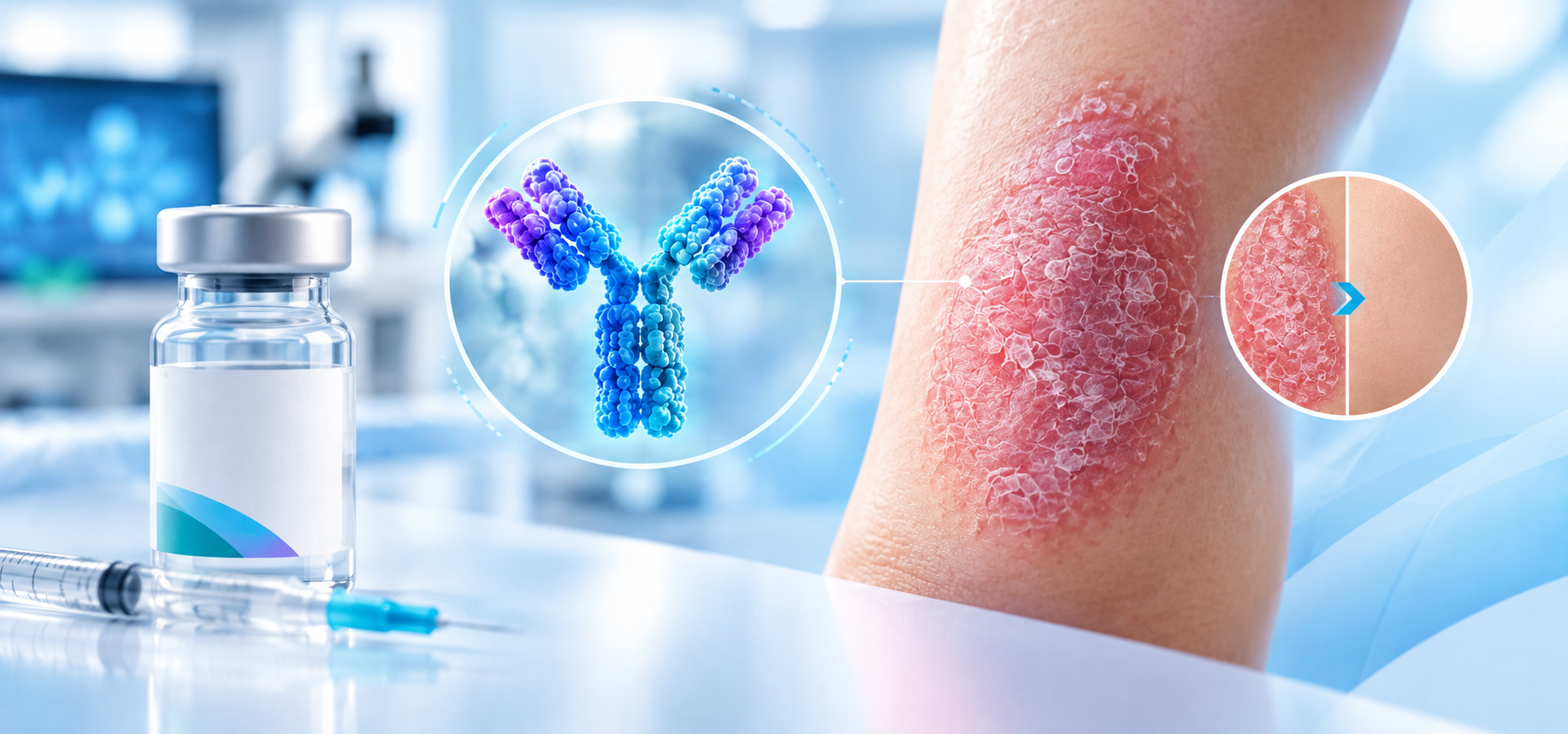
Oral IL-17A Inhibitor Shows Positive Results in 28-Day Proof-of-Concept Study
Ascletis Pharma Inc. has reported positive results from a Phase I proof-of-concept clinical trial evaluating ASC50 in people with mild-to-moderate plaque psoriasis in the United States.
ASC50 is an investigational oral small-molecule drug designed to block interleukin-17A, or IL-17A, a protein involved in inflammation and autoimmune diseases.
The randomized, double-blind, placebo-controlled study evaluated the safety, effectiveness and pharmacokinetics of once-daily 200 mg ASC50 after 28 days of treatment.
The study is registered as NCT07024602.
What Is Plaque Psoriasis?
Plaque psoriasis is a chronic inflammatory skin disease.
It happens when the immune system becomes overactive and causes skin cells to grow too quickly. This can lead to raised, red and scaly patches of skin.
The condition can affect different parts of the body and may cause itching, discomfort and pain.
IL-17A plays an important role in the inflammatory process associated with psoriasis. Because of this, IL-17A has become an established target for psoriasis treatments.
ASC50 Is Designed to Block IL-17A
ASC50 is an oral small-molecule inhibitor that targets IL-17A.
Unlike injectable IL-17A antibody therapies, ASC50 is designed to be taken by mouth.
Ascletis discovered and developed ASC50 internally. The company describes it as a new chemical entity with a novel molecular structure.
The goal is to develop an oral treatment that can provide IL-17A inhibition without requiring patients to receive injections.
The Phase I Study Included 28 Days of Treatment
The Phase I trial was designed as a randomized, double-blind and placebo-controlled proof-of-concept study.
Patients with mild-to-moderate plaque psoriasis received once-daily 200 mg ASC50 for 28 days.
Researchers evaluated several factors, including changes in psoriasis severity, drug levels in the body and safety.
The study was designed to provide early information about whether ASC50 could produce biological and clinical effects in patients with psoriasis.
ASC50 Reduced PASI Scores
One of the main findings was a reduction in the Psoriasis Area and Severity Index, known as PASI.
PASI is commonly used in psoriasis studies to measure the severity and extent of psoriasis.
After 28 days of once-daily 200 mg treatment, ASC50 produced a placebo-adjusted PASI reduction of 48.9%.
This result provided early evidence of activity in patients with mild-to-moderate plaque psoriasis.
The Effect Continued After the Last Dose
The reduction in PASI score continued to increase after patients stopped taking ASC50.
Six days after the final, or 28th, dose, the placebo-adjusted PASI reduction reached 60.7%.
Fifteen days after the last dose, the reduction reached 65.9%.
According to Ascletis, these findings are important because they suggest that the drug may continue to have an effect after dosing stops.
The company said the results also support the possibility of developing ASC50 as a once-weekly oral treatment.
ASC50 Had a 6.5-Day Half-Life
Pharmacokinetics, or PK, looks at how a medicine behaves inside the body.
After 28 days of treatment, ASC50 had a steady-state elimination half-life of 6.5 days in patients.
The half-life describes how long it takes for the amount of a drug in the body to decrease by approximately half.
A longer half-life can allow a medicine to remain in the body for a longer period.
Based on the ASC50 results, Ascletis believes the drug may be suitable for once-weekly oral dosing in future development.
However, additional clinical studies will be needed to determine whether a once-weekly dose can provide the desired safety and effectiveness.
ASC50 Showed Strong Target Engagement
The study also provided evidence that ASC50 was interacting with its intended biological target.
After 28 days of treatment, researchers observed elevated levels of IL-17A in the blood.
This increase was considered evidence of strong target engagement.
In simple terms, the finding suggests that ASC50 was affecting the IL-17A pathway it was designed to target.
Target engagement is an important part of early drug development because it helps researchers understand whether a drug is producing the expected biological effect.
ASC50 Results Were Compared With Published Secukinumab Data
Ascletis also compared the PASI reduction seen with ASC50 with previously published data for secukinumab.
Secukinumab is an approved injectable antibody that targets IL-17A and is used to treat psoriasis and other inflammatory diseases.
The company said the reduction in PASI seen with once-daily 200 mg ASC50 was comparable to published secukinumab data.
However, this was not a head-to-head clinical trial.
Because the results came from different studies, the comparison cannot directly establish that ASC50 is as effective as secukinumab.
ASC50 Was Well Tolerated in the Study
Safety was another important part of the Phase I trial.
According to Ascletis, once-daily 200 mg ASC50 was safe and well tolerated during the 28-day treatment period.
All reported adverse events were mild, classified as Grade 1, and were temporary.
No serious adverse events were reported.
No patients discontinued treatment because of adverse events.
The study also did not identify elevations in alanine aminotransferase, or ALT, or aspartate aminotransferase, or AST.
These enzymes are commonly monitored as indicators of possible liver injury.
Ascletis reported that no hepatic safety signal was detected during the study.
Why an Oral IL-17A Inhibitor Could Be Useful
Several IL-17A-targeting treatments are already available for inflammatory diseases, including psoriasis.
Many of these medicines are administered by injection.
ASC50 is being developed as an oral small molecule.
If later studies confirm its effectiveness and safety, an oral treatment could provide an alternative administration method for patients who prefer not to receive injectable therapies.
The possibility of once-weekly dosing could also reduce the number of doses patients need to take.
These potential benefits remain investigational and will need to be evaluated in larger clinical studies.
Ascletis Is Developing ASC50 as a New Chemical Entity
ASC50 is one of the internally discovered drug candidates in Ascletis’ pipeline.
The company describes ASC50 as a new chemical entity with a novel scaffold.
Ascletis is using its drug discovery capabilities to develop small molecules and peptides across several therapeutic areas.
Its technology platforms include Artificial Intelligence-assisted Structure-Based Drug Discovery, the Ultra-Long-Acting Platform and Peptide Oral Transport ENhancement Technology.
ASC50 Is Part of a Broader Ascletis Pipeline
Ascletis is developing several investigational medicines, including oral small molecules and peptide therapies.
Its pipeline includes programs targeting metabolic diseases, chronic weight management and diabetes.
The company’s lead program is ASC30, an oral small-molecule GLP-1 receptor agonist being developed for chronic weight management and diabetes.
Other programs include combinations involving GLP-1, GIP and amylin receptor pathways.
ASC50 adds an autoimmune and inflammatory disease program to this broader development portfolio.
What Ascletis Said About ASC50
Jinzi Jason Wu, PhD, founder, chairman and CEO of Ascletis, said the Phase I results showed strong efficacy, safety and pharmacokinetic findings.
He also highlighted the 6.5-day half-life observed in patients.
According to Wu, the findings support the potential development of ASC50 as an oral alternative to injectable IL-17A antibody therapies.
The company is particularly focused on the possibility of once-weekly oral dosing.
What Happens Next for ASC50?
The Phase I results provide early clinical evidence that ASC50 can affect the IL-17A pathway and reduce psoriasis severity over the study period.
The next stages of development will need to establish the appropriate dose and dosing schedule and further evaluate safety and effectiveness in larger patient populations.
Ascletis will use the clinical, pharmacokinetic and safety findings from the proof-of-concept study to guide the continued development of ASC50.
The company is developing ASC50 as a potential oral treatment option for psoriasis and other autoimmune and inflammatory diseases where IL-17A plays an important role.
About Ascletis Pharma
Ascletis Pharma Inc. is a biotechnology company focused on discovering, developing and commercializing medicines.
The company is listed on the Hong Kong Stock Exchange under stock code 1672.
Its research programs include small molecules and peptides developed using its proprietary drug discovery and drug delivery technologies.