
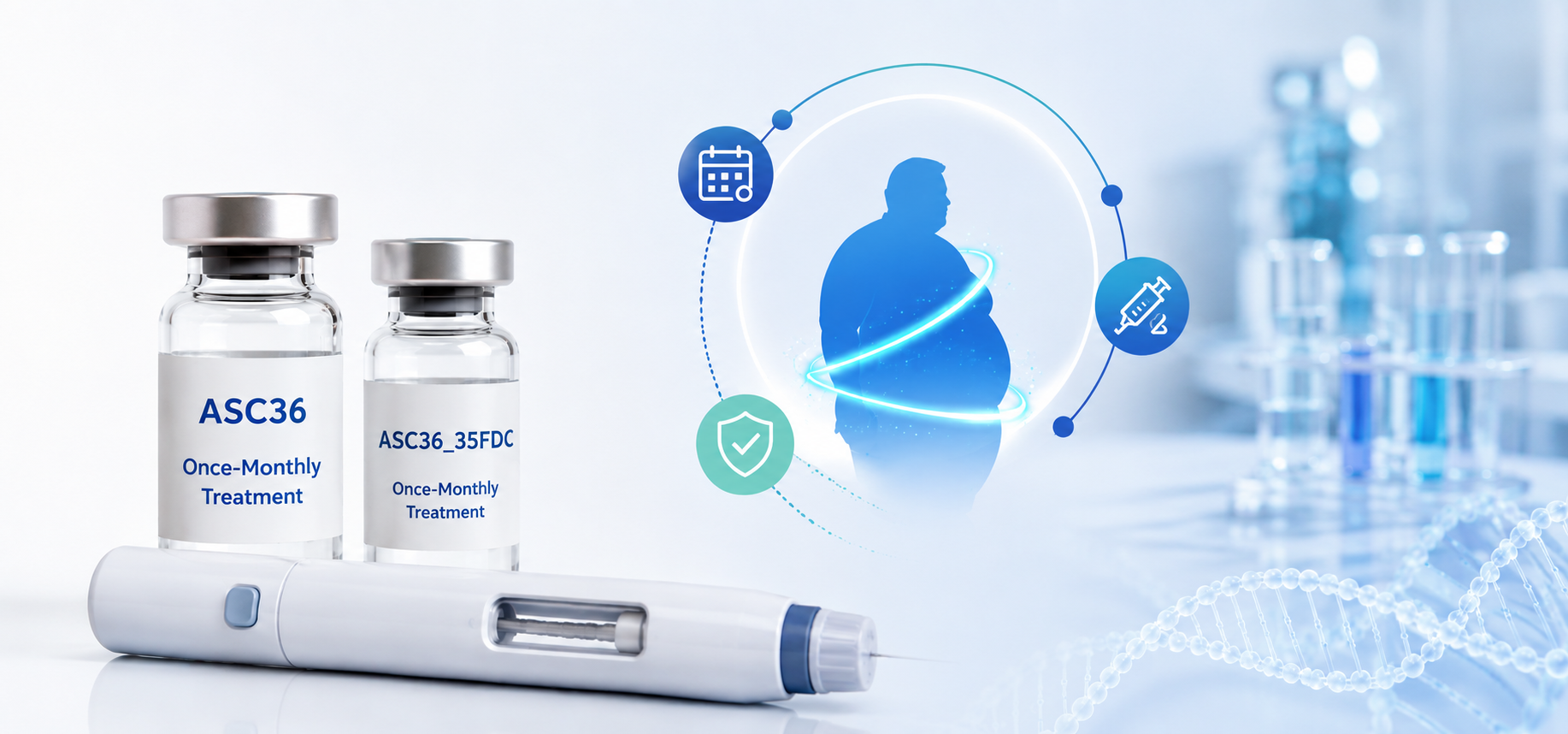
Ascletis Starts Phase 1 Trials for Once-Monthly Obesity Treatments ASC36 and ASC36_35FDC
Company Advances Two Long-Acting Obesity Drug Candidates in the US
Ascletis has started two Phase 1 clinical trials in the United States for its obesity treatment pipeline after receiving Investigational New Drug (IND) clearances from the US Food and Drug Administration (FDA).
The two programs are ASC36 and ASC36_35FDC. ASC36 is a long-acting amylin receptor peptide agonist designed for once-monthly to once-quarterly subcutaneous dosing. ASC36_35FDC is a fixed-dose combination that brings ASC36 together with ASC35, Ascletis' GLP-1 receptor and GIP receptor dual agonist.
The company is developing both candidates as potentially first-in-class treatments within their respective categories.
What Are the Two Phase 1 Studies Looking At?
Both studies are randomized, double-blind and placebo-controlled clinical trials. They are designed to look at the safety, tolerability, pharmacokinetics and pharmacodynamics of the treatments.
The trials include single ascending dose and multiple ascending dose stages.
Participants can have obesity, defined as a body mass index (BMI) of at least 30.0 kg/m², or overweight with a BMI of at least 27.0 kg/m² when accompanied by weight-related health conditions.
The ASC36 study is evaluating two formulations, called Injection A and Injection B. Each formulation is being studied in 72 participants.
The ASC36_35FDC study is also evaluating two formulations, Injection A and Injection B, with 88 participants planned for each formulation.
How Does ASC36 Work?
ASC36 is designed to activate the amylin receptor, which is a different biological pathway from GLP-1 and GIP.
Amylin is naturally produced by pancreatic beta cells along with insulin. It acts on receptors in the brainstem and can help increase feelings of fullness, slow stomach emptying and reduce food intake.
This makes the amylin pathway an area of growing interest in obesity drug development. Researchers are exploring whether targeting amylin alongside GLP-1 or GIP pathways can produce stronger or more durable weight loss.
ASC36 is designed to provide this amylin-based activity through a long-acting injectable formulation.
ASC36_35FDC Combines Three Metabolic Targets
ASC36_35FDC takes the approach one step further by combining ASC36 with ASC35 in a single injection.
ASC35 is a peptide that activates both the GLP-1 receptor and GIP receptor. When combined with ASC36, the fixed-dose formulation targets three metabolic pathways:
- Amylin receptor
- GLP-1 receptor
- GIP receptor
The goal is to combine these mechanisms into one long-acting treatment rather than requiring separate injections.
Ascletis Uses Its SALD Technology
Both ASC36 and ASC36_35FDC use Ascletis' Self-Assembling Lipid Depot, or SALD, formulation technology.
The technology uses a low-viscosity solution containing lipids, biocompatible organic solvents and the active pharmaceutical ingredient. The formulation can be administered under the skin through a fine needle, including needles as thin as 29 gauge.
After injection, the solution forms a gel-like depot under the skin. The depot then slowly breaks down through enzymes in the surrounding tissue and releases the drug over a period of one month or longer.
This approach is intended to support less frequent dosing.
In non-human primate studies, Ascletis reported that the SALD formulation of ASC36 produced an observed half-life approximately six times longer than eloralintide. The company believes this supports the potential for once-monthly to once-quarterly dosing in humans.
These findings are from preclinical studies, so they still need to be confirmed in human clinical trials.
How Does the Combination Compare With Other Amylin-Based Treatments?
Ascletis is also comparing ASC36_35FDC with other emerging approaches that combine amylin activity with GLP-1 or related pathways.
The company has referenced a reported 29.0% weight loss at Week 32 from a combination of eloralintide and tirzepatide. Ascletis attributed this figure to an Eli Lilly abstract accepted for presentation at EASD 2026, although the figure had not yet been independently verified at the time of the company's announcement.
Ascletis also conducted a head-to-head study in diet-induced obese rats.
In that study, the company reported that ASC36_35FDC produced approximately 51% greater relative body weight reduction than the combination of eloralintide and tirzepatide.
There was also a difference in the number of injections. Eloralintide and tirzepatide require separate weekly injections, which would mean eight injections per month. ASC36_35FDC is being developed as a single monthly injection.
However, these results come from animal studies and should not be treated as evidence of the same level of weight loss in humans.
ASC36 Also Showed Results in Animal Studies
Ascletis has reported additional preclinical findings for ASC36 as a standalone treatment.
In diet-induced obese rat studies, ASC36 produced approximately 91% greater relative body weight reduction than petrelintide and approximately 32% greater reduction than eloralintide.
Again, these comparisons were generated in animal models. The Phase 1 clinical trial is now needed to determine how ASC36 performs in people.
What Did Ascletis Say About the New Trials?
Jinzi Jason Wu, PhD, founder, chairman and chief executive officer of Ascletis, said the company sees the once-monthly combination as a potential advantage compared with treatments that require multiple injections.
According to Wu, ASC36_35FDC is designed to target the amylin receptor, GLP-1R and GIPR through one monthly subcutaneous injection.
He also pointed to the company's broader progress in long-acting obesity treatments, noting that Ascletis has initiated three Phase 1 studies in the US in 2026 involving ASC35, ASC36 and ASC36_35FDC.
ASC36 and ASC36_35FDC Join a Larger Obesity Pipeline
The two new Phase 1 programs are part of a broader metabolic disease pipeline at Ascletis.
The company's lead program is ASC30, an oral small-molecule GLP-1 receptor agonist being developed for chronic weight management and diabetes. ASC30 has entered a global Phase 3 program.
ASC35 is another peptide program from Ascletis. It activates both the GLP-1 receptor and GIP receptor and began Phase 1 development earlier in 2026 following FDA IND clearance.
The company is also working on several other combination and multi-target programs.
These include ASC30_48FDC, an oral GLP-1R/GIPR combination, and ASC30_48_39FDC, an oral combination designed to target GLP-1R, GIPR and amylin pathways.
Ascletis is also developing ASC39, an oral small-molecule amylin receptor agonist, along with ASC37, a peptide designed to activate GLP-1R, GIPR and GCGR.
Another program, ASC36_37FDC, is being developed as a once-monthly subcutaneous quadruple peptide combination that brings together ASC36 and ASC37.
What Happens Next for the Two Phase 1 Trials?
The immediate focus for ASC36 and ASC36_35FDC will be on safety, tolerability, pharmacokinetics and pharmacodynamic responses in participants with obesity or overweight and related health conditions.
The trials will also provide early information about how the long-acting formulations behave in humans and whether the dosing approach can support monthly administration.
Ascletis has not yet disclosed when it expects to report the first Phase 2 data from either program.
The clinical development of these candidates will help determine whether the long-acting amylin approach, either alone or combined with GLP-1 and GIP activity, can progress toward later-stage testing for obesity.
Optimize Your trial insights with Clival Database.
Are you exhausted from the uncertainty of trial insights pricing? Clival Database ensures the clarity in the midst of the global scenario for clinical trials to you.Clival Database is one of the best databases that offers an outstanding number of clinical trial data in terms of 50,000+ molecules and from primary regulatory markets as well as new entrants like Indian and Chinese markets.
With Clival, you get accurate positioning of historical sales data, patent database, company profiling, safety & efficacy, and prediction of launch of new innovative molecules helping you to align your research and driving down the cost.
To add value, we further break down our analytics for you so that improving your operational effectiveness; optimizing your clinical trials; and offering you accurate and high-quality data at lowest possible prices becomes possible.
Elevate your trial success rate with the cutting-edge insights from Clival database.
Check it out today and make more informed sourcing decisions! Learn More!