
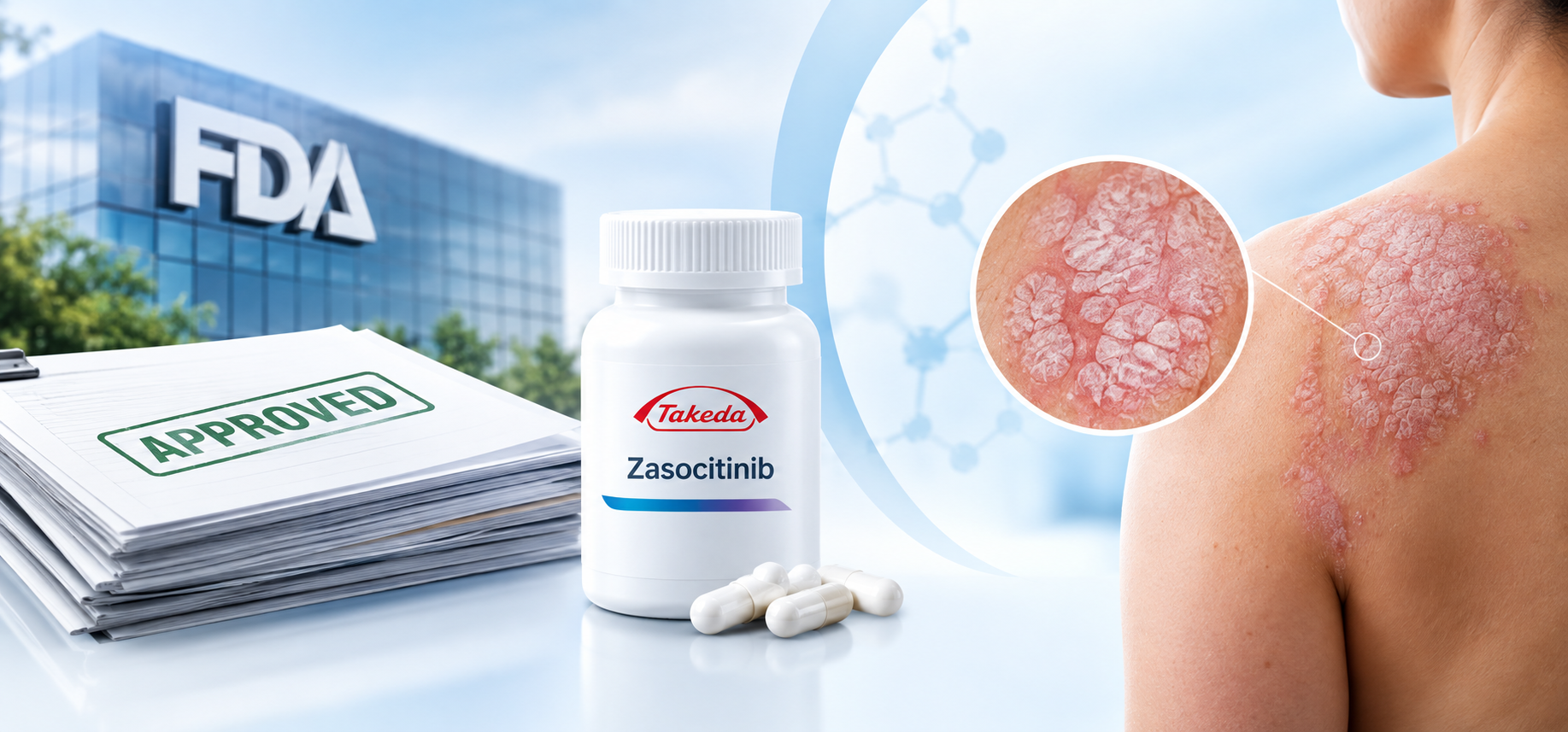
FDA Accepts Takeda’s Zasocitinib Application for Moderate-to-Severe Plaque Psoriasis
FDA Grants Priority Review to Takeda’s Zasocitinib Application
Takeda has announced that the U.S. Food and Drug Administration (FDA) has accepted its New Drug Application (NDA) for zasocitinib, also known as TAK-279.
The application is being reviewed under the FDA’s Priority Review process for the treatment of adults with moderate-to-severe plaque psoriasis.
Zasocitinib is an investigational oral medicine designed to selectively block tyrosine kinase 2, or TYK2. The drug is being developed as a once-daily treatment and has shown skin-clearing effects in Phase 3 clinical studies.
The FDA acceptance means the agency has formally agreed to review Takeda’s application. Zasocitinib has not yet been approved for use by the FDA or any other regulatory authority.
Phase 3 Studies Supported the FDA Application
Takeda’s application is supported by data from the Phase 3 LATITUDE PsO 3001 and LATITUDE PsO 3002 studies.
These were global, multicenter, randomized, double-blind studies that compared zasocitinib with placebo and an active treatment.
LATITUDE PsO 3001 enrolled 693 participants, while LATITUDE PsO 3002 enrolled 1,108 participants. The studies were conducted across 21 countries.
Both studies met their co-primary endpoints and ranked secondary endpoints.
The main goal was to see how many patients achieved significant improvements in their psoriasis after 16 weeks of treatment.
Around 70% of Patients Achieved Clear or Almost Clear Skin
Data from the Phase 3 program showed statistically significant and clinically meaningful improvements in skin clearance and symptoms.
At Week 16, about 70% of patients receiving zasocitinib achieved an sPGA score of 0 or 1.
The sPGA, or static Physician’s Global Assessment, is a measure doctors use to assess how severe psoriasis is. A score of 0 means clear skin, while a score of 1 generally means almost clear skin.
For a person living with psoriasis, reaching these levels means that visible skin lesions have been greatly reduced.
Skin Clearance Was Seen Early in Treatment
Takeda reported that improvements with zasocitinib could be seen as early as Week 4.
The level of skin clearance continued to increase through Week 24 and remained durable in longer-term evaluations.
This means the treatment was not only associated with an early response but also showed continued improvement with ongoing treatment in the clinical studies.
Zasocitinib Was Studied in Hard-to-Treat Areas
Psoriasis can affect different parts of the body, and some areas can be particularly difficult to treat.
The Phase 3 data showed skin clearance across several high-impact and hard-to-treat areas, including the scalp, nails, palms and soles.
These areas can have a major effect on daily life because psoriasis can interfere with activities such as walking, working and personal care.
Scalp and nail psoriasis can also be particularly noticeable and may affect how patients feel about their appearance.
What Is Zasocitinib?
Zasocitinib is an investigational oral TYK2 inhibitor.
It is designed to selectively target TYK2, an enzyme involved in immune signaling.
In simple terms, TYK2 helps control some of the immune signals that contribute to inflammation. By blocking TYK2, zasocitinib is designed to reduce activity in disease-related immune pathways.
The drug is being developed as a once-daily pill, which could provide an oral treatment option for people with moderate-to-severe psoriasis.
How Does TYK2 Relate to Psoriasis?
Psoriasis is a chronic inflammatory disease in which the immune system becomes overactive.
This can lead to inflammation and the development of thick, itchy and sometimes painful skin lesions.
TYK2 plays an important role in immune pathways involved in psoriasis, including the IL-23/IL-17 pathway and type I interferon signaling.
Because several immune pathways can contribute to psoriasis, targeting TYK2 is being studied as a way to affect important parts of the inflammatory process.
Zasocitinib Is Designed to Selectively Target TYK2
One of the features of zasocitinib is its selectivity for TYK2.
According to Takeda, the drug has more than 1-million-fold greater selectivity for TYK2 compared with other JAK enzymes based on in vitro data.
The other enzymes are known as JAK1, JAK2 and JAK3.
The goal of this selectivity is to inhibit TYK2 while having minimal impact on JAK1, JAK2 and JAK3 signaling.
These laboratory findings describe how the drug behaves in testing and do not by themselves establish how the medicine will perform in patients.
Long-Term Study Also Supports the Application
Takeda also included data from the Phase 3 LATITUDE PsO 3003 study.
This is an open-label study designed to evaluate the long-term safety, tolerability and effectiveness of zasocitinib.
The study enrolled approximately 2,100 adults with moderate-to-severe plaque psoriasis.
In Part A, patients who had not previously received zasocitinib received 30 mg once daily for up to 52 weeks.
Patients who completed Part A or the treatment period in the earlier Phase 3 studies could continue receiving zasocitinib for up to 156 weeks in Part B.
The Long-Term Study Is Looking at Safety and Skin Clearance
The main safety endpoint in LATITUDE PsO 3003 is the number of patients experiencing treatment-emergent or serious adverse events.
Researchers are also evaluating skin clearance.
These secondary measures include the proportion of patients achieving an sPGA score of 0 or 1 and those achieving a PASI 75 response.
PASI 75 means a patient has achieved at least a 75% improvement in their Psoriasis Area and Severity Index score compared with baseline.
Zasocitinib Was Generally Well Tolerated
Takeda reported that zasocitinib was generally well tolerated in the clinical studies.
The company said its safety profile was consistent with previous studies and that no new safety signals were identified.
Safety information will remain an important part of the FDA's review as the agency evaluates the complete application.
What Is Plaque Psoriasis?
Psoriasis is a chronic immune-mediated inflammatory disease.
It can cause itchy, painful and visible skin lesions. The disease can affect physical health as well as emotional and psychological wellbeing.
An estimated 66.4 million people worldwide are living with psoriasis, according to the information provided by Takeda.
Around 80% to 90% of people with psoriasis have plaque psoriasis, making it the most common form of the disease.
Psoriasis Can Affect More Than the Skin
Psoriasis is not only a skin condition.
People with psoriasis can also experience other health problems, including psoriatic arthritis.
The location and appearance of skin lesions can also affect daily activities and quality of life.
The disease can vary significantly from one person to another. Symptoms, disease severity and treatment response can change over time.
EMA Has Also Accepted the Application
The U.S. FDA is not the only regulatory agency reviewing zasocitinib.
The European Medicines Agency (EMA) has also accepted Takeda’s Marketing Authorization Application for the treatment of moderate-to-severe plaque psoriasis.
The EMA review process has now started.
Takeda also plans to submit additional regulatory applications in other countries as it works toward making zasocitinib available to people with psoriasis in different markets.
Takeda Is Studying Zasocitinib in Other Diseases
Takeda is not developing zasocitinib only for plaque psoriasis.
The company is currently evaluating the medicine in Phase 3 studies for psoriatic arthritis.
Zasocitinib is also being studied in Phase 2 clinical trials for Crohn’s disease, ulcerative colitis, vitiligo and hidradenitis suppurativa.
These studies are designed to determine whether selective TYK2 inhibition could be useful in other immune-mediated inflammatory diseases.
The FDA Filing Does Not Change Takeda’s 2026-2027 Financial Forecast
Takeda said the NDA filing is not expected to have a significant impact on its full-year consolidated financial forecast for the fiscal year ending March 31, 2027.
The company will continue to progress the regulatory review while its clinical development program remains active.
What Happens Next for Zasocitinib?
The FDA will now review Takeda’s NDA under Priority Review.
The review will include the clinical efficacy and safety data submitted by the company, along with other information required for regulatory assessment.
At the same time, the EMA will continue its review of the European application.
Further regulatory submissions are also planned in other markets.
Zasocitinib remains an investigational medicine until regulatory authorities make their decisions on approval.
Optimize Your trial insights with Clival Database.
Are you exhausted from the uncertainty of trial insights pricing? Clival Database ensures the clarity in the midst of the global scenario for clinical trials to you.Clival Database is one of the best databases that offers an outstanding number of clinical trial data in terms of 50,000+ molecules and from primary regulatory markets as well as new entrants like Indian and Chinese markets.
With Clival, you get accurate positioning of historical sales data, patent database, company profiling, safety & efficacy, and prediction of launch of new innovative molecules helping you to align your research and driving down the cost.
To add value, we further break down our analytics for you so that improving your operational effectiveness; optimizing your clinical trials; and offering you accurate and high-quality data at lowest possible prices becomes possible.
Elevate your trial success rate with the cutting-edge insights from Clival database.
Check it out today and make more informed sourcing decisions! Learn More!