
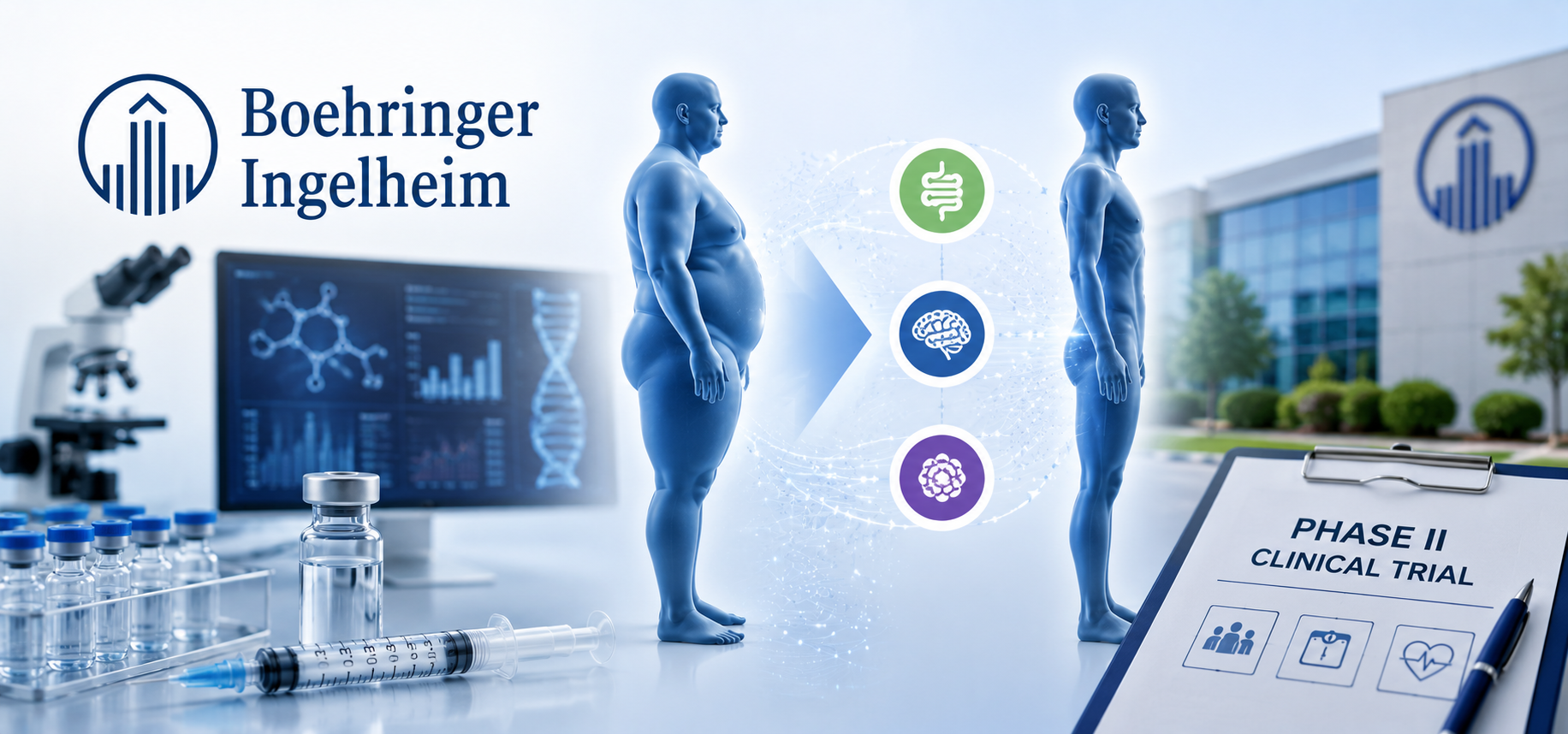
Boehringer Ingelheim Starts Phase II Trial of Triple-Action Obesity Drug BI 3034701
Company Expands Obesity Pipeline with New Investigational Therapy
Boehringer Ingelheim has started a Phase II clinical trial for BI 3034701, an investigational treatment for people living with obesity and overweight. The company says the study marks an important step in expanding its cardiometabolic and obesity pipeline.
The new therapy is designed to target multiple biological pathways involved in body weight regulation. Researchers hope this approach can offer another treatment option for people who need more than traditional weight-loss therapies.
New Drug Uses Three Different Mechanisms
BI 3034701 is a triple receptor agonist that targets three different receptors in the body:
- GLP-1
- GIP
- NPY2
The combination is designed to help control body weight and improve metabolism through multiple mechanisms at the same time.
GLP-1 and GIP are already well known for their role in reducing appetite, supporting weight loss, and improving metabolic health. The third target, NPY2, is believed to influence hunger signals in the brain. Researchers are still studying its full role in eating behavior and long-term weight management.
By combining these three mechanisms into one treatment, Boehringer Ingelheim hopes to provide a more comprehensive approach to obesity care.
Phase II Trial Now Underway
The newly launched Phase II study will evaluate BI 3034701 in adults living with obesity and overweight.
Researchers will study:
- The most effective dose
- Overall safety
- Tolerability
- Clinical effectiveness
The study follows encouraging Phase I results, where the investigational therapy showed a generally favorable safety and tolerability profile. Those findings allowed the program to move into the next stage of clinical development.
Why Obesity Needs Different Treatment Approaches
Obesity affects more than one in eight people around the world and is considered a chronic disease rather than simply a weight problem.
People living with obesity often develop other serious health conditions, including cardiovascular disease, kidney disease, and metabolic disorders. Because every patient experiences obesity differently, doctors increasingly believe that one treatment may not work for everyone.
Different biological pathways contribute to weight gain, appetite, metabolism, and energy balance. This is why companies are developing medicines that work through multiple mechanisms instead of focusing on only one target.
Expert Highlights the Need for More Personalized Care
Dr. Ania Jastreboff, Professor at Yale School of Medicine and Director of the Yale Obesity Research Center, said the obesity treatment landscape continues to evolve.
According to Dr. Jastreboff, obesity is a highly heterogeneous disease, meaning patients often require different therapeutic approaches depending on their individual health conditions and disease progression.
She explained that therapies targeting multiple biological pathways may help healthcare providers better match the right treatment to the right patient at the right time.
Boehringer Ingelheim Focuses on Long-Term Disease Management
Shashank Deshpande, Chairman of the Board of Managing Directors and Head of Human Pharma at Boehringer Ingelheim, said the company's long-term goal is not simply weight reduction.
Instead, the company wants to address the biological and behavioral factors that contribute to obesity while helping prevent the progression of interconnected cardiometabolic diseases.
He noted that future obesity treatment is expected to become increasingly personalized, with therapies selected based on the needs of individual patients.
BI 3034701 Adds to the Company's Growing Obesity Portfolio
BI 3034701 is one of several obesity therapies currently under development at Boehringer Ingelheim.
The company's pipeline also includes survodutide, a dual glucagon and GLP-1 receptor agonist that recently reported Phase III clinical trial results during the American Diabetes Association Scientific Sessions in 2026.
Beyond injectable medicines, Boehringer Ingelheim is also developing additional next-generation obesity therapies, including oral treatment options and several experimental approaches for obesity and liver diseases.
Partnership with Gubra Supports Drug Development
BI 3034701 was originally developed in collaboration with biotechnology company Gubra.
While both companies worked together during early development, Boehringer Ingelheim now holds full responsibility for the drug's continued clinical development and worldwide commercialization.
Obesity Continues to Grow Worldwide
The global burden of obesity continues to increase every year.
According to available estimates, more than one billion people worldwide are currently living with obesity. Earlier data also showed that over 1.9 billion adults were overweight, with more than 650 million classified as obese.
Health experts expect these numbers to continue rising over the coming years, making obesity one of the largest public health challenges worldwide.
Because obesity increases the risk of diabetes, heart disease, kidney disease, and several other chronic conditions, researchers continue to explore new treatment strategies that can deliver better long-term outcomes.
About BI 3034701
BI 3034701 is an investigational triple receptor agonist designed to activate GLP-1, GIP, and NPY2 receptors.
The therapy aims to improve weight management by influencing appetite regulation, metabolism, and central hunger signaling simultaneously.
Following positive Phase I safety findings, the drug has now entered Phase II clinical evaluation to determine its effectiveness and safety in people living with obesity and overweight.
About Boehringer Ingelheim
Boehringer Ingelheim is a global biopharmaceutical company active in both human and animal health.
The company invests heavily in research and development and focuses on creating innovative therapies for diseases with significant unmet medical needs. Its current research spans obesity, cardiometabolic diseases, respiratory disorders, oncology, immunology, and several other therapeutic areas.
Optimize Your trial insights with Clival Database.
Are you exhausted from the uncertainty of trial insights pricing? Clival Database ensures the clarity in the midst of the global scenario for clinical trials to you.Clival Database is one of the best databases that offers an outstanding number of clinical trial data in terms of 50,000+ molecules and from primary regulatory markets as well as new entrants like Indian and Chinese markets.
With Clival, you get accurate positioning of historical sales data, patent database, company profiling, safety & efficacy, and prediction of launch of new innovative molecules helping you to align your research and driving down the cost.
To add value, we further break down our analytics for you so that improving your operational effectiveness; optimizing your clinical trials; and offering you accurate and high-quality data at lowest possible prices becomes possible.
Elevate your trial success rate with the cutting-edge insights from Clival database.
Check it out today and make more informed sourcing decisions! Learn More!