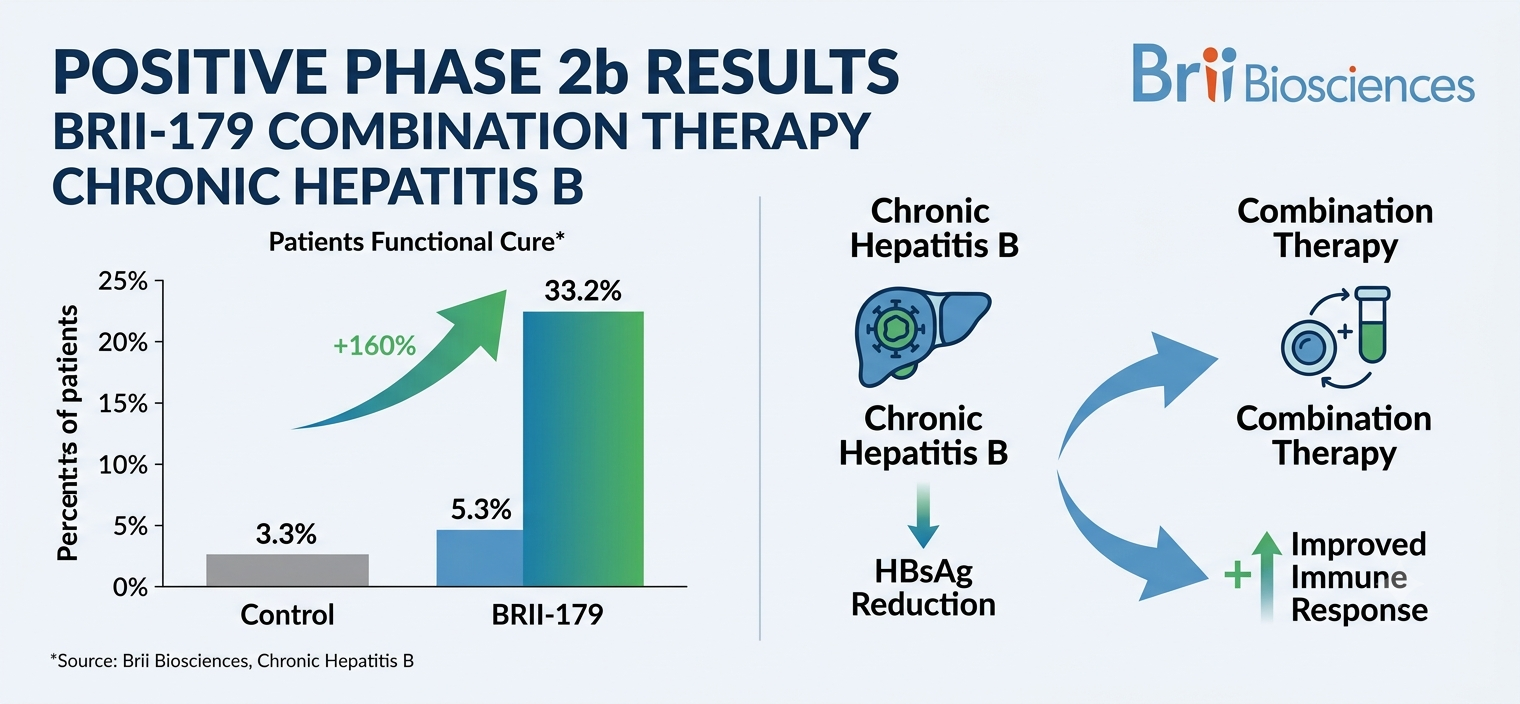
Brii Bio Reports Positive Phase 2b Results for BRII-179 Combination Therapy in Chronic Hepatitis B
End-of-Treatment Data Highlights Strong HBsAg Loss in Sequential Treatment Study
Brii Biosciences Limited has announced new end-of-treatment (EOT) results from its ongoing Phase 2b ENRICH and ENHANCE clinical studies, which are evaluating different combination treatment strategies for people living with chronic hepatitis B virus (HBV) infection.
The results showed that the sequential treatment approach tested in the ENRICH study delivered higher hepatitis B surface antigen (HBsAg) loss rates than the concurrent combination evaluated in the ENHANCE study. These findings provide new insight into how BRII-179 may be used alongside elebsiran and pegylated interferon alfa (PEG-IFNa) in future HBV treatment strategies.
The company also said it has already held discussions with the Center for Drug Evaluation of China's National Medical Products Administration (NMPA) regarding a potential registrational study based on the ENRICH results.
What the ENRICH and ENHANCE Studies Are Evaluating
Both studies are designed to understand the best way to use BRII-179 as part of combination therapy for chronic hepatitis B.
The ENRICH study looks at a sequential treatment approach. Patients first receive BRII-179 before starting treatment with elebsiran and PEG-IFNa. The goal is to determine whether BRII-179 can prepare or "prime" the immune system before antiviral therapy begins.
The ENHANCE study evaluates a concurrent treatment approach, where BRII-179, elebsiran, and PEG-IFNa are given together to see if simultaneous treatment improves functional cure rates.
ENRICH Study Shows Higher HBsAg Loss Rates
The ENRICH study produced encouraging results at the end of treatment.
Patients receiving five doses of BRII-179 every three weeks achieved an HBsAg loss rate of 42.9% (42 out of 98 patients).
Patients receiving seven doses every two weeks achieved an HBsAg loss rate of 40.0% (20 out of 50 patients).
According to Brii Bio, these results closely matched findings from the earlier ENSURE Cohort 4 study, where patients previously treated with BRII-179 achieved an HBsAg loss rate of 41.9%.
The company believes these consistent findings support the idea that BRII-179 may help prepare the immune system before combination treatment begins.
ENHANCE Study Delivers Mixed Results
The concurrent triple combination tested in ENHANCE Part A-1 did not produce higher HBsAg loss rates than previously reported studies.
At the end of treatment, the HBsAg loss rate reached 25.5% (25 out of 98 patients).
Although this result was lower than the ENRICH study, it remained higher than the PEG-IFNa control group, where the HBsAg loss rate was 10.2% (5 out of 49 patients).
Researchers also evaluated another sequential approach in ENHANCE Part A-2.
In this treatment plan, patients received BRII-179 together with elebsiran during the first 24 weeks, followed by elebsiran plus PEG-IFNa for another 24 weeks.
This regimen achieved an HBsAg loss rate of 22.5% (18 out of 80 patients).
Based on these findings, the company believes that completing a full course of PEG-IFNa treatment may be important for achieving better functional cure outcomes.
Subgroup Analysis Offers Additional Insight
Researchers also looked at patients who entered the ENRICH study with higher baseline HBsAg levels between 1,000 and 3,000 IU/mL.
The subgroup analysis suggested that BRII-179 may still generate beneficial immune responses in these more difficult-to-treat patients.
The findings were consistent with observations from the earlier ENSURE Cohort 4 study.
Safety Profile Remains Consistent
Brii Bio reported that no new safety concerns were identified in either Phase 2b study.
The company plans to present more detailed efficacy, safety, subgroup, and follow-up data at a scientific conference later in 2026.
Researchers will also continue monitoring patients after treatment because HBsAg loss needs to remain stable over time before it can be considered a durable functional cure.
Company Prefers the ENRICH Treatment Strategy
Commenting on the results, Chief Medical Officer Dr. David Margolis said the current data suggest that the ENRICH treatment design appears to be the stronger option for a future registrational study.
He noted that longer-term follow-up remains necessary to confirm whether patients continue to maintain HBsAg loss after treatment ends, but the results observed so far are consistent with previous clinical studies.
Arbitration Creates Uncertainty Around Elebsiran Program
Brii Bio also provided an update on the future of its elebsiran program.
The company said an ongoing arbitration with Vir Biotechnology continues to create uncertainty regarding future development.
Because of the unresolved legal situation, Brii Bio said it cannot move forward with a Phase 3 study involving elebsiran-containing combination therapies unless the dispute is resolved.
The company will continue evaluating developments and provide updates as appropriate.
Why Functional Cure Matters in Hepatitis B
Chronic hepatitis B remains one of the world's most serious infectious diseases.
More than 254 million people worldwide are living with chronic HBV infection, and around 820,000 people die every year from HBV-related complications.
China alone has an estimated 87 million people living with chronic hepatitis B.
Current treatments can suppress the virus, but achieving functional cure remains difficult. One of the key goals of new therapies is the loss of hepatitis B surface antigen, which is considered an important marker of long-term disease control.
About BRII-179 and Elebsiran
BRII-179 is an investigational recombinant protein-based immunotherapy designed to stimulate broad immune responses against hepatitis B by targeting multiple HBV surface antigens.
The therapy received Breakthrough Therapy Designation from China's NMPA in 2023.
Elebsiran is an investigational small interfering RNA (siRNA) therapy designed to reduce hepatitis B viral RNA and decrease production of hepatitis B surface antigen.
The drug also received Breakthrough Therapy Designation from China's NMPA in 2024.
Together, the two therapies are being evaluated as part of combination strategies aimed at increasing the chances of achieving functional cure in people living with chronic hepatitis B.
Optimize Your trial insights with Clival Database.
Are you exhausted from the uncertainty of trial insights pricing? Clival Database ensures the clarity in the midst of the global scenario for clinical trials to you.Clival Database is one of the best databases that offers an outstanding number of clinical trial data in terms of 50,000+ molecules and from primary regulatory markets as well as new entrants like Indian and Chinese markets.
With Clival, you get accurate positioning of historical sales data, patent database, company profiling, safety & efficacy, and prediction of launch of new innovative molecules helping you to align your research and driving down the cost.
To add value, we further break down our analytics for you so that improving your operational effectiveness; optimizing your clinical trials; and offering you accurate and high-quality data at lowest possible prices becomes possible.
Elevate your trial success rate with the cutting-edge insights from Clival database.
Check it out today and make more informed sourcing decisions! Learn More!