
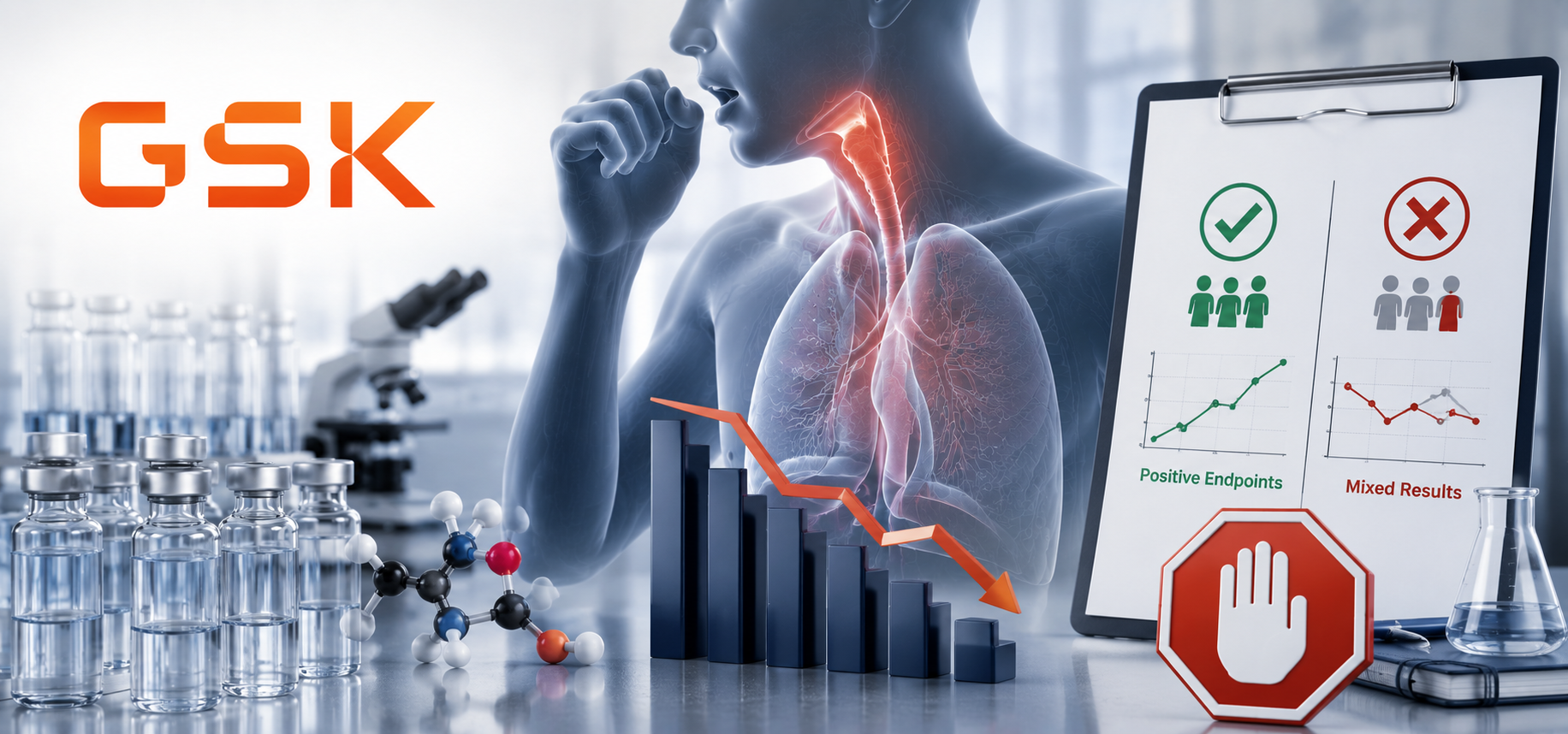
GSK Stops Development of Camlipixant for Refractory Chronic Cough After Mixed Phase III Results
CALM Phase III Programme Delivers Mixed Outcomes
GSK plc has announced that it will discontinue the development of camlipixant for the treatment of refractory chronic cough (RCC) after reviewing results from its Phase III CALM-1 and CALM-2 clinical trials.
The two global studies evaluated the efficacy and safety of camlipixant, an investigational P2X3 receptor antagonist, in adults living with refractory chronic cough, a condition that remains difficult to treat and is often under-recognised.
While one study achieved its primary objective, the overall clinical results were not considered strong enough to support continued development of the therapy for RCC.
CALM-1 Meets Primary Endpoint
The CALM-1 Phase III trial successfully met its primary endpoint.
Patients receiving camlipixant 50 mg twice daily showed a statistically significant reduction in 24-hour cough frequency compared with placebo after 12 weeks of treatment.
This result suggested that the higher dose of camlipixant could reduce coughing in adults with refractory chronic cough.
CALM-2 Fails to Reach Statistical Significance
Unlike CALM-1, the second Phase III study did not achieve its primary endpoint.
In CALM-2, patients treated with camlipixant 50 mg twice daily did not show a statistically significant reduction in 24-hour cough frequency compared with placebo after 24 weeks.
The lower dose of camlipixant, 25 mg taken twice daily, also failed to reach statistical significance in both CALM-1 and CALM-2.
Secondary Endpoints Also Missed
GSK reported that several important secondary endpoints were also not achieved during the clinical programme.
Among them was the Chronic Cough Diary (CCD), which measures how cough affects patients' daily lives.
Neither study reached the predefined target thresholds for these secondary assessments, indicating that the overall clinical benefit was limited.
Safety Profile Remained Consistent
Although the efficacy results were mixed, camlipixant demonstrated a safety profile that was consistent across both studies.
According to GSK, the overall number of treatment-related adverse events and their severity were similar in patients receiving camlipixant and those receiving placebo.
No major differences in safety were observed between the treatment groups.
GSK Decides to End RCC Development Programme
After reviewing the complete data from both Phase III trials, GSK concluded that the level of efficacy demonstrated by camlipixant is unlikely to meaningfully change the current treatment landscape for patients with refractory chronic cough.
As a result, the company has decided not to continue developing camlipixant for this indication.
GSK also stated that the findings from the CALM clinical programme will be submitted for future scientific presentations and publications to support ongoing research into refractory chronic cough.
IBS Clinical Trial Will Continue
While development for refractory chronic cough has ended, GSK confirmed that camlipixant will continue to be studied in another disease area.
The ongoing Phase IIb BALANCE clinical trial is evaluating the safety and effectiveness of camlipixant in adults with irritable bowel syndrome with diarrhoea (IBS-D) and irritable bowel syndrome with mixed bowel habits (IBS-M).
The study remains active as researchers continue to investigate the therapy's potential in gastrointestinal disorders.
About Refractory Chronic Cough
Refractory chronic cough is a persistent cough that continues despite treatment of underlying causes.
The condition can significantly affect quality of life, leading to sleep disturbances, physical discomfort, and social limitations.
Despite ongoing research, treatment options remain limited, creating a continued need for more effective therapies.
About Camlipixant
Camlipixant is an investigational P2X3 receptor antagonist designed to reduce the nerve signals responsible for chronic coughing.
The medicine has not been approved for any indication and remains under clinical investigation for irritable bowel syndrome through GSK's ongoing BALANCE trial.
Optimize Your trial insights with Clival Database.
Are you exhausted from the uncertainty of trial insights pricing? Clival Database ensures the clarity in the midst of the global scenario for clinical trials to you.Clival Database is one of the best databases that offers an outstanding number of clinical trial data in terms of 50,000+ molecules and from primary regulatory markets as well as new entrants like Indian and Chinese markets.
With Clival, you get accurate positioning of historical sales data, patent database, company profiling, safety & efficacy, and prediction of launch of new innovative molecules helping you to align your research and driving down the cost.
To add value, we further break down our analytics for you so that improving your operational effectiveness; optimizing your clinical trials; and offering you accurate and high-quality data at lowest possible prices becomes possible.
Elevate your trial success rate with the cutting-edge insights from Clival database.
Check it out today and make more informed sourcing decisions! Learn More!