
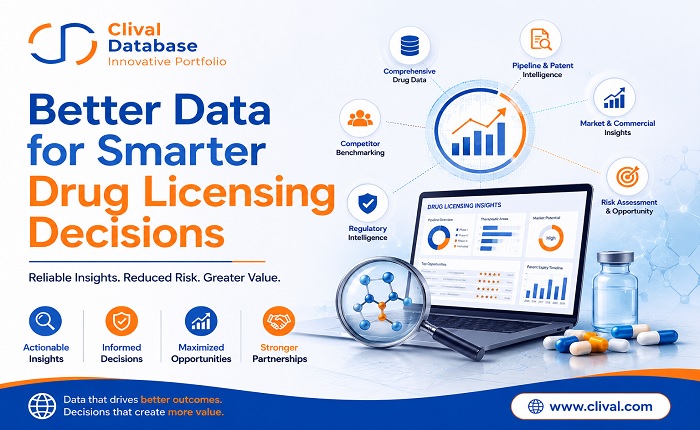
Drug licensing has come to be recognized as among the fastest methods through which pharmaceutical firms can improve their pipeline, enter new therapy areas, and offer new treatments. Rather than developing any products from scratch, organizations may license potentially promising drug candidates with scientific validation or clinical progress.
But it is getting more difficult to find the right opportunity. There are thousands of drug candidates being developed globally and new biotechnology companies bringing new innovative drugs to the market every year. Meanwhile, however, the competition for asset values is growing.
There are no opportunities to be found, only opportunities to be found.
This is why good data is becoming one of the greatest assets in the pharmaceutical licensing process. Businesses that integrate the expertise of clinical trial data, drug pipeline intelligence, competitive landscape, and scientific data can make more informed decisions about opportunities and minimize the uncertainty of licensing.
Drug Licensing Is a More Competitive Than Ever Field of Study
Pharmaceutical companies are on a fast-changing trajectory.
Research expenses keep increasing, expiration of patents places pressure to renew revenue and the demand for new treatments in a number of disease areas keeps rising. Therefore, licensing has become a must for any enterprise, regardless of size.
Innovative assets often are licensed from biotechnology companies to larger pharmaceutical companies to build their development pipeline, and from smaller companies to commercialize and gain access to or entry into global markets.
As a result of this heightened activity, there are many competitive opportunities and more than one organization may seek licensing for the same opportunity.
In such a scenario, time becomes important; however, so does making decisions wisely.
A lot of information helps in identifying opportunities that would not have been known to an organization otherwise.
Why Better Data Leads to Better Licensing Decisions
Licensing is a tremendous monetary and long-term strategic commitment. The wrong asset will lead to years of development time lost and significant costs.
That is why the companies that make it work look at these opportunities through a number of intelligence sources instead of one clinical trial or published study.
Better data can give a deeper understanding of a potential asset by integrating data from:
- Clinical trial activity
- Drug pipeline progress
- Sponsor history
- Biomarker research
- Mechanism of action
- Competitive landscape
- Regulatory developments
- Therapeutic area trends
Together, these insights will support the science and business case of a licensing opportunity.
Rather than asking if a drug candidate is a good looking drug now, an organization can ask if it has a good chance of staying competitive along the path of drug development.
Assessing Opportunities Throughout the Clinical Drug Development Process
Many firms only look at the end-of-the-chain assets as they seem with less risk. Later-stage programs may have more clinical evidence and better competition may mean higher licensing costs, as well as greater competition.
The most successful organizations assess opportunities during the clinical drug development process, starting much earlier in the process.
Early Discovery and Research
The first phase of drug development is the discovery of biological targets, the elucidation of disease mechanisms and the validation of scientific hypotheses.
These programs are more uncertain, but also the most likely to have strategic partnerships.
Businesses who are keeping track of new research can uncover new methods to achieve what they need to do and new therapies that are not yet known to anyone else.
Preclinical Development
Companies start to assess safety, biological activity and feasibility in development as candidates move forward into preclinical research.
Useful quality data is available at this stage, and it also offers good licensing opportunities.
Organizations should make sure to compare similar programs, look at the preclinical data and evaluate if the asset is filled by an unmet medical need.
Early Clinical Development
Phase I and II Clinical Trials are the initial steps to establish the potential for meaningful clinical benefit from a therapy.
This is when licenses are checked for the following:
- Safety profile
- Early efficacy data
- Biomarker strategy
- Patient selection
- Trial design
- Sponsor capabilities
These findings guide investment decisions about whether further investment is warranted.
Late Clinical Development
Phase III studies give higher levels of evidence of effectiveness and regulatory readiness.
For organizations assessing late stage opportunities, other factors to consider include competition in the market, anticipated launch date, reimbursement possibilities, and commercial differentiation.
These assets are typically considered to have lower scientific risk, but they also tend to be higher cost items.
A balanced licensing approach to drug development considers opportunities at all stages of the clinical development process and not just late in the process when drugs are nearing commercialization.
Why API Drug Development is relevant to Licensing Decisions
Understanding the role of the active pharmaceutical ingredient (API) is an important aspect when considering any licensing opportunity.
API drug development plays a critical role in long-term success as the API is responsible for the therapeutic effect of a medicine.
When deciding on whom to license to, companies should consider:
- API stability
- Manufacturing scalability
- Safety profile
- Clinical performance
- Formulation flexibility
- Regulatory considerations
Clinical intelligence (CI) is useful and offers evidence to support these assessments.
The scientific, clinical and manufacturing information should be combined in a single decision-making process, rather than developed and managed as separate entities for API development.
This results in a more realistic picture of the complete capabilities of the asset.
The Role Ai Plays in the Drug Licensing Landscape
AI is revolutionising the approach of pharmaceutical companies to licensing opportunities.Pharmaceutical companies are approaching licensing opportunities with the help of artificial intelligence.
AI is able to analyze huge amounts of information such as scientific literature, patents, and pipeline reports without manual screening, thus saving time for the organization that does not have to screen thousands of clinical trials.
The company can use intelligence powered by AI as follows:
Identify and select promising assets earlier.
Identify new trends in therapy
- Monitor competitor pipelines
- Predict development risks
- Evaluate market opportunities
- Prioritize licensing candidates
While the expertise of humans remains important, AI allows licensing teams to spend less time gathering data manually and more time on strategic analysis.
Decisions made under such circumstances are faster and more effective.
How Clival Database Supports Better Licensing Decisions
To achieve the right opportunity in licensing, more than individual datasets are needed.
Organizations require an integrated intelligence platform that combines data from all points in the pharmaceutical ecosystem.
Clival Database offers all the intelligence you need via:
- Clinical Trial Intelligence
- Drug Pipeline Intelligence
- Sponsor Intelligence
- Biomarker Intelligence
The mechanism of action for this product is "Intelligence".
- Therapeutic Area Intelligence
- Competitive Intelligence
- Investigator & Site Intelligence
Clival Database combines all these intelligence sources to enable pharmaceutical companies, biotechnology companies, CROs, business development teams, investors and consultants to assess the opportunities with more confidence.
Users can no longer have to hunt down data in various disconnected databases—they will have a unified view of pipeline activity, clinical progress, competitor strategies, and therapeutic trends.
This holistic approach facilitates more informed decisions on licence during the drug lifecycle and minimises uncertainty and decision-making.
Conclusion
Pharma licensing is now more competitive, more data focused and more strategic than ever before.
Companies that depend on disjointed data or on-the-go clinical outcomes may miss out on opportunities and overpay for assets that are already successful.
The companies that are able to consistently find good licensing opportunities are the ones that assess programmes throughout the clinical drug development process and consider the scientific evidence, the clinical, competitive and market intelligence.
With the advancements in AI and intelligence systems, access to good data will prove to be one of the greatest advantages for pharmaceutical licensing.