
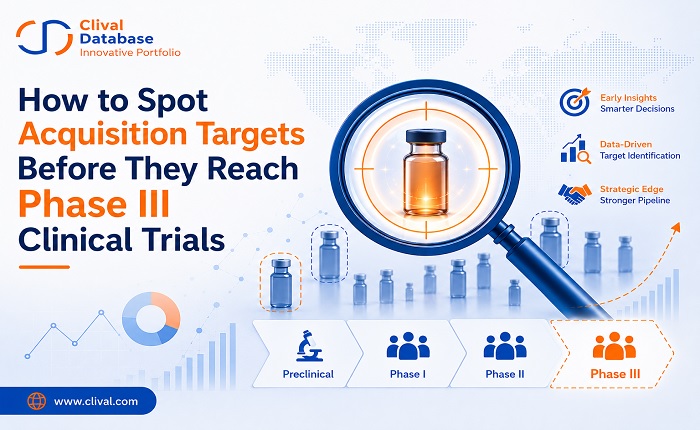
Pharma firms are under constant pressure to build their pipelines and discover next generation of promising therapies. However, picking a good drug to acquire isn't just a matter of waiting until a drug has great Phase III results. At that point, an asset could have already garnered a lot of attention, been competing for attention from others and have a much higher value.
As a result, pharmaceutical companies are searching for ways to look earlier in the drug development process. Companies can be monitored during the preclinical stages and Phase 1 and Phase 2 to help pinpoint potential acquisition targets before they go mainstream.
Early identification does not ensure a drug will be successful. The development of drugs is very unpredictable. Rather, the goal is to select companies with sufficient scientific, clinical and commercial and strategic interest for further study.
Why Pharma Companies Are Looking Earlier
Since there is a need for new drug pipelines for the future, competition for valuable biotech deals will continue to be intense. There has been an increase in the level of M&A deals in biotech in 2026, and target identification has become much more important than ever before.
When an interesting target is identified at Phase I and Phase II, the next step will be the analysis of the scientific background, clinical development, competitive environment, commercial potential, relations with management, and licensing or acquisition potential by the pharmaceutical company.
The goal isn't to buy all the innovative biotechs. Rather, companies must have a systematic approach to pinpointing organisations for closer scrutiny.
What features make a biotech an attractive acquisition target?
No one ultimate criterion makes an attractive biotech an acquisition target. The ideal candidates tend to be those with the scientific differentiation, clinical progress, commercial potential and strategic fit.
These characteristics can be:
- The drug has a unique mechanism of action
- There is early clinical evidence that is positive.
- A large number of patients
- Strong commercial potential
- Competitive advantages
- The pipeline is considered to be in excess of 1 lead asset.
- Technology that can be used for more than one therapy
- Strategic fit with the Buyer's portfolio
Acquisition teams should consider the entire company—its lead drug is not the only thing that matters.
Why Phase II Can Be an Important Acquisition Window
Acquisition screening of Phase II trials may be appealing, especially given that they fall between the smaller clinical trials of Phase I and the much larger and costly Phase III trials.
Companies might have early evidence of effectiveness and considerable development uncertainty at this point. Acquisition teams will review if the drug has shown meaningful efficacy, if the safety profile is acceptable, if there is evidence of the mechanism and if there is a commercially attractive patient population.
They are also able to assess possible benefits over alternative treatments, or if the candidate might be developed for other indications.
The success of Phase II is not an indicator of success in Phase III. Rather, it can offer valuable chance for greater scientific and strategic diligence.
Begin With a Clinical Trial Intelligence System
A potential acquisition target's clinical trial data is one of the most valuable signals that should be assessed.
Acquisition teams would then consider trial design, patient population, endpoints, recruitment status, study locations, trial duration, comparator, dosing strategy, and development timelines, not just on the basis of a company announcement.
Signals can also be obtained from changes in clinical activity. If there's quick movement from one development stage to the next, it could be a sign of momentum; if the company expands to more indications, it could be a sign of more wide-ranging business goals.
On the other hand, repeated delays, recruitment problems, changes in study design, or unforeseen changes in study design might necessitate additional investigation.
The goal is to get a full picture of the situation, not just what's being said one-by-one.
Look Beyond Clinical Results
Performance in the clinic is crucial but doesn't define the whole value of a biotech.
The acquisition team should consider these:
Scientific differentiation: Is a novel/differentiating mechanism used?
Clinical differentiation: Can it provide potential benefits in terms of efficacy/safety/dosing/convenience/patient selection?
If so, how significant is it? Market Opportunity: Does it fill a large enough medical need?
Competitive position: How many similar programmes are in development?
Pipeline depth: has the company got more candidates in the pipeline?
The strategic fit: Does the asset complement the buyer's existing portfolio?
This more comprehensive assessment can identify acquisition opportunities which are not detected in the normal course of business.
Examine the Complete Drug Pipeline
While the company's main asset might receive all the focus, its pipeline may provide some clues to further value.
Drug pipeline intelligence enables teams to compare development stages, therapeutic areas, indications, mechanisms of action, biomarkers, clinical trial activity, pipeline timelines, and depth of pipeline.
A firm with one Phase II asset and some earlier stage programs utilizing the same technology platform could have far greater long-term potential than the lead program alone suggests.
Identify Hidden Value Using Biomarkers
Another level of acquisition insight can be gained through biomarker intelligence. A therapy that treats a relatively limited number of patients can be more useful if a biomarker can be identified which classifies patients most likely to benefit from the therapy.
Different teams can assess whether the disease is being targeted, how to measure the response to treatment, if the selection of patients is becoming more specific, if new indications might be possible with biomarkers, and if there are other lines of treatment targeting the same disease.
These findings can uncover opportunities which may not have been evident in a traditional pipeline review.
Monitor Licensing and Partnership Activity
Strategic signals could include licensing agreements, research collaborating agreements, co-development agreements, regional partnerships, milestone structures, and commercialization agreements.
A partnership doesn't necessarily equate to an acquisition target. But in conjunction with clinical advancement, pipeline depth and market opportunity can help determine which companies warrant further consideration.
Compare Target vs Competitor Pipelines
It's important to have a great strategic fit. Even if a drug proves to be promising, it might not be a suitable pharmaceutical acquisition.
Is it not enough that it should be:
“So is this a good drug?
It is:
“Will this drug fill a pipeline void?”
A comparison of the target's assets and the buyer's portfolio and competing programs can help to identify potential areas of therapeutic coverage enhancement or a new market access by acquisition.
Apply AI to Identify Early Indicators
Pharmaceutical firms are dealing with huge amounts of data in clinical trials, corporate communications, scientific publications, drug pipelines, regulatory action and collaborations.
AI can aid in the discovery of trends such as: accelerating pipeline speed, new target areas, growing trial activity, new MOAs, competitor investments, and partnership activity.
AI, however, should not be a replacement for humans in the screening and decision-making process. It remains to be seen if an opportunity is worth the scientific, clinical, commercial, financial, and legal experts' scrutiny.
Create a Continuous Acquisition Watchlist
Pharma companies don't have to wait for news reports to come up for a potential acquisition, they can proactively keep a target watch list.
There are five areas to evaluate companies:
|
Area |
Key Factors |
|---|---|
|
Clinical |
Trial stage, efficacy, safety, endpoints |
|
Scientific |
Mechanism, biomarkers, differentiation |
|
Pipeline |
Lead asset and additional programs |
|
Commercial |
Market size, competition, unmet need |
|
Strategic |
Fit with existing portfolio |
Through continuous monitoring teams are able to identify significant milestones like positive Phase II data, milestones, new indications, or heavier development activity.
Why Waiting for Phase III May Be Too Late
Phase III offers more developed clinical evidence, and can also be associated with higher level competition and valuation. The target also has negotiating leverage as other pharma companies are looking at the asset, too.
Development risk is not eradicated by early intelligence. Rather, it offers something quite precious: time.
Now's the time to explore the science, evaluate the competition, research the clinical evidence, build connections and decide if the opportunity fits into long-term plans.
How Clival Database Supports Earlier Acquisition Intelligence
The Clival Database has the following forms of Life Science Intelligence incorporated in its system: Clinical Trial Intelligence, Drug Pipeline Intelligence, Sponsor Intelligence, Competitive Intelligence, Biomarker Intelligence, Mechanism of Action Intelligence, Therapeutic Area Intelligence, Market Intelligence and Investigator & Site Intelligence.
Through this combined system, members of the pharmaceutical and biotechnology industry can explore their clinical projects and get information on sponsors, pipelines, biomarkers, mechanisms of action and development activities.
Business Development and/or Corporate Strategy can follow a process of:
Discover → Monitor → Compare → Evaluate → Prioritize
It is useful in the process of teams to find and assess possible acquisition firms before they are known by the wider market.
Conclusion
Successful Phase III results don't always ensure the best acquisition prospects. They could well be the companies with great scientific, clinical, commercial and strategic signals much earlier.
Pharmaceutical companies will be able to develop a more proactive acquisition-screening process by integrating clinical trial intelligence data with drug pipeline data, biomarker data, competitive intelligence, partnership activity, and strategic fit data.
The objective is not to anticipate that a biotech would certainly with certainty prosper. To spot potential opportunities at an early stage to perform due diligence and establish relationships and make informed decisions on licensing or acquisition.