
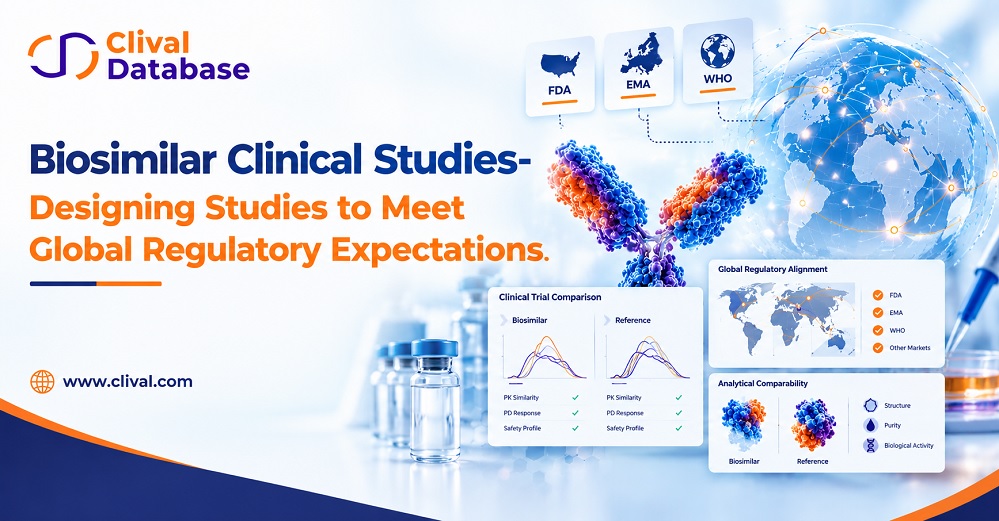
The development of a biosimilar product must be based on a scientific approach, which should establish that the proposed product, having regard to its molecular structure, manufacturing process and intended application, is highly similar to the approved reference product and has no clinically significant differences in terms of safety, purity and potency. Biosimilar drug development, however, differs from novel biologic drug development in that the former is based on lessons learned from past development processes, and the purpose is to demonstrate comparability using analytical, functional and clinical data.
Regulatory demands vary from market to market, and the first thing pharmaceutical companies, biotechnology companies and contract research organizations need to do is plan ahead. This will help developers develop appropriate studies and budget their costs, and prepare appropriate regulatory filings.
Biosimilar Clinical Study Design
Biological products that are highly similar to an approved reference product are called biosimilars. Biologics are produced in living systems, so there may be slight changes in making them. It will be the responsibility of the developers to prove that these differences are not clinically detrimental.
Biosimilar development is a progressive approach, which takes into account all the available evidence, such as:
- Structural similarity and biological activity comparison: the comparison of the structural similarity and biological activity of the molecules.
- Pharmacokinetics (PK): Drug exposure similarity assessment.
- Pharmacodynamics (PD): Assessment of the biological effects with appropriate biological markers available where these can be used.
- Clinical efficacy: If need be, handling any residual uncertainty in relation to similar clinical performance.
- Safety and immunogenicity: Assessment of safety issues and immunogenicity (such as AADAs).
The intention is not to repeat the clinical development program of the originator biologic but to resolve any remaining scientific uncertainties.
Global Regulatory Expectations for Biosimilar Biologics
Despite the fact that the regulatory requirements for biosimilarity of both FDA, EMA and WHO are basically the same, there are differences in the regulatory framework and application process.
1. US Food and Drug Administration (FDA)
Biosimilars are assessed by the FDA under the Biologics Price Competition and Innovation Act. It is evaluated based on analytical, functional, nonclinical and clinical evidence.
Comparative PK studies are useful; PD studies can be helpful if appropriate markers are available. Comparative efficacy and safety studies may be required where there are uncertainties.
Under U.S. law, the FDA also recognizes the difference between biosimilarity and interchangeability. It is important for developers to confirm to the latest FDA guidance on what evidence should include for their particular product.
2. European Medicines Agency (EMA)
For the EMA, the analytical and quality assessments are regulatory milestones to proceed clinical development, following a step-wise comparability process.
Approved in March 2026, the reflection paper on an individualized clinical development pathway for biosimilars highlights that comparative effectiveness trials are not necessarily required in situations where the analysis of similarity and relevant safety data and/or pharmacokinetic data have already been conducted.
In case of any uncertainty, the pharmaceutical companies looking to enter the European market need to take into account the guidelines published by the EMA.
3. World Health Organization (WHO)
The WHO offers guidance for national regulatory authorities to implement or leverage for their national biosimilar guidance.
The updated 2022 guidelines are focused on a step-wise scientific assessment. The level of clinical evidence needed is determined by the analytical and functional evidence, and the uncertainties that still exist.
Businesses that are submitting internationally need to separate general scientific requirements from those specific to their country.
Essential points to take into account in the design of biosimilar clinical trials
1. Choose the Reference Product
The entire development program is influenced by reference product selection. This means that the product selected by the developer will have to be proven to be acceptable by the appropriate regulatory route.
Some important factors are: product availability of references; consistency of studies; formulation characteristics and acceptability of products from different regions.
Early action on these factors can help ensure there is no gap in comparability and no delays in submissions.
2. The Selection of PK and PD Endpoints
Comparative PK studies are used to compare the exposures of the biosimilar and reference product. Parameters used include area under the concentration time curve (AUC) and maximum observed concentration (Cmax).
Research projects can be single dose or multi-dose. If validated biomarkers are available then PD endpoints can increase evidence of similarity.
Endpoints, sampling schedules, statistical methods and acceptance criteria should be clearly specified in protocols.
3. Planning Comparative Efficacy Studies
If a comparative efficacy study is warranted, the study must be carried out in a design that is sensitive to detecting clinically significant differences.
Key considerations include:
- Patient population: The patient population should be chosen to achieve detection of potential differences.
- Primary endpoint: Select a clinically meaningful and scientifically appropriate endpoint.
- Study length: Give adequate follow-up for evaluation of efficacy and safety.
- Selected statistical methods: Set up suitable equivalence margins and analysis methods.
- Sample size: Consider endpoint variability, statistical power and study objectives.
Equivalence trials are frequently used, and the types of trial design are based on the product and regulatory situation. Equivalence margins must be based on scientific reasons rather than just to decrease the sample size.
4. Immunogenicity and Safety Evaluation
Biologicals might have an immune response that will affect the safety and exposure of the drug or its activity. Thus, evaluation of the immunogenicity of the product is necessary during the development of biosimilar.
Anti-drug antibodies, neutralizing antibodies, hypersensitivity reaction, and other adverse effects could be considered in the study. The developers need to choose the appropriate assays, sampling schedule and follow-up period.
The postmarketing pharmacovigilance further contributes to the detection of rare or late emerging safety signals.
Issues with Global Biosimilar Development
There may be variations between companies regarding the number of reference products, the expectations for how the products should be submitted, and the type of clinical evidence required, depending on the multiple markets they are seeking to enter.
|
Challenge |
Recommended approach |
|
Different regional requirements |
Prepare a regulatory requirements matrix |
|
Reference product uncertainty |
Confirm regulatory acceptability early |
|
Insensitive endpoints |
Select scientifically appropriate measures |
|
Immunogenicity concerns |
Plan suitable assays and monitoring |
|
Inadequate sample size |
Use justified statistical assumptions |
|
Changing guidance |
Monitor regulatory updates |
The evidence must be collected since it will help in submitting the application more than once and regional differences must be considered in a global strategy. Discussions with regulation in the early stages can address questions without the need for protocols and budgets to be completed.
What does Clinical Trial intelligence mean for Biosimilar development?
The regulatory aspects of biosimilar development are just one aspect. Companies need to be aware of the activity of competitors, sponsor pipelines, clinical milestones and therapeutic area opportunities.
The activities can be supported by clinical trial intelligence, which allows clinical trial teams to:
- Benchmark competitors: Consider the design, endpoint, patient population targeted, and phase of the competing trials.
- Sponsors: Companies involved in developing biological products in the same therapeutic area.
- Pipeline development: Track progress of biosimilar pipeline development in respective therapeutic areas.
- Therapeutic areas/ biological products: Identify the therapeutic areas and biological products for which biosimilars are being developed.
- Develop partnerships: Develop partnerships/licensing opportunities.
The pharma, biotech, CRO, and competitive intelligence organizations can explore the clinical trial information, sponsors, therapeutic areas, and drug development pipelines through Clival Database. The information may be useful to conduct competitive analysis, but not in lieu of scientific and regulatory evaluation.
Best Practices to reach the market with biosimilars
Companies should:Companies should:
- Prioritize analytical similarity before determining the need for additional clinical studies.
- Adopt a risk-based strategy that addresses product-specific uncertainties.
- Plan global submissions early to identify regional differences.
- Use appropriate biomarkers when validated PD measures can strengthen comparability evidence.
- Integrate safety monitoring and immunogenicity assessment into the development plan.
- Monitor competitor pipelines to understand clinical progress and market opportunities.
- Document scientific decisions supporting study design, endpoints, and statistical assumptions.
Conclusion
There should be an overall design strategy to be considered during the design of clinical trials for biosimilars. This should include the elements of analytical comparability, clinical evidence, safety, and regulation planning. Although the FDA, EMA, and WHO have the same scientific standards, different standards would apply, depending on the product and the issues involved. Regulatory expertise and clinical trials intelligence help companies evaluate their competitors. Clival Database can assist with this process via clinical trial intelligence, sponsor intelligence and pipeline intelligence.