
Safety is an essential aspect of a pharmaceutical's research and development. Pharmaceutical companies need to identify, assess and manage risks to ensure the safety of their patients and regulatory compliance during the first clinical trial dose all the way through to long-term monitoring of an approved medicine.
Pharmacovigilance and clinical safety are two commonly employed terms in the process. While they are related, they have differing scope, responsibilities, timing and the variety of safety activities they address.
It is crucial for pharmaceutical companies, biotechnology companies, contract research organisations (CROs), clinical research professionals and drug development teams to understand the difference between pharmacovigilance and clinical safety. Clarity of responsibility enables organisations to recognise growing safety concerns, and make informed development decisions and to ensure patient safety throughout a medicine's lifecycle.
The main difference between pharmacovigilance and clinical safety, the interaction between them and the importance of both in today's drug development are explained in this guide.
Pharmacovigilance - What Is It?
Pharmacovigilance (PV), the study and practice of monitoring, identifying, evaluating, understanding and prevention of adverse reactions from drugs.
It is mainly employed for monitoring drug safety and identifying risks that have been insufficiently recognized during clinical development.
Selected patient groups are used in clinical trials that are conducted under controlled conditionsHowever, after the increased utilization of the drug by different individuals, there may be a discovery of new information about the safety of the drug due to the difference in age, medical background, interaction of drugs, or mode of utilization. Pharmacovigilance plays an important role in identifying such risks.
Pharmacovigilance: key Responsibilities
- Among the most common responsibilities of pharmacovigilance, there are the following:
- Adverse event reporting: Recording and analyzing adverse events reports.
- Management of Individual Case Safety Reports (ICSR): Generation and submission of pertinent safety reports to the regulatory authorities within stipulated time periods.
- Signal Detection: The ability to detect any pattern which can serve as signals for any current or developing safety issue.
- Benefit-Risk Assessment: Assess whether the clinical benefit of a medicine continues to outweigh the risks associated with it.
- Periodic Safety Reporting: Generate periodic safety reports comprising PBRER and PSUR where applicable.
- Risk Management: Help in managing the identified risk and assessment of efficacy of help provided.
- Post-marketing surveillance: Surveillance of safety data after authorisation for a medicine to be marketed.
In addition, Pharmacovigilance is applicable in the clinical development phase. Does not have to be a medicine that has been approved first.
Clinical Safety Definition
Clinical safety entails the assessment, monitoring, and management of the safety issues of the investigational drugs and subjects under clinical studies.
This is usually done mainly with the intention of ensuring that the patients who will participate in the trials are safe, as well as collecting information on safety which could help decide if the development of the drug should continue.
The responsibilities of the clinical safety team would involve working in collaboration with team members from the clinical operations team, investigators, medical monitors, data management team, regulatory affairs team, and pharmacovigilance team. The specifics of the arrangement would depend upon the sponsor, study, therapy area, and regulations.
Duties of Clinical Safety
Clinical safety tasks:
- Safety monitoring during clinical trials: adverse events, SAEs, laboratory data, vital sign reports, and other relevant safety data.
- Medical review: Reviewing clinical information to gain an understanding of the potential importance of the safety events.
- Relationship between the event and study drug and the severity of the event - This is an assessment of causality and severity. Safety escalation - It involves the identification of clinically significant information that requires further questioning or treatment.
- Protocol and safety evaluation - Determining whether the new safety data would affect the eligibility, monitoring or dosing or continuation of the trial.
- Support of the safety committee in cases when relevant safety information should be provided to the DMC or DSMB.
- Risk reassessment continuously - Assisting in the decision whether the new risk profile is acceptable.
Clinical safety is especially important in early phase trials because there may be less data available on tolerability and toxicity.
Differences Between Pharmacovigilance and Clinical Safety
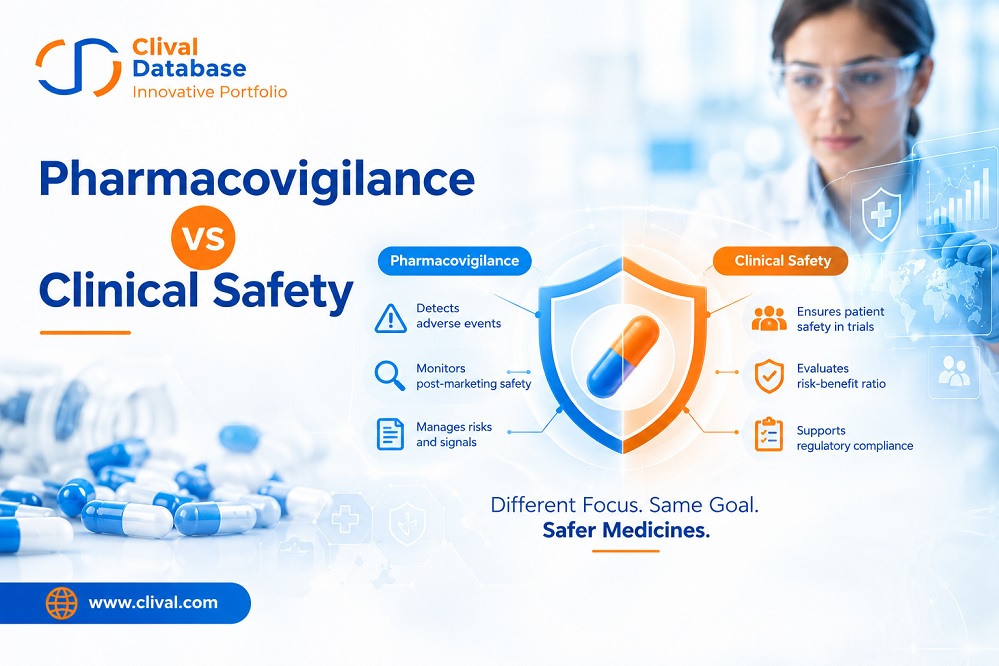
The key difference is that clinical safety is concerned with the evaluation and management of risks that occur during clinical trials, while pharmacovigilance is concerned with the ongoing surveillance of the safety of medicine throughout the drug development cycle and after marketing.
The two functions share a degree of overlap, especially in clinical development and the structure of the two boundaries depends on the company and the safety management process. There is a linkage between pre-approval and post-approval safety reporting as recognised internationally.
|
Comparison factor |
Pharmacovigilance |
Clinical safety |
|
Primary focus |
Identifying, assessing, and preventing medicine-related safety risks across the product lifecycle |
Monitoring and evaluating safety risks in clinical trial participants |
|
Scope |
Clinical development and post-marketing use |
Primarily clinical trials and investigational products |
|
Main objective |
Maintain an evolving understanding of a medicine's safety profile and benefit-risk balance |
Protect participants and support safe, scientifically sound trial decisions |
|
Typical data sources |
Clinical trials, spontaneous reports, literature, post-marketing studies, and other relevant safety sources |
Adverse events, SAEs, laboratory results, medical examinations, and trial-specific safety data |
|
Core activities |
Case processing, signal detection, aggregate reporting, and risk management |
Medical review, trial safety assessment, safety escalation, and support for study-level decisions |
|
Regulatory responsibilities |
Applicable expedited and periodic safety reporting, including post-marketing obligations |
Trial-related safety reporting, protocol compliance, and communication of important safety findings |
|
Key stakeholders |
PV specialists, drug safety physicians, regulatory affairs, epidemiologists, and risk management teams |
Clinical safety physicians, medical monitors, investigators, clinical operations, and PV teams |
|
Long-term contribution |
Supports continued evaluation of medicine safety after approval |
Helps determine whether a clinical development program can proceed safely |
It should be kept in mind that these are general limits instead of being precise onesThe pharmacovigilance team will take care of all safety issues related to clinical trials, whereas the clinical safety team can contribute to more comprehensive benefit and risk assessments. Various roles are assigned based on regulations, product phase, and sponsor’s policies.
What is the link between Pharmacovigilance and Clinical Safety?
Both pharmacovigilance and clinical safety are important components in drug safety management, which is suggested.
Let us take an example of a drug being developed for cancer treatment, undergoing Phase II trials.
1. Safety Information That Comes Out of the Trial
Several participants acquire an unexpected abnormal lab finding that relates to the liver. This will be done by the investigator after assessing the participant concerned as per the protocol.
This will then be considered by the clinical safety team in terms of its clinical significance and whether an investigation is required.
2. Safety Information Is Assessed and Reported
The designated safety function of the sponsor assesses the cases in relation to the relevant definitions and reporting. If information satisfies the requirements to be reported as an expedient safety report, then the team responsible for the report follows the reporting schedule for such reports.
In the United States, for instance, there are some severe and unexpected suspected adverse reactions that are reported in an expedited manner due to applicable investigational new drug (IND) regulations. Not all adverse events are considered to be a failure.
3. Risk Statement Is Issued That Covers the Emerging Risk Throughout the Program
The sponsor reviews to determine if similar results have been observed in other participants, studies, or pertinent sources of safety information.
Pharmacovigilance staff can participate in a wider evaluation of the signal, while clinical safety professionals can comment on the results of their evaluations based on the clinical data of the investigational product, dose, patient population, and trial design.
4. Development Strategy Is Reviewed
The sponsor may decide that additional monitoring, adjustments in participant management, changes in the protocol, dose changes, or any other step can be taken to control the risk on the basis of available data. All steps must conform to the appropriate guidelines.
The importance of proper sharing of time-sensitive data and clear accountability for patient safety and drug development decisions are illustrated here.
When Is Each Function Most Important?
Both roles are very important throughout the drug development process, albeit in different areas with growing evidence.
Phase Ii: First in Man Studies
Safety is a very crucial factor when it comes to tolerance, dosing, and risks. These pharmacovigilance efforts help in the gathering and evaluation of the safety data.
Phase II: Evaluation of Efficacy and Safety
Both functions are used to assess adverse events, to identify possible safety trends or patterns and to decide if there is evidence of continued development.
Phase III: Large-scale clinical trials
For safety evaluation, the number of participant populations, duration of exposure (if applicable), and results from various sites and regions should be considered. Standard reporting and reviewing processes are of particular importance.
Phase IV and Post-Marketing Surveillance
Pharmacovigilance plays an important role when pharmaceutical companies are studying large numbers of patients to detect any safety and risk signals and reassessing the benefits and risks of the drug. Clinical activities needed to ensure safety after the approval of the drug can also be carried out within existing and new studies.
Post-market surveillance is important since adverse events or risks which happen on a high frequency might not be detected before approval.
Drug Developers, Regulatory Requirements: What Do They Know?
Pharmacovigilance and clinical safety share responsibility for regulatory compliance – but regulatory requirements vary by both product and study, jurisdiction and by the nature of the safety information.
Guidelines and frameworks that are international
- ICH E2A: Establishes key clinical safety terminology, and offers guidance for accelerated reporting of clinical safety data during clinical development.
- ICH E2B(R3): Individual Case Safety Reports (ICSRs) – Data elements and electronic transmission.
- ICH E2C(R2): Gives guidance on the framework for Periodic Benefit-Risk Evaluation Reports (PBRERs).
European Medicines Agency (EMA)
- ICH E2F: Addresses the Development Safety Update Report (DSUR), which is given during clinical development to evaluate the safety profile of an investigational drug.
European Medicines Agency (EMA)
- Incorporate FDA safety reporting requirements for drugs and biological products in the United States.
In addition, there are other things to take into account, such as local requirements and differences in reporting timelines, definitions, and submission process when conducting multination trials.
It is essential, therefore, to have SOPs, accountability, escalation process, documentation process, and quality control within an integrated safety management program.
Common Challenges in Managing Clinical Safety and Pharmacovigilance
Even with their significance, safety teams may be challenged with operational issues which can impact on the quality and timeliness of decisions that are made.
1. Fragmented Safety Data
Data can be shared in clinical trial management systems, electronic data capture systems, safety data systems, medical records, and external reporting sources. It is more difficult to form a whole view of emerging risks with disconnected systems.
2. Delayed Identification of Safety Signals
A potential risk can only come to light when information from several participants, studies, or data sources is assessed as a whole. If it takes time to identify the relevant patterns, this can delay the further investigation.
3. Complex Global Reporting Requirements
There are regulatory issues, clinical submission requirements, and other concerns that come with multinational clinical development. The sponsors need systems for compliance in their areas of operation.
4. Lack of Overall Development Picture
Information regarding the mode of action, disease area, competitive development, and clinical studies of the drug under investigation can be quite helpful in putting into perspective the drug’s safety profile.
The information can help the pharmaceutical and competitive intelligence departments to gain some perspective on how any development concerning the drug’s safety may influence its future prospects. Not a substitute for a proper medical/pharmacovigilance assessment.
Why Clinical Trial Intelligence is Helping to Inform Drug Safety Decisions
Clinical trial intelligence will help to make decisions about drug safety based on a comprehensive analysis of the entire landscape of the clinical development process.
When properly organized, clinical trial intelligence will be helpful for:
- Competitive drug monitoring: Monitoring the different stages of drug development and design, sponsors of the drugs, and changes made during the clinical development process.
- Therapeutic areas: Knowing the different therapeutic areas where drugs are developed.
- Comparison and contrast of MOAs: Comparison and contrast of the different drug products in terms of biological target and MOA.
- Monitoring the activities of tracked sponsors: Knowing the different companies developing drugs for a particular indication or therapeutic area.
- Support in licensing and portfolio decisions: Take into account not only the context of clinical development but also other evidence when evaluating partnership and asset opportunities.
Clival Database is a solution that can be used in clinical trial intelligence and life sciences market intelligence use cases including pipeline intelligence, sponsor intelligence, biomarker intelligence, mechanism of action intelligence, therapeutic area intelligence, and competitive intelligence.
The information may become useful for clinical safety and pharmacovigilance specialists. It is meant to be used along with effective safety programs, medical review, and authorities instead of substituting patient level safety data or any mandatory reporting requirements.
Best Practices in Combining Pharmacovigilance and Clinical Safety
The combination of clinical development and post-market surveillance activities carried out by the pharmaceutical industry can be of great use in managing drug safety.
Among some of the best practices that have been identified include:
- Role definition: It is essential to define whose responsibility it will be in relation to case management, medical review, regulatory requirements, and signal detection and reporting.
- Ensure consistency in the process of safety data gathering. The same language, data standard, and processes must be used in order to make the process efficient.
- Make the information available where necessary. Safety data has to be made available to the clinical operations, investigator, medical monitor, pharmacovigilance, and regulatory affairs.
- Implement the Risk Based Monitoring approach. Conduct an analysis of clinically significant risks and evidence in accordance with the protocol of the study.
- Maintain audit-ready documentation. The safety documentation, safety decision, and follow up should be documented.
- Regularly conduct benefit risk assessment. Assess any emerging evidences against the ongoing development of the program and increased exposure to the drug.
The above practices help in the management of safety risks without compromising the clinical, regulatory, and patient safety considerations.
Conclusion
The disparities between pharmacovigilance and clinical safety involve scope and focus. The focus on clinical safety entails the identification and management of risk within the context of a clinical trial, whereas the focus on pharmacovigilance is concerned with the identification and management of risks of drugs.
There are connections between both types of function.
Pharma collaboration will be very helpful in identifying any risks, compliance with any reporting requirements, ensuring safety of the clinical trials participants, and making decisions.
Pharmaceutical companies, CROs, and biotechnology firms will benefit greatly from the possibility of integrating comprehensive safety information and clinical trials/pipeline data in understanding drug development field.
Clival Database offers a vast amount of information for teams of life sciences that they can explore, including information on clinical trials, drug pipelines, sponsors, biomarkers, mechanism of actions and competitive information.