
Introduction
Data is always important for the pharmaceutical industry but by 2026, the amount, complexity and velocity of data is unprecedented. Pharmaceutical enterprises have huge amounts of data that are being generated and used every day, from clinical trials to drug pipelines, biomarkers to competitors, regulatory work to scientific publications, and market developments.
The amount of information that is available has grown massively but many organizations still face the challenge of turning data into actionable intelligence. The most important insights can be found in several databases, spreadsheets, reports and departmental systems. This means that teams waste precious time looking for information rather than making decisions.
As speed, innovation and accuracy are key pillars of success, siloed intelligence is increasingly a disadvantage in the business world. That's why more and more pharmaceutical companies are investing in a unified intelligence platform to centralize data, gain visibility and make better decisions along the drug development lifecycle.
The Growing Challenge of Data Fragmentation in Pharma
In today's pharmaceutical companies, dozens of information sources are used. Trial monitoring teams keep an eye on trial activity, business development teams analyze license possibilities, competitive intelligence teams keep a close watch on the rival pipelines, and market research teams analyze the emerging trends.
Unfortunately, these datasets are typically available separately.
Clinical trial information could be kept in one system, and competitor intelligence in another. Chances are that multiple teams are responsible for market insights, sponsor data, biomarker information, and pipeline analytics and they use different tools to handle each.
This fragmentation poses a few challenges:
- Replicates research within departments.
- Delayed decision-making
- Limited visibility into competitors
- Missed licensing opportunities
- Inconsistent strategic planning
Because of the lack of information, companies have the possibility of making key decisions without having full information about the market.
In fact, with the increasing complexity and competition in the drug development landscape, disconnected intelligence is no longer meeting the demands of today's pharmaceutical companies.
What is a Unified Intelligence Platform?
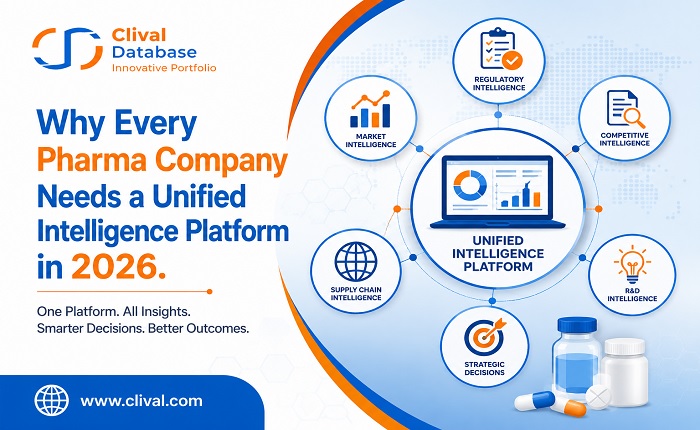
A single intelligence platform integrates across various sources of life sciences intelligence in a single environment.
The platform provides access to relevant information without users having to look for it in different databases and reports, including:
- Clinical trial intelligence
- Drug pipeline intelligence
- Sponsor intelligence
- Biomarker intelligence
- Competitive intelligence
- Therapeutic area intelligence
- Market intelligence
These data flows allow organizations to see the clinical and commercial picture as a whole.
An all-in-one intelligence platform makes it easier for users to detect trends, compare competitors, assess opportunities, and make informed choices.
It essentially provides one source of truth for strategic decision making.
Why Unified Intelligence Is Becoming Essential in 2026
Faster Clinical Development Decisions
The cost and complexity of drug development is increasing more and more. There are numerous decisions that can impact timelines and outcomes from trial design to site selection, patient enrollment to development strategy.
The teams can leverage integrated clinical intelligence to better assess current trials, analyze competitive activity, find seasoned investigators, and track trends in the therapeutic area.
Teams can access extensive intelligence in one place, avoiding days or weeks of collating information from a variety of sources, in order to speed up decision-making.
Better Competitive Intelligence and Benchmarking
The level of competition has also ramped up in almost all therapeutic areas of the pharmaceutical market.
Organizations should have access to:
- Competitor pipelines
- Clinical trial progress
- Development milestones
- Sponsor activities
- Emerging technologies
- Biomarker trends
A single intelligence platform enables companies to track their competitor's activities in real-time and understand their assets in relation to the broader market.
This visibility helps to facilitate strategic planning and also helps companies identify threats and opportunities in their early stages.
Strategies for Smarter Licensing and Business Development
Licensing and Partnership opportunities can arise before products commercialization.
In order to enable their business development teams to have access to detailed intelligence around:
- Early-stage assets
- Clinical progress
- Sponsor capabilities
- Scientific differentiation
- Competitive positioning
Without consolidating this data, it's difficult to identify opportunities that have the greatest potential.
Having all intelligence data in one source enables companies to assess assets, perform quicker due diligence and identify licensing opportunities that fit the company's strategic plan.
Improved Portfolio and Pipeline Planning
Portfolio management involves managing risk, opportunity and resource allocation to several programs.
Companies can put resources into saturated therapeutic areas, and miss on new market opportunities without a complete understanding of the market.
Unified intelligence helps businesses to:
- Identify white-space opportunities
- Evaluate competitive density
- Assess development risks
- Prioritize high-value assets
- Optimize portfolio investments
This results in better pipeline planning and better long-term growth plans.
Improved Cross-Functional Collaboration
The development of drugs is a cross-functional process.
Intelligence is used by research, clinical development, medical affairs, commercial strategy and business development teams in making decisions.
Information stuck in silos, collaboration is hard.
A single platform helps everyone to have access to the same information and data. This helps ensure alignment, eliminates redundant effort and facilitates better decision-making across the organization.
How Data, Technology & Strategy Work Together
Successful integration of data, technology and strategy is the future of pharmaceutical decision making.
Data Creates Visibility
Data is the basis of clinical and commercial understanding.
Activity is revealed by clinical trial data. Pipeline data provides a competitive positioning indicator. Biomarker and MOA information provide scientific insights. Market intelligence is used to recognise market opportunities for business.
If these are not known, it is hard to do the strategic planning.
Technology Creates Intelligence
Technologies help to transform information into insights to act upon.
Using advanced analytics, artificial intelligence, automation, and data integration technology allows organisations to obtain valuable insights, identify trends, and develop intelligence using the use of the enormous amounts of data collected. By being able to use these tools in the way that they are intended and designed, persons will finally be able to concentrate on understanding the insights rather than manually going through millions of records.
Strategy Creates Competitive Advantage
Data and technology by themselves don't generate value.
The competitive advantage is achieved by using intelligence to make strategic decisions in the following ways:
- Pipeline prioritization
- Clinical development planning
- Market expansion
- Licensing opportunities
- Portfolio optimization
Firms that are able to integrate data, technology and strategy are better armed to respond to shifts in market conditions and take advantage of new opportunities.
Key Capabilities Pharma Companies Should Look for in a Unified Intelligence Platform
Not every intelligence platform will be equally useful.
Pharma companies should look for platforms that offer:
Clinical Trial Intelligence
Full visibility of clinical trial activity worldwide by therapeutic area and stage of development.
Pipeline Intelligence
Drug Intelligence on drugs, drug development and competitors' pipelines.
Sponsor Intelligence
Data about pharmaceuticals, biotechnology firms and sponsors of clinical trials.
Biomarker and MOA Intelligence
In-depth scientific information for research and development decisions.
Competitive Intelligence
Continued monitoring of competitor activities and movements.
Market Intelligence
Industry trend, therapeutic areas and commercial opportunities analysis.
These capabilities give a comprehensive understanding of the life sciences ecosystem.
How to convert Intelligence to Strategic Advantage with Clival
Pharmaceutical companies are experiencing greater complexity and therefore the need for integrated intelligence has become a strategic necessity.
Clival integrates clinical trial intelligence, pipeline intelligence, sponsor intelligence, biomarker intelligence, competitive intelligence and market intelligence in a single platform.
This allows a pharmaceutical firm, biotechnology company, CRO, consultant, investor and BD team to have more insight into the drug development landscape across the globe.
Clival assists organizations by consolidating intelligence and turning data into actionable insights:
This will help identify and monitor clinical development activity.
- Benchmark competitors
- Identify licensing opportunities
- Monitor emerging trends
- Support portfolio strategy
- Improve decision-making speed
This leads to a more aware and proactive strategy planning.
Conclusion
In the pharmaceutical industry, we are living in a new time in which there is a wealth of information but a dearth of actionable intelligence.
With the growing complexity of clinical development and the ever-rising competitive pressures, data system fragmentation is not enough. There is a need to integrate clinical, scientific, competitive and market intelligence into a single strategy to bring the discipline of the organisation together.
The companies who will win in 2026 are the ones who are able to convert data into intelligence and intelligence into action.
The unified intelligence platform isn't just a technology upgrade, it's a new paradigm for today's pharmaceutical decision making.