Arrowhead’s Plozasiran Meets Key Goals in Phase 3 Studies for Severe Hypertriglyceridemia
SHASTA-3 and SHASTA-4 show major triglyceride reductions and fewer acute pancreatitis events
Arrowhead Pharmaceuticals has announced positive topline results from two global Phase 3 clinical studies evaluating plozasiran in people with severe hypertriglyceridemia, or sHTG.
The SHASTA-3 and SHASTA-4 studies both met their primary endpoint, showing a statistically significant reduction in triglyceride levels compared with placebo.
The studies also met all prespecified secondary endpoints. One of the most important findings was a statistically significant reduction in acute pancreatitis events among patients treated with plozasiran.
The results could support Arrowhead's plans to expand the use of plozasiran beyond its current approval in familial chylomicronemia syndrome, or FCS.
Plozasiran delivered large reductions in triglyceride levels
In both Phase 3 studies, patients received a 25 mg subcutaneous injection of plozasiran once every three months.
At Month 12, median triglyceride levels fell by 79% in the SHASTA-3 study and by 81% in SHASTA-4.
In comparison, patients receiving placebo experienced a reduction of around 27%.
This difference is important because severe hypertriglyceridemia is defined by triglyceride levels above 500 mg/dL and can significantly increase the risk of acute pancreatitis.
The once-every-three-month dosing schedule could also make the treatment more convenient for patients who need long-term management of very high triglyceride levels.
Acute pancreatitis events were also reduced
High triglyceride levels are closely linked to acute pancreatitis, a painful and potentially life-threatening inflammation of the pancreas.
Some patients with severe hypertriglyceridemia experience repeated attacks that can lead to hospital admissions and serious complications.
Arrowhead conducted a pre-planned pooled analysis of acute pancreatitis events from the SHASTA-3 and SHASTA-4 studies.
The analysis showed a statistically significant reduction in the number of patients experiencing at least one acute pancreatitis event compared with placebo.
The total incidence rate of acute pancreatitis events was also significantly lower in patients receiving plozasiran.
Across the broad sHTG population, which included patients with triglyceride levels above 500 mg/dL with or without a previous history of acute pancreatitis, cumulative acute pancreatitis events were reduced by 78% compared with placebo.
The results were even more notable in a group considered to have a particularly high risk of acute pancreatitis. These patients had triglyceride levels above 880 mg/dL and a previous history of the condition.
In this subgroup, patients treated with plozasiran experienced a 100% reduction in acute pancreatitis events compared with placebo.
Safety results remain encouraging
Arrowhead also reported a favorable safety and tolerability profile for plozasiran in the two Phase 3 studies.
The overall rate of treatment-emergent adverse events and related adverse events was consistent with the safety profile already observed in earlier clinical studies.
The company said there were no new safety signals identified.
Routine laboratory testing also did not show clinically meaningful differences between the treatment and placebo groups.
The company reported no statistically significant differences in mean liver fat content, based on MRI-PDFF testing in a prespecified subgroup.
There were also no clinically meaningful adverse changes in liver enzyme levels.
No cases of hypersensitivity were reported, and the company said there was no thrombocytopenia signal.
A complete analysis of the safety and efficacy data is still underway. More detailed results are expected to be presented at future medical conferences and published.
Why severe hypertriglyceridemia matters
Severe hypertriglyceridemia occurs when triglyceride levels in the blood rise above 500 mg/dL.
The most severe form includes familial chylomicronemia syndrome, where triglyceride levels typically exceed 880 mg/dL.
Triglycerides are carried in the blood by triglyceride-rich lipoproteins. As triglyceride levels increase, the risk of acute pancreatitis also rises.
Patients can experience repeated attacks of pancreatitis, which may require hospital treatment.
High triglyceride levels may also contribute to the risk of atherosclerotic cardiovascular disease.
Despite these risks, treatment options that can consistently bring triglyceride levels below recommended risk thresholds remain limited.
Plozasiran works by targeting APOC3
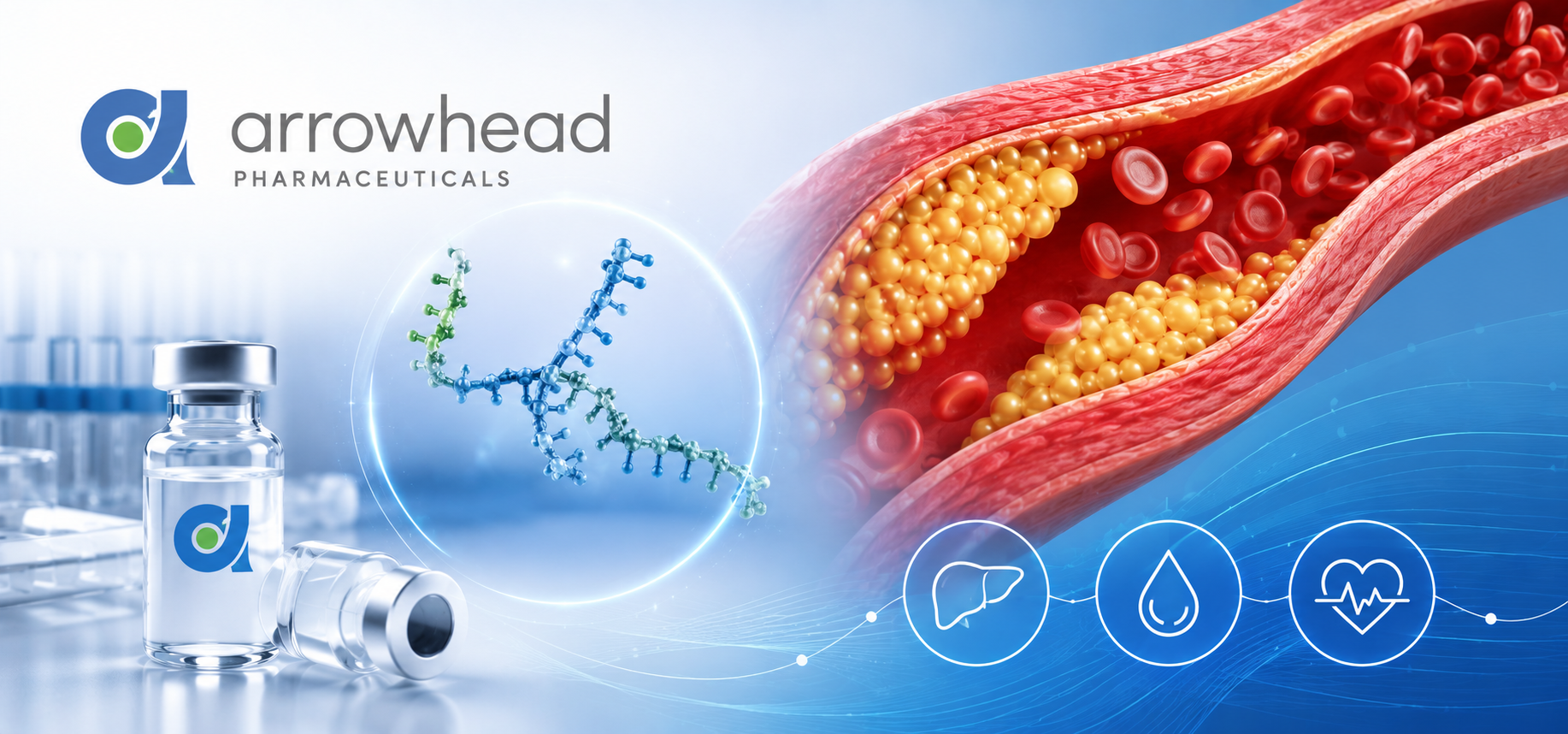
Plozasiran is an RNA interference, or RNAi, therapy designed to reduce the production of apolipoprotein C-III, also known as APOC3.
APOC3 is a protein produced mainly in the liver that can increase triglyceride levels by slowing the breakdown and clearance of triglyceride-rich particles from the blood.
By silencing the gene responsible for APOC3 production, plozasiran is designed to support the body's ability to clear triglycerides.
The treatment is administered through a subcutaneous injection once every three months.
Arrowhead is developing plozasiran using its RNAi technology, which is designed to silence specific genes involved in disease.
Arrowhead plans regulatory submissions
The positive SHASTA-3 and SHASTA-4 results give Arrowhead a path toward seeking regulatory approval for plozasiran in severe hypertriglyceridemia.
The company plans to use data from SHASTA-3, SHASTA-4 and MUIR-3 to support regulatory submissions in multiple countries.
Arrowhead's first planned filing is a supplemental New Drug Application, or sNDA, with the US Food and Drug Administration before the end of 2026.
Additional regulatory submissions are expected to follow in other global markets.
Christopher Anzalone, president and CEO of Arrowhead, said the company is now beginning the process of seeking regulatory approval in multiple regions.
The company believes the data could help expand access to new treatment options for people living with severe hypertriglyceridemia.
Plozasiran is already approved for FCS
Plozasiran is already approved under the brand name Redemplo in several markets for adults with familial chylomicronemia syndrome.
The drug has received approval in the United States, European Union, China, Australia and Canada as an addition to diet for reducing triglyceride levels in adults with FCS.
FCS is the most severe form of severe hypertriglyceridemia.
Redemplo is currently the first and only approved siRNA treatment in these markets that has been studied in both clinically diagnosed and genetically confirmed patients with FCS.
The drug has also received several regulatory designations, including Breakthrough Therapy, Fast Track and Orphan Drug designations from the US FDA for FCS. It has also received Breakthrough Therapy designation for severe hypertriglyceridemia.
The European Medicines Agency has granted Redemplo Orphan Medicinal Product Designation for FCS.
Phase 3 studies included around 750 patients
SHASTA-3 and SHASTA-4 were designed as global, double-blind, placebo-controlled Phase 3 studies.
Together, the trials enrolled approximately 750 adults with severe hypertriglyceridemia.
Patients were randomized to receive either 25 mg of plozasiran or placebo once every three months, for a total of four doses during the first 12 months.
The primary endpoint was the percentage change in fasting serum triglyceride levels from baseline to Month 12 compared with placebo.
Eligible participants can continue treatment through an optional open-label extension after the initial 12-month study period.
Detailed results expected at ESC Congress
Arrowhead plans to present detailed results from SHASTA-3 and SHASTA-4 at the European Society of Cardiology Congress in Munich on August 30, 2026.
The data are scheduled to be presented as a HOT LINE Late Breaker.
The company also plans to hold a conference call and webcast on August 31 to discuss the findings.
These presentations are expected to provide more detailed information about the efficacy, safety and acute pancreatitis results from the two Phase 3 studies.
Arrowhead continues to expand its RNAi pipeline
Arrowhead Pharmaceuticals is developing medicines based on RNA interference technology.
The company's approach is designed to silence genes that contribute to serious diseases.
Its TRiM platform is being used to develop RNAi medicines targeting different tissues, including the liver, lungs, muscles, adipose tissue and central nervous system.
Plozasiran is one of the company's lead commercial-stage programs and has already established a regulatory presence through its approval for FCS.
The new Phase 3 data from SHASTA-3 and SHASTA-4 now give Arrowhead the opportunity to pursue a broader indication for patients with severe hypertriglyceridemia, including those who do not have genetically confirmed familial chylomicronemia syndrome.
Optimize Your trial insights with Clival Database.
Are you exhausted from the uncertainty of trial insights pricing? Clival Database ensures the clarity in the midst of the global scenario for clinical trials to you.Clival Database is one of the best databases that offers an outstanding number of clinical trial data in terms of 50,000+ molecules and from primary regulatory markets as well as new entrants like Indian and Chinese markets.
With Clival, you get accurate positioning of historical sales data, patent database, company profiling, safety & efficacy, and prediction of launch of new innovative molecules helping you to align your research and driving down the cost.
To add value, we further break down our analytics for you so that improving your operational effectiveness; optimizing your clinical trials; and offering you accurate and high-quality data at lowest possible prices becomes possible.
Elevate your trial success rate with the cutting-edge insights from Clival database.
Check it out today and make more informed sourcing decisions! Learn More!