Johnson & Johnson Reports Positive Phase 2/3 Results for IMAAVY in Warm Autoimmune Hemolytic Anemia
ENERGY Study Shows Significant Hemoglobin Improvement in Patients with Rare Blood Disorder
Johnson & Johnson has announced positive results from its Phase 2/3 ENERGY clinical trial evaluating IMAAVY (nipocalimab-aahu) in patients living with warm autoimmune hemolytic anemia (wAIHA), a rare and potentially life-threatening blood disorder.
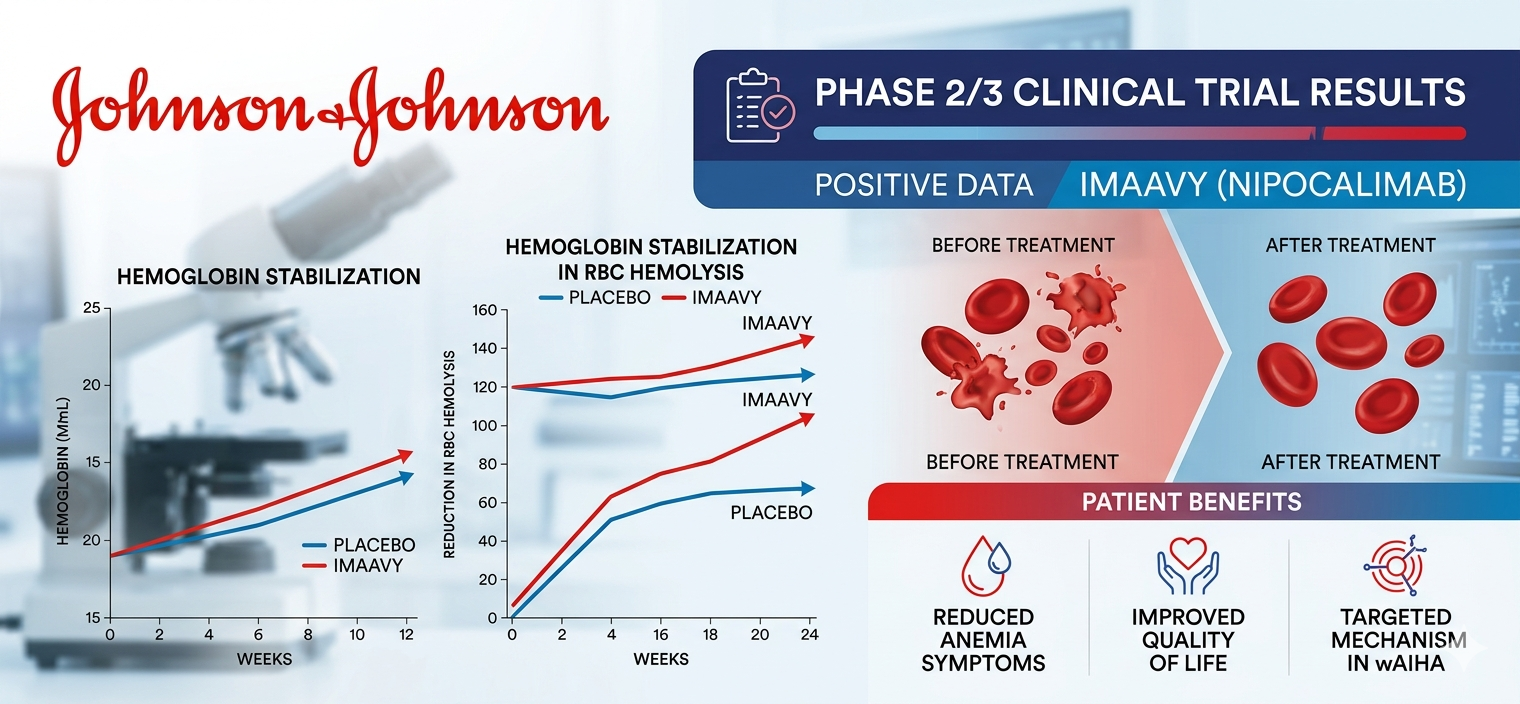
The findings, being presented at the European Hematology Association (EHA) 2026 Congress, showed that patients receiving the 30 mg/kg dose of IMAAVY achieved statistically significant and durable improvements in hemoglobin levels compared with placebo. The study also demonstrated a rapid onset of effect, with patients showing meaningful improvements as early as the first week of treatment.
The results represent an important development for people living with wAIHA, especially since there are currently no FDA-approved treatments available for the condition.
Durable Hemoglobin Response Achieved in the ENERGY Trial
The Phase 2/3 ENERGY study evaluated whether IMAAVY could improve and maintain healthy hemoglobin levels in adults with warm autoimmune hemolytic anemia.
Researchers measured a durable hemoglobin response using strict criteria. Patients were required to achieve at least a 2 g/dL increase from baseline hemoglobin levels, reach a hemoglobin concentration of at least 10 g/dL, maintain those levels for a minimum of 28 days, and avoid rescue therapies or major treatment changes.
According to the study results, approximately three times more patients treated with IMAAVY achieved this durable response compared with those receiving placebo.
Patients receiving the 30 mg/kg dose also experienced a mean hemoglobin increase of at least 1 g/dL by Week 1, while patients in the placebo group showed no meaningful change during the same period.
By Week 24, nearly two-thirds of patients receiving IMAAVY achieved both major treatment goals of maintaining hemoglobin levels above 10 g/dL and increasing hemoglobin by at least 2 g/dL from baseline.
Improvements Seen in Fatigue and Steroid Reduction
Beyond improving anemia, the study also showed positive effects on fatigue, one of the most challenging symptoms experienced by patients with wAIHA.
Researchers observed improvements in patient-reported fatigue scores as early as Week 2. These benefits continued throughout the 24-week treatment period.
The study also showed a reduction in corticosteroid use among patients receiving IMAAVY. Participants who achieved durable hemoglobin responses were able to gradually reduce their steroid doses.
By Week 24, patients treated with IMAAVY experienced an average 15% reduction in corticosteroid use from baseline, compared with a 4% reduction in the placebo group.
Experts Highlight Clinical Importance of the Findings
Dr. Bruno Fattizzo, Assistant Professor at the Department of Oncology and Hematology-Oncology at the University of Milan, noted that the study demonstrated both rapid and durable improvements in anemia.
According to Dr. Fattizzo, achieving meaningful hemoglobin improvements within such a short period can be highly valuable in clinical practice, especially because fatigue remains one of the most debilitating symptoms for people living with warm autoimmune hemolytic anemia.
Johnson & Johnson also emphasized the importance of targeting the underlying disease process rather than simply managing symptoms.
Leonard L. Dragone, M.D., Ph.D., Disease Area Leader for Autoantibody and Rheumatology at Johnson & Johnson, stated that the trial represents the first large placebo-controlled study of its kind in this patient population. He noted that IMAAVY produced durable hemoglobin improvements without introducing new safety concerns.
Safety Profile Remains Consistent
The safety findings from the ENERGY trial were generally consistent with the established safety profile of IMAAVY in its currently approved indication, generalized myasthenia gravis.
The most commonly reported side effects among patients with wAIHA included:
• Peripheral edema
• Diarrhea
• Fever
No unexpected safety signals were reported during the study.
How IMAAVY Works
IMAAVY is designed to target the underlying cause of disease in warm autoimmune hemolytic anemia.
The treatment works by blocking the neonatal Fc receptor (FcRn), which helps reduce the levels of harmful immunoglobulin G (IgG) autoantibodies that attack and destroy red blood cells.
Unlike broader immunosuppressive therapies, IMAAVY uses an immunoselective approach. This means it aims to reduce disease-causing antibodies while preserving important immune system functions.
This mechanism may offer a potential advantage for patients who currently rely on corticosteroids, immunosuppressants, and other off-label treatments.
Understanding Warm Autoimmune Hemolytic Anemia
Warm autoimmune hemolytic anemia is a rare autoimmune disorder in which the body's immune system mistakenly attacks its own red blood cells.
As red blood cells are destroyed faster than they can be replaced, patients develop anemia and related complications.
The condition affects approximately one to three people per 100,000 each year, with about one in every 8,000 individuals currently living with the disease.
Symptoms often include:
• Severe fatigue
• Weakness
• Shortness of breath
• Dizziness
• Reduced quality of life
Patients with wAIHA are also at greater risk for serious complications such as blood clots, infections, and kidney problems.
Despite these challenges, no FDA-approved therapies currently exist specifically for the treatment of wAIHA.
About the ENERGY Study
The ENERGY trial is a global, multicenter, randomized, double-blind, placebo-controlled Phase 2/3 study evaluating the safety and efficacy of nipocalimab in adults with warm autoimmune hemolytic anemia.
A total of 115 patients were randomly assigned to receive one of two dosing schedules of nipocalimab or placebo.
After completing the initial 24-week treatment period, eligible participants could enter a long-term open-label extension study and continue receiving treatment for up to 144 additional weeks.
Regulatory Progress for IMAAVY
The positive ENERGY study results have supported Johnson & Johnson's supplemental Biologics License Application (sBLA) for IMAAVY in warm autoimmune hemolytic anemia.
The application has already received Priority Review designation from the U.S. Food and Drug Administration.
IMAAVY is currently approved for the treatment of generalized myasthenia gravis in adults and pediatric patients aged 12 years and older who test positive for anti-acetylcholine receptor or anti-muscle-specific tyrosine kinase antibodies.
The therapy is also being investigated across multiple autoimmune and rare disease indications, including rheumatologic disorders, maternal-fetal conditions, and other antibody-mediated diseases.
Optimize Your trial insights with Clival Database.
Are you exhausted from the uncertainty of trial insights pricing? Clival Database ensures the clarity in the midst of the global scenario for clinical trials to you.Clival Database is one of the best databases that offers an outstanding number of clinical trial data in terms of 50,000+ molecules and from primary regulatory markets as well as new entrants like Indian and Chinese markets.
With Clival, you get accurate positioning of historical sales data, patent database, company profiling, safety & efficacy, and prediction of launch of new innovative molecules helping you to align your research and driving down the cost.
To add value, we further break down our analytics for you so that improving your operational effectiveness; optimizing your clinical trials; and offering you accurate and high-quality data at lowest possible prices becomes possible.
Elevate your trial success rate with the cutting-edge insights from Clival database.
Check it out today and make more informed sourcing decisions! Learn More!