Novartis Reports Positive FORTITUDE Study Results for Del-Brax in FSHD
Biomarker Data Shows Strong Target Engagement and Reduced Muscle Damage
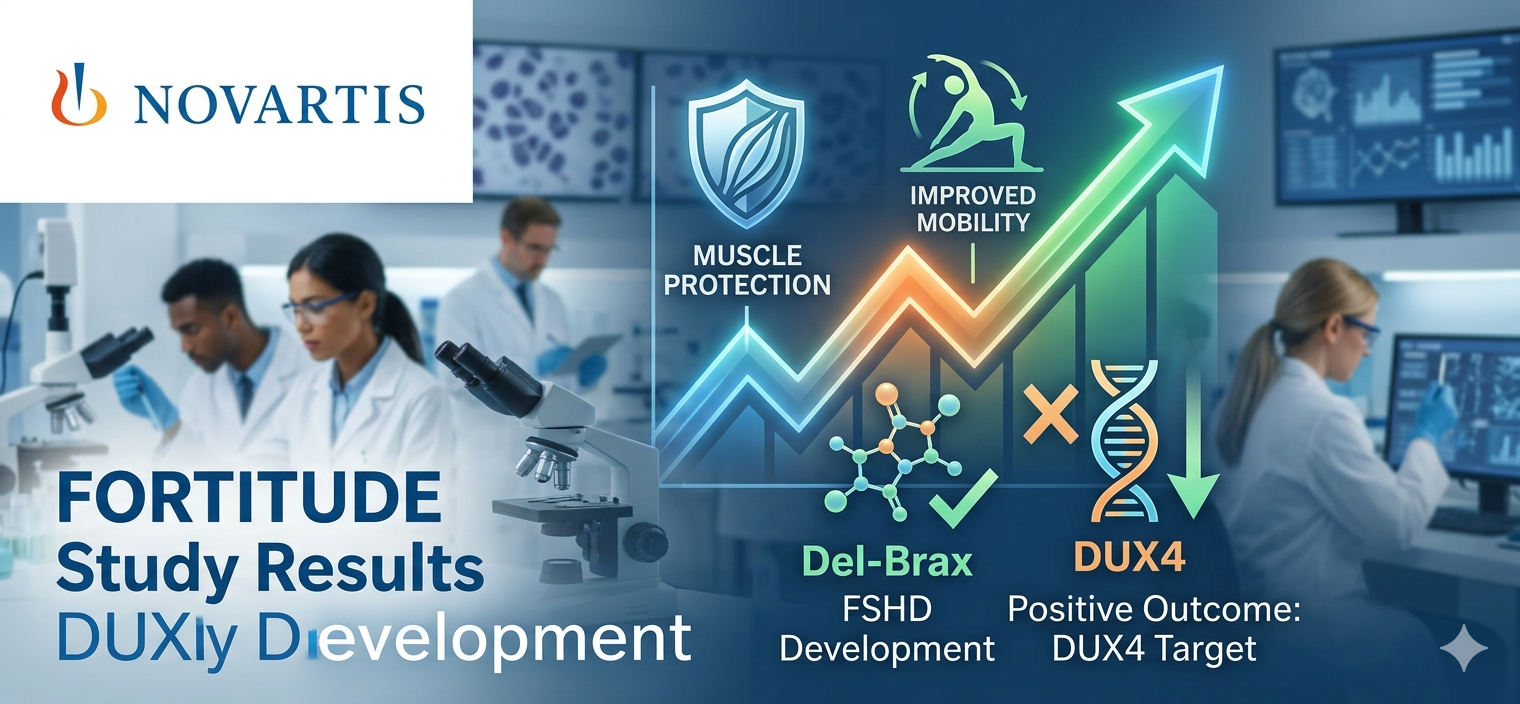
Novartis has announced positive results from the biomarker cohort of its Phase I/II FORTITUDE study evaluating del-brax, an investigational therapy being developed for facioscapulohumeral muscular dystrophy (FSHD).
The study achieved both its primary and key secondary endpoints, showing meaningful reductions in KHDC1L (cDUX) and creatine kinase biomarker levels. These findings indicate strong target engagement and a reduction in muscle damage among patients living with FSHD.
The latest results add to the growing clinical evidence supporting del-brax as a potential disease-modifying treatment for this rare and progressive neuromuscular disorder.
Del-Brax Targets the Root Cause of FSHD
FSHD is a rare genetic disease that causes gradual and irreversible muscle weakness. Over time, patients experience worsening muscle function, reduced mobility, and increasing disability.
Unlike treatments that focus only on symptoms, del-brax is designed to address the underlying cause of the disease. The therapy targets abnormal expression of the DUX4 gene, which plays a central role in driving muscle damage in FSHD patients.
Del-brax uses an antibody oligonucleotide conjugate (AOC) platform, a new class of RNA-based therapeutics. This technology combines the tissue-targeting ability of monoclonal antibodies with the precision of oligonucleotides, allowing the treatment to deliver small interfering RNA (siRNA) directly into muscle cells.
The goal is to suppress DUX4 expression and reduce the ongoing muscle damage associated with the disease.
Results Support Ongoing Phase III Development
According to Novartis, the new biomarker data are consistent with findings observed in earlier dose-escalation studies.
Nazem Atassi, Global Head of Neuroscience and Gene Therapy Development at Novartis, stated that the results confirm both target engagement and downstream muscle protection seen in previous cohorts. He noted that the findings validate the dosing regimen currently being used in the ongoing Phase III study and provide additional evidence that del-brax may offer meaningful benefits for people living with FSHD.
The company is now reviewing the complete set of biomarker and clinical data and plans to engage with global regulatory authorities as development progresses.
Del-Brax Remains the Only Disease-Modifying Candidate in Clinical Development for FSHD
Currently, del-brax is the only investigational therapy that has demonstrated disease-modifying potential for FSHD in clinical studies.
The therapy has already received several important regulatory designations, including:
• U.S. FDA Orphan Drug Designation
• U.S. FDA Fast Track Designation
• European Medicines Agency Orphan Drug Designation
These designations are intended to support the development of treatments for rare diseases that have significant unmet medical needs.
Phase III FORTITUDE-3 Trial Continues Enrollment
Novartis is currently conducting the Phase III FORTITUDE-3 study, a randomized, double-blind, placebo-controlled trial designed to evaluate the efficacy and safety of del-brax in patients with FSHD.
The study plans to enroll approximately 200 patients between 16 and 70 years of age.
Researchers will evaluate several clinical outcomes, including muscle strength, mobility, patient-reported symptoms, and biomarker changes.
The primary endpoint differs by region:
• Quantitative Muscle Testing (QMT) in the United States
• 10-Meter Walk/Run Test (10MWRT) in Europe
Additional secondary endpoints will assess physical function, symptom burden, and overall disease progression.
Del-Brax Joined Novartis Through the Avidity Biosciences Acquisition
Del-brax became part of Novartis' neuroscience portfolio following the company's acquisition of Avidity Biosciences in February 2026.
The acquisition added three late-stage AOC-based neuromuscular programs to Novartis' pipeline.
Alongside del-brax, the portfolio includes:
Del-Desiran for Myotonic Dystrophy Type 1
Delpacibart-etedesiran, also known as del-desiran, is currently in Phase III development for myotonic dystrophy type 1 (DM1).
DM1 is a rare and progressive neuromuscular disease with no approved disease-modifying treatments currently available.
Del-Zota for Duchenne Muscular Dystrophy
Delpacibart-zotadirsen, known as del-zota, is being evaluated in Phase II clinical studies for Duchenne muscular dystrophy (DMD).
DMD is a severe genetic muscle disorder that begins in childhood and leads to progressive muscle degeneration, loss of mobility, and shortened life expectancy.
Building a Broader Neuromuscular Disease Pipeline
The addition of these AOC therapies further expands Novartis' presence in neuromuscular diseases.
Combined with the company's established expertise in spinal muscular atrophy, these programs are helping Novartis build a broader pipeline focused on addressing serious neurological and muscle-related disorders through disease-modifying therapies.
The positive FORTITUDE biomarker data represent another important development as the company continues advancing del-brax through late-stage clinical testing for patients living with FSHD.

Optimize Your trial insights with Clival Database.
Are you exhausted from the uncertainty of trial insights pricing? Clival Database ensures the clarity in the midst of the global scenario for clinical trials to you.Clival Database is one of the best databases that offers an outstanding number of clinical trial data in terms of 50,000+ molecules and from primary regulatory markets as well as new entrants like Indian and Chinese markets.
With Clival, you get accurate positioning of historical sales data, patent database, company profiling, safety & efficacy, and prediction of launch of new innovative molecules helping you to align your research and driving down the cost.
To add value, we further break down our analytics for you so that improving your operational effectiveness; optimizing your clinical trials; and offering you accurate and high-quality data at lowest possible prices becomes possible.
Elevate your trial success rate with the cutting-edge insights from Clival database.
Check it out today and make more informed sourcing decisions! Learn More!