Lundbeck Reports Encouraging Phase II Results for Asedebart in Cushing’s Disease
Lundbeck Shares New Clinical Data at ENDO 2026
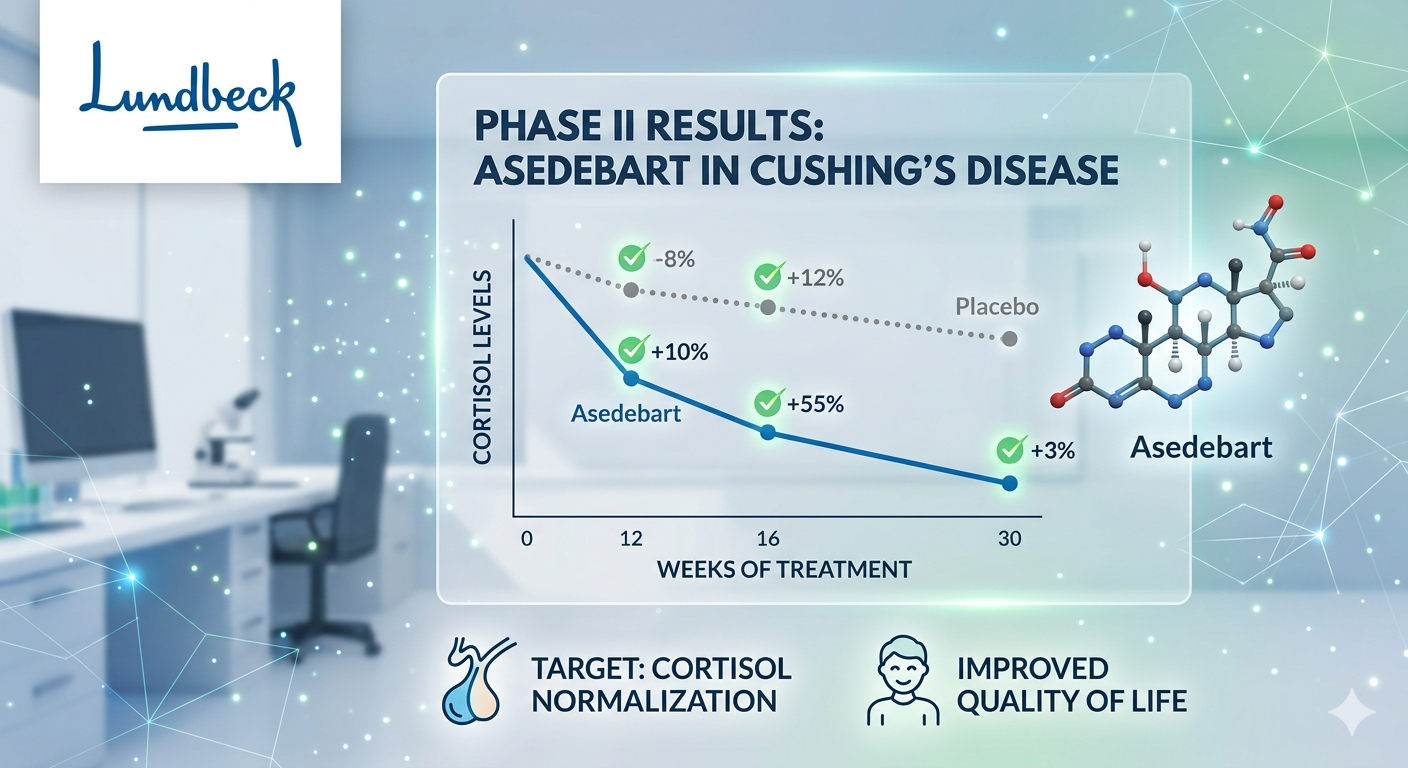
Biopharmaceutical company Lundbeck has announced preliminary results from Part A of its ongoing Phase II clinical study evaluating asedebart, an investigational anti-adrenocorticotropic hormone (ACTH) monoclonal antibody, in adults living with Cushing’s disease (CD).
The findings were presented during an oral presentation at the 2026 Endocrine Society Annual Meeting (ENDO), held from June 13 to June 16 in Chicago, United States.
According to the company, the study showed encouraging results, with most evaluable patients achieving normalization of urinary free cortisol (UFC), a key marker used to measure cortisol levels in patients with Cushing’s disease.
Understanding Cushing’s Disease
Cushing’s disease is a rare endocrine disorder caused by a pituitary tumor, known as a pituitary adenoma, which produces excessive amounts of adrenocorticotropic hormone (ACTH).
This excess ACTH stimulates the adrenal glands to produce too much cortisol. Over time, high cortisol levels can lead to serious health problems, including weight gain, diabetes, high blood pressure, muscle weakness, osteoporosis, and cardiovascular complications.
One of the most important measurements used to monitor disease activity is urinary free cortisol (UFC), which reflects the overall cortisol burden in the body.
How Asedebart Works
Asedebart is designed to directly target and neutralize ACTH, the hormone responsible for driving excessive cortisol production in Cushing’s disease.
By reducing abnormal ACTH activity, the therapy aims to lower cortisol levels and help control the underlying hormonal imbalance that causes the disease.
This approach represents a different treatment strategy compared to currently available therapies, making it a potentially important option for patients if future studies continue to show positive results.
Majority of Patients Achieved UFC Normalization
The ongoing Phase II study is a multi-center, open-label dose-titration trial evaluating both intravenous (IV) and subcutaneous (SC) administration of asedebart in adults with ACTH-driven Cushing’s disease of pituitary origin.
At the time of the data cut-off:
• 12 patients had been enrolled in the study.
• 9 patients entered the intravenous treatment phase.
• 8 patients completed individualized dose titration.
Among the eight evaluable patients, seven achieved normalization of urinary free cortisol levels following treatment with asedebart.
These findings suggest that direct ACTH neutralization may effectively reduce excess cortisol production in a significant proportion of patients.
Lundbeck Highlights Potential of a New Treatment Approach
Johan Luthman, Executive Vice President and Head of Research and Development at Lundbeck, said the findings support the potential of direct ACTH neutralization as a novel treatment strategy for Cushing’s disease.
He noted that major unmet medical needs still exist in the treatment of this rare neuroendocrine condition and described the UFC normalization results as highly encouraging for the future development of asedebart.
Lundbeck also confirmed that the next stage of development will include evaluation of a subcutaneous formulation of the therapy.
Safety and Tolerability Findings
According to the preliminary analysis, asedebart was generally well tolerated during the study.
Researchers reported no unexpected adverse events and no new safety concerns.
Treatment-emergent adverse events were reported in all 12 enrolled patients, which is common in clinical trials involving investigational therapies.
Serious adverse events occurred in three patients. One death was reported during the study; however, investigators determined that it was unrelated to treatment with asedebart.
No hypersensitivity reactions were observed.
Two patients experienced glucocorticoid deficiency events during treatment. These cases were managed successfully with short-term hydrocortisone therapy.
Part B Study to Evaluate Subcutaneous Administration
The study is continuing with Part B, which will focus on subcutaneous administration of asedebart.
Researchers aim to further assess several important factors, including:
• Cortisol reduction
• Safety and tolerability
• Pharmacokinetics
• Patient experience with subcutaneous dosing
The subcutaneous formulation could potentially offer a more convenient treatment option compared with intravenous administration if future results remain positive.
Expanding Beyond Traditional Neuroscience Research
Lundbeck stated that the asedebart program reflects the company’s broader strategy of expanding beyond its traditional neuroscience focus into neurohormonal signaling and rare endocrine disorders.
The company believes that targeting biological pathways involved in hormone regulation may create opportunities to develop differentiated therapies for patients with rare diseases that currently have limited treatment options.
The development program is supported by biomarker-driven clinical studies, allowing researchers to evaluate treatment responses early and make informed development decisions.
Asedebart Remains an Investigational Therapy
Asedebart is currently an investigational medicine and has not been approved by any regulatory authority worldwide.
Its safety and effectiveness have not yet been fully established, and additional clinical studies will be required before the therapy can be considered for regulatory approval and potential commercialization.
The ongoing Phase II study will continue to generate data on the therapy’s clinical profile as researchers further evaluate its potential role in treating Cushing’s disease.
Optimize Your trial insights with Clival Database.
Are you exhausted from the uncertainty of trial insights pricing? Clival Database ensures the clarity in the midst of the global scenario for clinical trials to you.Clival Database is one of the best databases that offers an outstanding number of clinical trial data in terms of 50,000+ molecules and from primary regulatory markets as well as new entrants like Indian and Chinese markets.
With Clival, you get accurate positioning of historical sales data, patent database, company profiling, safety & efficacy, and prediction of launch of new innovative molecules helping you to align your research and driving down the cost.
To add value, we further break down our analytics for you so that improving your operational effectiveness; optimizing your clinical trials; and offering you accurate and high-quality data at lowest possible prices becomes possible.
Elevate your trial success rate with the cutting-edge insights from Clival database.
Check it out today and make more informed sourcing decisions! Learn More!