
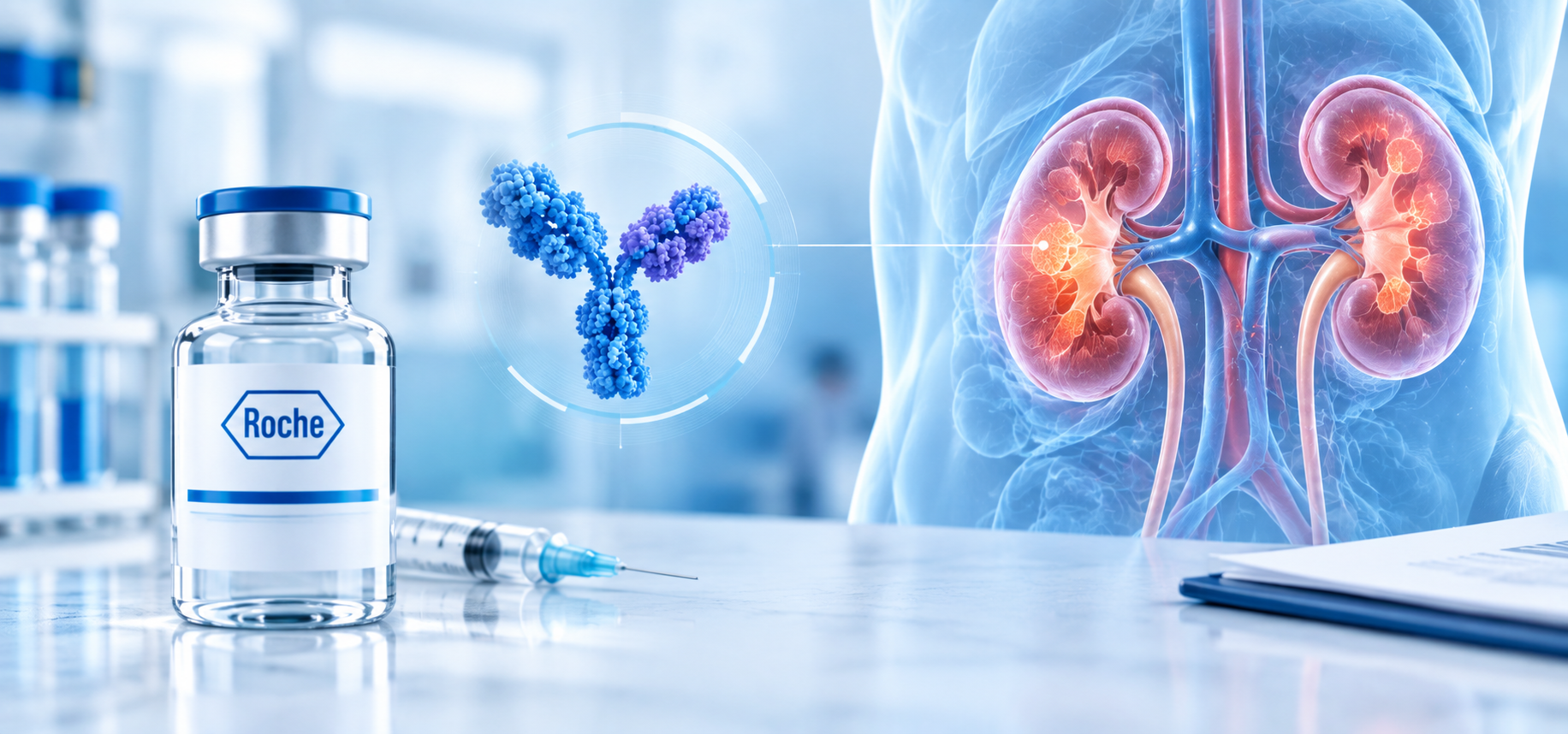
Roche’s Sefaxersen Meets Phase III IMAgINATION Goal in IgA Nephropathy
Study Shows Significant Reduction in Proteinuria at Week 37
Roche has reported positive prespecified interim results from the ongoing Phase III IMAgINATION study of investigational sefaxersen in adults with primary IgA nephropathy, also known as IgAN or Berger’s disease.
The study met its primary endpoint.
Patients treated with sefaxersen showed a statistically significant and clinically meaningful reduction in proteinuria compared with placebo at Week 37.
The reduction was measured using the 24-hour urine protein-to-creatinine ratio, or UPCR.
Protein in the urine is an important sign of kidney damage. A reduction in proteinuria is also strongly associated with better long-term preservation of kidney function.
What Is IgA Nephropathy?
IgA nephropathy is a chronic autoimmune disease that affects the kidneys.
In simple terms, the immune system produces abnormal immune complexes that can become deposited in the kidneys.
These deposits can activate part of the immune system called the complement system.
This can cause inflammation and damage to the kidney's filtering structures.
The disease is also known as Berger’s disease.
IgA nephropathy is the most common form of primary glomerulonephritis, a group of diseases that cause inflammation in the tiny filtering structures of the kidneys.
IgA Nephropathy Can Progress to Kidney Failure
IgA nephropathy can progress slowly over many years.
However, it can become serious in some patients.
Roche estimates that up to 50% of people with IgAN can develop end-stage kidney disease within 20 years of diagnosis.
The disease is typically diagnosed before the age of 40.
It affects at least 25 adults per million people worldwide each year.
As kidney function declines, patients may eventually need dialysis or a kidney transplant.
Proteinuria Is an Important Sign of Kidney Damage
One of the key things doctors monitor in people with IgA nephropathy is the amount of protein in the urine.
Healthy kidneys normally prevent large amounts of protein from passing into urine.
When the kidneys become damaged, more protein can leak through the kidney filters.
This is called proteinuria.
The amount of protein in the urine can therefore provide information about how much kidney damage is occurring.
In clinical studies, researchers often measure proteinuria to determine whether a treatment is helping protect the kidneys.
Sefaxersen Reduced Proteinuria in the Phase III Study
The IMAgINATION study met its primary endpoint by showing a significant reduction in proteinuria with sefaxersen compared with placebo at Week 37.
The measurement used was the 24-hour urine protein-to-creatinine ratio.
UPCR compares the amount of protein in urine with the amount of creatinine, another substance found in urine.
This helps researchers measure protein loss without relying only on the total volume of urine produced.
Roche described the reduction in proteinuria as both statistically significant and clinically meaningful.
The company has not yet released the full numerical results from the interim analysis.
Why the Week 37 Result Matters
Proteinuria is not simply a laboratory number.
Higher levels of protein in the urine are associated with a greater risk of kidney function decline in IgA nephropathy.
Reducing proteinuria is therefore an important goal when treating the disease.
The IMAgINATION study is also designed to go beyond this early measurement.
Researchers will continue following participants to determine whether the treatment can help preserve kidney function over a longer period.
Sefaxersen Is Designed to Target the Complement System
Sefaxersen is an investigational antisense oligonucleotide designed to target complement factor B.
It works in the liver and is designed to reduce the production of factor B.
Factor B is part of the alternative complement pathway.
This pathway is one of the mechanisms involved in the development of IgA nephropathy.
In people with IgAN, immune complexes can activate the alternative complement pathway.
This can contribute to inflammation and damage inside the kidneys.
By reducing factor B production, sefaxersen is designed to reduce activity in this pathway.
How Sefaxersen Works
Sefaxersen is a liver-directed antisense oligonucleotide.
Antisense medicines are designed to bind to specific messenger RNA molecules.
Messenger RNA carries instructions that cells use to make proteins.
Sefaxersen is designed to target the messenger RNA responsible for producing complement factor B.
By reducing this message, the treatment is designed to lower the amount of factor B produced by the liver.
This could reduce activity in the alternative complement pathway and potentially reduce downstream kidney damage.
Sefaxersen Is Designed for Once-Monthly Dosing
Another feature of sefaxersen is its dosing schedule.
The treatment is being developed as a once-monthly injection given under the skin, also known as a subcutaneous injection.
Roche also designed the treatment to potentially allow self-administration.
This could give patients a more convenient way to receive treatment compared with therapies that require more frequent administration or visits to a healthcare facility.
Whether this approach will be suitable for patients in routine care will depend on future regulatory decisions and prescribing requirements.
Phase I and II Studies Supported Further Development
Before moving into the Phase III IMAgINATION study, sefaxersen was evaluated in Phase I and Phase II clinical studies.
According to Roche, the treatment was generally well tolerated in healthy volunteers and in people with IgA nephropathy who were considered at high risk of disease progression.
Earlier studies also showed reductions in proteinuria and plasma complement factor B.
These findings provided the basis for further evaluation in the larger Phase III program.
The IMAgINATION Study Includes 459 Patients
IMAgINATION, registered as NCT05797610, is a Phase III multicentre, randomized, double-blind, placebo-controlled study.
The trial enrolled 459 people with primary IgA nephropathy who were considered at high risk of disease progression.
Participants were randomized in a 1:1 ratio to receive either sefaxersen or placebo.
Treatment is planned for 105 weeks.
The primary endpoint is the change from baseline in urine protein-to-creatinine ratio at Week 37.
The study will also evaluate kidney function over a longer period.
Researchers Will Continue to Measure Kidney Function
The IMAgINATION study will continue as a blinded study after the interim analysis.
Researchers will evaluate changes in estimated glomerular filtration rate, or eGFR, at Week 105.
eGFR is an estimate of how well the kidneys are filtering waste from the blood.
A decline in eGFR can indicate that kidney function is getting worse.
By following patients for two years, the study is designed to provide more information about whether the reduction in proteinuria seen with sefaxersen is accompanied by preservation of kidney function.
No New Safety Signals Were Reported
Roche said the safety and tolerability profile of sefaxersen remained consistent with previously reported data.
No new safety signals were identified in the interim analysis.
More detailed safety information is expected to be presented when the complete study data are shared at a future medical congress.
The company also plans to share the interim findings with health authorities.
Roche Says the Treatment Could Help Slow Disease Progression
Levi Garraway, M.D., Ph.D., Roche's chief medical officer and head of global product development, said the Phase III results show the potential of sefaxersen to affect an important measure of kidney damage.
He said the treatment could potentially provide a new option for people with IgA nephropathy and help slow disease progression.
However, the long-term effect on kidney function is still being studied in the ongoing trial.
Patient Advocacy Groups Welcome the Results
Bonnie Schneider, director and co-founder of the IgA Nephropathy Foundation, said patients and families often face significant uncertainty because of the risk of kidney failure, dialysis and transplantation.
She said the positive IMAgINATION results provide hope that new treatments could help preserve kidney function.
Detailed data from the study will provide more information about the extent and durability of the treatment effect.
Current IgA Nephropathy Treatment Still Has Limitations
Current treatment approaches for IgAN often focus on reducing proteinuria, controlling blood pressure and slowing the decline in kidney function.
These approaches can help manage the disease, but they do not eliminate the underlying autoimmune process.
The updated KDIGO 2025 guidelines highlight the need to address both the immune-related causes of IgA nephropathy and the kidney damage that develops as a result.
New treatment options have expanded the choices available to patients, but there is still a need for therapies that can provide stronger and longer-term kidney protection.
Sefaxersen Was Licensed From Ionis
Roche licensed sefaxersen from Ionis Pharmaceuticals for the treatment of complement-mediated diseases.
The drug is being developed as a targeted approach to complement activation.
Roche is studying the medicine specifically in IgA nephropathy through the IMAgINATION program.
What Happens Next for Sefaxersen?
The IMAgINATION study will continue while researchers collect longer-term kidney function data.
The study is expected to measure the change in eGFR at Week 105.
Roche plans to present the interim results at an upcoming medical congress and share the findings with health authorities.
The company will use the additional clinical data to support discussions about the potential future development and availability of sefaxersen for people with IgA nephropathy.
About Roche
Roche is a healthcare company that develops medicines, diagnostic technologies and digital health solutions.
The company works across areas including oncology, neurological diseases, autoimmune conditions, blood disorders and kidney diseases.
Roche has been researching the immune system for more than two decades and is developing treatments aimed at chronic immune-related diseases, including autoimmune kidney disorders.
Its development pipeline includes programs targeting different biological pathways involved in chronic and complex diseases.
Optimize Your trial insights with Clival Database.
Are you exhausted from the uncertainty of trial insights pricing? Clival Database ensures the clarity in the midst of the global scenario for clinical trials to you.Clival Database is one of the best databases that offers an outstanding number of clinical trial data in terms of 50,000+ molecules and from primary regulatory markets as well as new entrants like Indian and Chinese markets.
With Clival, you get accurate positioning of historical sales data, patent database, company profiling, safety & efficacy, and prediction of launch of new innovative molecules helping you to align your research and driving down the cost.
To add value, we further break down our analytics for you so that improving your operational effectiveness; optimizing your clinical trials; and offering you accurate and high-quality data at lowest possible prices becomes possible.
Elevate your trial success rate with the cutting-edge insights from Clival database.
Check it out today and make more informed sourcing decisions! Learn More!