
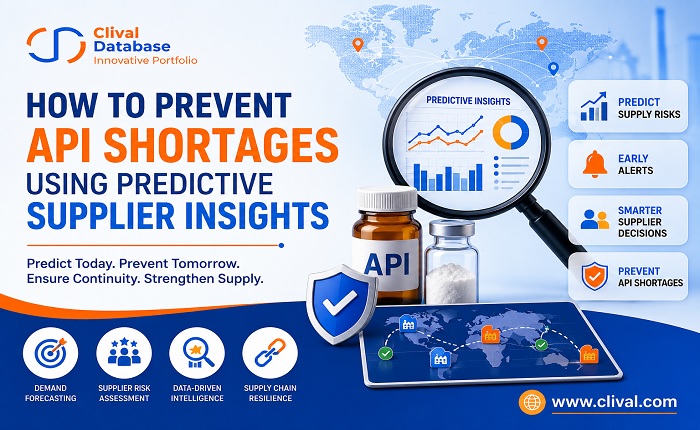
The pharmaceutical industry faces a complex landscape in which supply chain dynamics are becoming a more critical challenge to the drug development process, clinical trial implementation and commercialization. One of the biggest problems that pharmaceutical and biotechnology firms are facing now is the shortage of Active Pharmaceutical Ingredients (API).
APIs form the backbone of all drug products. The lack of a dependable source for APIs could result in delays for clinical development projects, delayed timetables for trials, and setbacks in terms of commercialization. Drug pipelines are becoming increasingly complicated and the source network for the globe increasingly dependent on each other.
Rather, visionary pharmaceutical firms are turning to predictive supplier intelligence to preemptively be alerted to possible supply issues before they turn into shortages. With the integration of supplier information, clinical intelligence, and pipeline prediction, companies can construct more robust plans for development and manufacturing.
Global Shortage of APIs Is an Increasing Problem in Clinical Development
The last ten years have seen the pharmaceutical supply chain undergo substantial change. There are now many companies that depend on a worldwide system of API manufacturers, contract development and manufacturing organizations (CDMOs), and raw material suppliers.
Globalization has been a boon to efficiency and cost reduction but also added new vulnerabilities. The availability of critical APIs can be impacted by a disruption at any single manufacturing site, regulatory compliance problem, transportation challenge, or geopolitical event.
A disruption in supply for API clinical research organizations can have a ripple effect for a long time. Delays in obtaining APIs can impact formulation development, toxicology studies, clinical trial manufacturing, and patient enrollment timelines.
Likewise, the clinical trial material is a strategic issue for the availability of API. Materials for clinical trials need to be produced within precise timelines and compliance with the regulatory standards. An API disruption can impact the continuity of trials and also enhance development expenses.
Specialty APIs are becoming in higher demand as pharmaceutical pipelines grow in Oncology, Rare Diseases, Immunology and other high growth therapeutic areas. This is even more critical in the context of proactive monitoring of the supply chain.
The Implications of API Shortages on Clinical Trials and Drug Development
API shortages bring more problems than just procurement. They impact almost all phases of the drug development journey.
Delays in Clinical Development Programs Are a Challenge
Once API supply limits are reached, development teams sometimes have trouble keeping timelines. Production delays for clinical batches can cause delays in important milestones and affect development strategies.
Clinical Trial Material Shortages
Investigational Products are needed for clinical trials. Disruptions to the availability of API may impact manufacturing due to disruption of manufacturing schedules and delay of trial materials to research sites.
These risks can affect sponsors with global trials, and can include delayed patient recruitment, change in study protocols, and increased operational costs.
Regulatory and Commercial Risks
Disruptions in supplies can also impact commercial launch planning and regulatory submissions. Firms could find their production targets are difficult to achieve and their supplies to regulatory bodies may be questioned.
These risks can be worth the investment of organizations heavily invested in drug development, but can also be a loss of market opportunities and return on investment.
Predictive Supplier Insights: What are They?
Predictive supplier insights are the ability to leverage data, analytics and intelligence to anticipate and proactively address supplier risk that could affect business operations.
Organizations can keep track of various indicators that can warn about potential supply disruptions, instead of waiting for a shortage.
These signs can be:
- Supplier manufacturing capacity
- Determine and document the quality and compliance performance.
- Regulatory inspection outcomes
- Financial stability
- Geographic risk exposure
- Production trends
- Demand forecasts
- Industry-wide supply constraints
The objective is to develop early warning systems that will enable the organisations to take preventive measures prior to shortages to development programmes.
Predictive supplier intelligence is particularly useful in the pharmaceutical sector to equip procurement, supply chain, R&D and business development teams with better information about API sourcing and risk management.
The Key Supplier Intelligence Signals That Will Prevent the Shortage of APIs
Organisations need to monitor several risk indicators at once to effectively monitor their suppliers.
Manufacturing and Quality Performance
One of the most frequent reasons for API shortages is manufacturing problems. Quality issues, observations by regulators and production flaws can effectively affect supply levels.
Supplier Quality Management ensures that an organisation can track the quality performances of its suppliers and can find out the risks in advance, to avoid production interruption.
Supplier Capacity Constraints
When there is a high demand for certain APIs, the amount of production will be limited.
The organisations that monitor the activities of their suppliers in terms of expansion, facility utilisation, and production trends, stand to have an edge in predicting shortages and negotiating supply contracts.
Geographic Concentration Risk
There are many APIs that are produced in few geographic areas of the world. An increasing risk of regional disruptions results from multiple companies relying on suppliers within the same geographical area.
These challenges can be mitigated through diversification of sourcing methods and also considering geographic risk indicators.
Financial Stability of Suppliers
Financial difficulties may impact the supplier's capacity to run its operations, to expand its capacity, or to fulfill contractual requirements.
Financial results and business security should be an integral part of any program for supplier intelligence.
Pipeline-Driven Demand Forecasting
A key and under-realized factor in the API shortage is the growth of drug development pipelines.
Organizations can measure clinical development activity to pinpoint therapeutic areas and molecules showing great growth. This gives a good indication of future API demand and any potential supply limitations.
Creating a Proactive API Supply Risk Management Strategy
No monitoring of suppliers can guarantee that there will be no API shortages. There is a need for an organized approach to managing supply risk in their development portfolios.
Identify Important API Dependencies
The first step is to determine which APIs are needed for existing and future development programs.
Organizations should evaluate:
- Single-source dependencies
- Critical suppliers
- Alternative sourcing options
- Manufacturing bottlenecks
The identification of these dependencies helps to lay the groundwork for risk mitigation planning.
Set up Supplier Risk Scoring
A supplier risk scoring framework enables organizations to assess the supplier on various parameters such as:
- Quality performance
- Compliance history
- Capacity availability
- Geographic exposure
- Financial stability
Risk scoring enables you to select suppliers with higher risk scores to focus your supplier management activities and allocate your resources appropriately.
Diversify Supplier Networks
Having all your eggs in one basket for critical APIs makes you vulnerable.
Have several qualified suppliers and contingency sources where possible in the company.
Enhance Collaboration Across Functions
An effective and robust supply chain requires collaboration among procurement, clinical, manufacturing, regulatory, and business development functions.
Sharing of intelligence between functions allows for the early detection of risks and more proactive response.
How Clinical Intelligence and Supplier Intelligence are Related
When combined with clinical intelligence and pipeline analysis, supplier intelligence is even more powerful.
The traditional supply chain management is more on the present operational needs. But the pharmaceutical companies need to factor in future demand due to clinical development activity as well.
This is where clinical intelligence platforms provide strategic value.
By tracking:
- Global clinical trials
- Drug development pipelines
- Sponsor activity
- Therapeutic area trends
- Emerging molecules
- Competitive development programs
Organizations can get a clearer picture of future demand dynamics and find potential places where API supply may be limited.
For example, should there be an increase in activity within certain therapeutic areas in Phase II and Phase III trials, then there could be a huge demand for certain APIs in the coming years.To prevent shortages, businesses that catch onto these trends first can shore up sourcing plans.
This layering of supplier intelligence with the clinical intelligence allows the decision-makers to make more informed portfolio planning, risk assessment and business development decisions.
The Future of API Supply Risk Management
With a growing reliance on data-driven information in the development of pharmaceutical products, there is a trend toward predictive risk management models.
These are likely to be included in the future supply chain strategies for:
- Real-time supplier monitoring
- Advanced analytics
- Clinical pipeline forecasting
- Market intelligence
- Competitive intelligence
- Predictive demand modeling
Businesses that invest in these capabilities will have a better advantage of controlling uncertainty, adhering to development timelines, and safeguarding long-term growth objectives.
Instead of API sourcing as a procurement problem, the smart companies understand that it is a key part of their drug development success story.
Conclusion
One of the biggest operational challenges for pharmaceutical and biotechnology firms today is the shortage of APIs. The consequences ripple out to impact clinical development schedules, regulatory events, commercialization dates and portfolio performance.
Reactive supply chain management may not be sufficient to respond to the growing supply chain complexity and disruption in the world. By contrast, businesses who make use of predictive supplier data can spot dangers in advance, enhance sourcing approaches and boost development continuity.
Pharmaceutical companies can shift from reacting to shortage to preventing shortage by leveraging supplier intelligence, clinical intelligence, pipeline analysis and market intelligence. This kind of strategy would help reduce the risk of having drug shortages and would allow faster and easier decision-making through the drug development process.