Takeda Reports Positive Phase 3 Results for Zasocitinib in Plaque Psoriasis
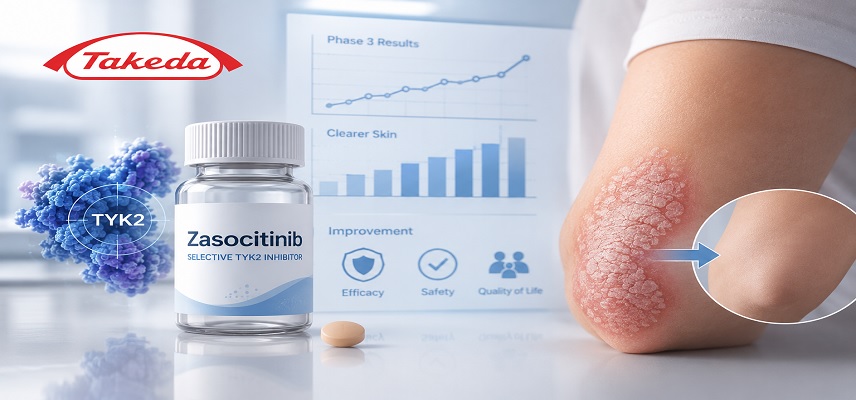
Takeda has announced positive topline results from its Phase 3 LATITUDE Atlas study evaluating zasocitinib (TAK-279), an investigational oral TYK2 inhibitor, in adults with moderate-to-severe plaque psoriasis.
The study compared zasocitinib directly against deucravacitinib, an approved TYK2 inhibitor, and showed that zasocitinib delivered superior results across both primary and key secondary endpoints. The findings strengthen Takeda’s position as it prepares regulatory submissions for the treatment.
Head-to-Head Study Shows Superior Skin Clearance
The Phase 3 LATITUDE Atlas trial was designed to compare the efficacy, safety, and tolerability of zasocitinib with deucravacitinib in patients living with moderate-to-severe plaque psoriasis.
The study met its primary endpoint, demonstrating that a significantly higher percentage of patients treated with zasocitinib achieved complete skin clearance, measured by the Psoriasis Area and Severity Index 100 (PASI 100), at Week 16 compared with patients receiving deucravacitinib.
In addition, zasocitinib also achieved superiority across all key secondary endpoints, including:
- PASI 90 response at Week 16
- Static Physician's Global Assessment (sPGA) 0 response at Week 16
The treatment was generally well tolerated, and no new safety concerns were identified during the study.
Strong Clinical Results Highlight Potential of Zasocitinib
According to Takeda, more than 35% of patients receiving zasocitinib achieved complete skin clearance by Week 16.
The company also reported that the PASI 100 response rate was more than 2.5 times higher than that observed with deucravacitinib.
Another notable finding was the speed of response. Differences between the two treatment groups began to appear as early as Week 8, indicating a rapid onset of action for zasocitinib.
These results suggest that the drug may offer a new treatment option for patients seeking stronger outcomes from oral psoriasis therapies.
Experts Highlight the Importance of the Findings
Dr. Linda Stein Gold, Director of Dermatology Clinical Research at Henry Ford Health and Principal Investigator of the LATITUDE Atlas study, said the results demonstrate meaningful improvements within the oral treatment category.
She noted that patient and physician expectations for oral psoriasis therapies continue to increase, and the findings suggest that zasocitinib may help redefine what can be achieved with a once-daily oral treatment.
Takeda also emphasized that the results reinforce the potential of highly selective TYK2 inhibition as a treatment strategy for plaque psoriasis.
What Makes Zasocitinib Different?
Zasocitinib is a next-generation oral TYK2 inhibitor designed to target key inflammatory pathways involved in psoriasis.
The therapy works by maintaining continuous inhibition of IL-23 and other important immune pathways that drive disease activity.
According to Takeda, zasocitinib demonstrates more than one-million-fold greater selectivity for TYK2 compared with other Janus kinase (JAK) enzymes in laboratory studies.
This high level of selectivity is important because TYK2 primarily regulates immune responses, while other JAK family members are involved in broader biological functions such as blood cell production and metabolism.
By focusing specifically on TYK2, researchers hope to maximize anti-inflammatory benefits while minimizing risks associated with inhibition of other JAK pathways.
About the LATITUDE Atlas Study
The LATITUDE Atlas study (NCT06973291) is a randomized, multicenter, double-blind Phase 3 clinical trial.
A total of 606 adults with moderate-to-severe plaque psoriasis participated in the study.
Patients received either:
- Zasocitinib 30 mg once daily
- Deucravacitinib 6 mg once daily
Treatment continued for 16 weeks, followed by a safety follow-up period.
The primary objective was to evaluate the percentage of patients achieving complete skin clearance, defined as PASI 100, at Week 16.
Understanding Plaque Psoriasis
Plaque psoriasis is the most common form of psoriasis and affects millions of people worldwide.
The disease causes inflamed, itchy, painful skin lesions that can significantly impact physical comfort, emotional well-being, and daily life.
Globally, around 64 million people are living with psoriasis, and approximately 80% to 90% of them have plaque psoriasis.
Many patients experience ongoing symptoms, including persistent itching and visible skin plaques that may appear on highly sensitive or noticeable areas of the body.
The condition is also associated with other health issues such as psoriatic arthritis, making effective treatment especially important.
Regulatory Submission Plans Underway
Following the positive Phase 3 results, Takeda plans to present detailed findings from the LATITUDE Atlas study at upcoming medical conferences.
The company also remains on track to submit a New Drug Application (NDA) for zasocitinib to the U.S. Food and Drug Administration and other regulatory agencies beginning this fiscal year.
The latest data build on previously reported Phase 3 LATITUDE PsO studies, further supporting the potential role of zasocitinib as a future treatment option for plaque psoriasis.
Broader Development Program Continues
Beyond plaque psoriasis, Takeda is investigating zasocitinib across several immune-mediated inflammatory diseases.
Current clinical development programs include:
- Phase 3 studies in psoriatic arthritis
- Phase 2 studies in Crohn’s disease
- Phase 2 studies in ulcerative colitis
- Phase 2 studies in vitiligo
- Phase 2 studies in hidradenitis suppurativa
The company believes the broad potential of TYK2 inhibition could help address multiple inflammatory conditions where current treatment options remain limited.
Takeda Expands Focus on Immune-Mediated Diseases
Takeda continues to invest in therapies across its key therapeutic areas, including gastrointestinal and inflammatory diseases, rare diseases, oncology, neuroscience, vaccines, and plasma-derived therapies.
The positive LATITUDE Atlas results represent another important step in the company’s efforts to develop innovative treatments that address significant unmet medical needs for patients living with chronic inflammatory diseases.
Optimize Your trial insights with Clival Database.
Are you exhausted from the uncertainty of trial insights pricing? Clival Database ensures the clarity in the midst of the global scenario for clinical trials to you.Clival Database is one of the best databases that offers an outstanding number of clinical trial data in terms of 50,000+ molecules and from primary regulatory markets as well as new entrants like Indian and Chinese markets.
With Clival, you get accurate positioning of historical sales data, patent database, company profiling, safety & efficacy, and prediction of launch of new innovative molecules helping you to align your research and driving down the cost.
To add value, we further break down our analytics for you so that improving your operational effectiveness; optimizing your clinical trials; and offering you accurate and high-quality data at lowest possible prices becomes possible.
Elevate your trial success rate with the cutting-edge insights from Clival database.
Check it out today and make more informed sourcing decisions! Learn More!